Wall printing has transformed the way homeowners, businesses, and interior designers approach large-scale décor in the UK. Whether you're considering a bold mural for a commercial space or a personalised design for your living room, understanding how this technology works before you invest is essential.
The market has grown significantly over the past few years, and with that growth comes a wider range of suppliers, price points, and quality standards. Knowing what separates a reliable service from a disappointing one can save you considerable time and money.
In this guide, we've pulled together nine critical things every UK buyer should know before committing to a wall printing project. From understanding the different printing methods and surface requirements to navigating costs, lead times, and aftercare, this list covers the details that often get overlooked until it's too late. Whether you're a first-time buyer or someone who has explored wall printing before, these insights will sharpen your decision-making and help you achieve results that genuinely impress. Let's get into what you need to know.
What Wall Printing Actually Is (And What It Is Not)
Wall printing is not wallpaper. That distinction matters more than most people realise before they start comparing options for a feature wall or commercial mural project.
True wall printing means ink is deposited and cured directly onto the physical wall surface itself, whether that is plaster, concrete, brick, or render. The wall is the substrate. There is no intermediate layer, no backing paper, no vinyl film, and no adhesive involved. The ink bonds to the surface permanently through a UV-curing process that sets the ink instantly under ultraviolet light, without requiring heat or extended drying time.
Contrast this with digitally printed wallpaper or vinyl wraps, where the printing happens onto a separate backing material that is then adhered to the wall. The digitally printed wallpaper market is a recognised and growing segment in its own right, but its product comes with inherent failure modes that direct-to-surface printing eliminates entirely: seams where panels meet, air bubbles trapped beneath the substrate, edges that peel as adhesive weakens over time, and delamination when the backing eventually separates from the wall.
The technology underpinning direct-to-surface printing sits within a dominant and rapidly expanding sector. According to digital printing market research forecasting through 2035, inkjet technology commands 63.1% of global digital printing revenue in 2025, while UV-curable ink formulations account for 34.2% of total digital printing market share, valued specifically for their ability to bond permanently to varied surfaces without heat dependency.
Machine Canvas operates at the technical frontier of this approach, using UV-cured CMYK technology at 2400DPI to print directly onto interior and exterior surfaces for homes and commercial clients throughout England, Scotland, and Wales. At that resolution, fine detail, colour gradients, and photographic imagery render with a precision that no pasted wallpaper panel can match consistently across a large surface.
Why Direct-to-Surface Beats Wallpaper Murals and Vinyl
Wallpaper murals and printed vinyl panels share the same fundamental weakness: every roll has an edge, and every edge eventually becomes a problem. Adhesive application requires sequential panel joins across the width of a wall, and those seam lines are rarely invisible. Under raking light, the oblique illumination standard in hotel corridors, restaurant dining rooms, and gallery-style retail spaces, even millimetre-level misalignments catch shadows and interrupt the visual flow of the design. Direct-to-wall printing eliminates this entirely, delivering seam-free, edge-to-edge output with no panel breaks across the entire surface.
The structural vulnerabilities of applied substrates extend well beyond aesthetics. In high-traffic, high-humidity environments, adhesive bonds deteriorate faster than specification sheets suggest. Hotel corridor walls absorb cleaning product vapour, gym changing rooms experience sustained moisture cycling, and restaurant kitchens generate heat gradients that stress adhesive layers daily. Vinyl wraps bubble after two to three years in these conditions, and wallpaper lifts at edges where contact is frequent. The maintenance cost of re-adhering, patching, or replacing panels adds to the original installation bill in ways that rarely appear in initial procurement comparisons.
Removal compounds the problem further. Stripping vinyl wraps typically requires either chemical solvents or mechanical scraping, both of which risk damaging the underlying plasterboard or painted surface. According to practitioners working in commercial interiors, adhesive residue routinely pulls paint and skim coat with it, adding remediation costs to every refit cycle before new decoration can begin. Over a five-year period, industry estimates suggest direct-to-wall printing runs 40 to 50 percent less costly than vinyl when removal and reinstatement are factored in.
Direct-to-surface technology removes the substrate from the equation entirely. UV-curable inks bond with the wall surface directly, meaning there is no adhesive layer to fail, no film edge to lift, and no physical layer capable of peeling or bubbling. The bond is between ink and wall. That is a fundamentally different durability model, not a marginal improvement on existing applied methods.
The regulatory environment is reinforcing this shift. EU directives progressively restricting solvent-based analog printing processes are accelerating industry migration toward UV digital workflows, strengthening both the technical and environmental case for UV-cured direct-to-surface technology. Reduced material waste and the elimination of solvent-based installation products position this approach as the more sustainable long-term choice for commercial clients operating under tightening environmental procurement standards.
Which Surfaces Can Be Printed On
Direct-to-surface printing is compatible with a wide range of substrates, but the suitability of any given surface depends on three consistent factors: cleanliness, structural stability, and appropriate preparation.
Interior surfaces that print successfully include painted plaster, bare plaster, concrete, brick, blockwork, MDF, and timber boarding. Glass is also printable using UV-cured ink formulations, which bond to non-porous surfaces without requiring an absorbent substrate. The baseline requirement across all of these is that the surface must be clean, sound, and free from flaking paint or loose material. A contaminated or friable surface will compromise ink adhesion regardless of the technology used.
Exterior surfaces, including rendered walls, brick facades, and concrete structures, are equally viable provided the correct preparation is carried out beforehand. UV-cured inks are inherently weatherproof, but a lacquer-sealed finish is applied over exterior prints to ensure long-term durability and resistance to UV degradation, frost, and moisture. Without this topcoat, even high-quality prints will deteriorate prematurely on exposed elevations.
Textured surfaces such as exposed brick or rough render are printable, but texture introduces a trade-off. The nozzle-to-surface distance must be increased to clear the profile of the material, which reduces the precision of fine detail. Bold graphics, high-contrast imagery, and large-scale murals perform well on textured masonry; fine line work and small typography can be lost in deep mortar lines or coarse render profiles. A professional site visit resolves this before any artwork is finalised, as confirmed across multiple surface compatibility resources.
Surfaces that are not suitable for direct printing include those with active moisture ingress, ongoing structural movement, or heavily contaminated coatings that cannot be stabilised. These conditions prevent reliable ink adhesion and will cause premature failure regardless of ink quality or application technique.
Machine Canvas conducts a pre-print surface assessment on every project. This determines the correct preparation method, ink formulation, and finish specification before any commitment is made, removing the guesswork from what is otherwise a highly technical decision.
How Long Does Wall Printing Last
The chemistry behind wall print durability is worth understanding before committing to any project. UV-cured inks are not simply dried onto a surface; they are photo-initiated polymers that cross-link at a molecular level the instant ultraviolet light strikes the ink. This produces a hard, chemically resistant bond integrated with the wall substrate rather than sitting on top of it. The practical consequence is that UV-cured prints resist fading and yellowing in ways that solvent-based inks structurally cannot match, because there is no evaporated solvent layer left vulnerable to oxidation or moisture ingress. The eufyMake lab durability guide identifies this cross-linking chemistry as the single most important factor separating UV prints from conventional alternatives.
For interior applications, Machine Canvas backs its work with a 5-year guarantee. Interior walls operate in stable conditions: consistent humidity, minimal temperature cycling, and negligible UV radiation on most indoor surfaces. These controlled variables are precisely why interior prints outperform exterior work in longevity terms, and why a 5-year guarantee is a commercially defensible commitment rather than a marketing number. For hotels, gyms, and retail clients working to planned refurbishment cycles, this guarantee period aligns directly with standard interior refresh schedules of three to five years, meaning a printed feature wall is warranted for at least one complete design cycle without premature replacement costs entering the calculation.
Exterior prints operate under compounding stressors: direct UV radiation, rain, freeze-thaw temperature cycling, and airborne particulates all gradually stress even high-quality coatings. Machine Canvas addresses this with a protective lacquer finish applied as standard on all exterior work, and covers those prints under a 3-year guarantee. Industry practice across the signs and large-format sector confirms that a liquid lacquer or laminate overcoat is effectively non-negotiable for any outdoor direct-to-surface print expected to hold colour and adhesion across multiple seasons.
One point worth raising with any provider before committing: surface preparation, including priming, wall porosity, and existing paint type, is a significant variable in long-term adhesion that no guarantee can fully substitute for. Specialist environments such as commercial kitchens or pool halls, where humidity levels are consistently elevated, warrant direct consultation rather than assumptions based on standard interior guarantee terms.
The Visual Effects You Can Achieve with Wall Printing
Direct-to-surface wall printing is not limited to a single aesthetic outcome. The technology supports a genuinely broad spectrum of visual effects, and understanding the range helps you commission with precision rather than settling for a generic result.
Feature Walls and Full-Room Murals
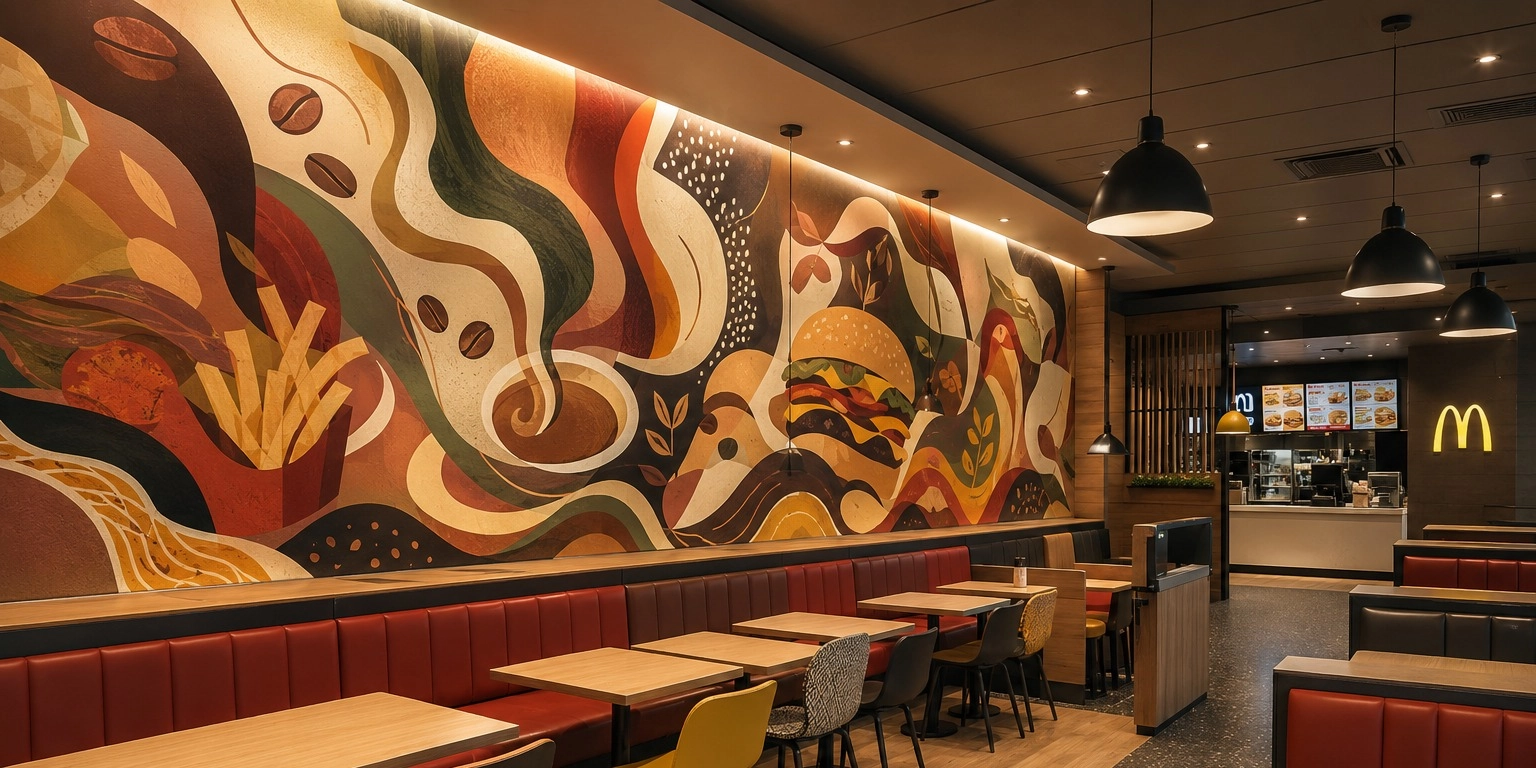
Feature walls and full-room murals represent the most frequently requested application. The output spectrum runs from photorealistic landscapes and architectural trompe l'oeil to abstract colour washes, geometric patterns, and brand-led graphics. Trompe l'oeil, a technique with documented roots as far back as Pompeii, uses precise shading and colour relationships to create convincing three-dimensional illusions on flat surfaces. When executed through UV-cured printing at 2400DPI resolution, the result is indistinguishable from a hand-painted finish at normal viewing distances but reproducible with far greater consistency.
3D Relief and Burst-Through Effects
Burst-through effects are a compositional technique where design elements, animals, foliage, architectural features, are staged so they appear to physically break the plane of the wall. The illusion depends on disciplined layering of foreground, midground, and shadow detail. No flat-printed substrate, wallpaper or vinyl, can replicate this because the composition must be engineered specifically for a fixed surface and viewing distance.
Perspective Corridor Illusions
Forced-perspective corridor prints use geometric optical illusion principles to make narrow or short corridors read as significantly wider or longer than their actual dimensions. Schools, hotels, and office buildings with constrained circulation routes are the primary commercial beneficiaries of this effect.
Floor Graphics and Multi-Surface Applications
UV-cured technology applies equally to horizontal surfaces. Car park floor graphics, retail wayfinding, gym zone markings, and event venue installations are all viable outputs, with anti-slip lacquer finishes applied as standard to meet safety compliance requirements.
AI-Assisted Concept Development
Tools such as Midjourney now allow clients and design teams to iterate mural concepts rapidly before any final artwork is locked. This has materially lowered the creative barrier to commissioning ambitious custom work, making large-format bespoke murals accessible to clients who previously lacked the design vocabulary to brief a project confidently.
Which Commercial Sectors Use Wall Printing Most
Across the UK, direct-to-surface wall printing has found a natural home in several distinct commercial environments, each with specific reasons why permanent, high-resolution printed surfaces outperform conventional décor solutions.
Hotels and Hospitality Venues
Hotels are among the highest-value clients in the wall printing sector. Reception murals, themed corridor graphics, and feature walls in guest rooms each serve a dual commercial purpose: reinforcing the property's brand identity while giving guests an organic reason to photograph and share their surroundings. Hotel wall printing trends in 2026 show properties increasingly using printed murals to reflect local culture and create memorable focal points that distinguish them from generic competitors. The scale of opportunity within a single hospitality client is significant; one documented case study describes how a complimentary demonstration print converted into a contract covering 100 hotel rooms, illustrating the roll-out potential once a property owner sees the finished quality in situ.
Gyms, Leisure Centres, and Education
Gyms and leisure centres commission motivational murals, branded feature walls, and zone-defining floor graphics that strengthen member retention and move the facility away from commodity positioning. A well-executed wall print signals investment in the member experience in a way that painted walls simply cannot replicate. Schools and nurseries apply the same technology differently: educational murals, wayfinding graphics, and playground floor imagery create stimulating environments that support development and make spaces more welcoming for children and parents alike.
Offices, Retail, and Wider Commercial Settings
Offices and co-working spaces use wall printing to express company culture visibly, displaying values statements and brand graphics that support employer branding and contribute to staff wellbeing. Retail fit-outs, restaurants, cafes, automotive showrooms, and exhibition stands take a more commercial angle, using combined wall and floor printing to build immersive branded environments that increase dwell time and purchase intent.
Machine Canvas serves all of these sectors across England, Scotland, and Wales. Its commercial portfolio spans 3D safari murals, floral burst-through effects, live-printed landscape murals, and car park floor graphics, covering the full breadth of briefs these sectors typically generate.
Exterior Wall Printing Is Possible and More Durable Than You Think
Most UK wall printing content focuses almost exclusively on interior applications. That framing has created a genuine awareness gap, and many buyers who could benefit from exterior wall printing never consider it because they simply do not know it is available. Facades, gable ends, boundary walls, underpasses, and external retail frontages are all viable print surfaces, provided the substrate is correctly prepared and an appropriate protective finish is applied.
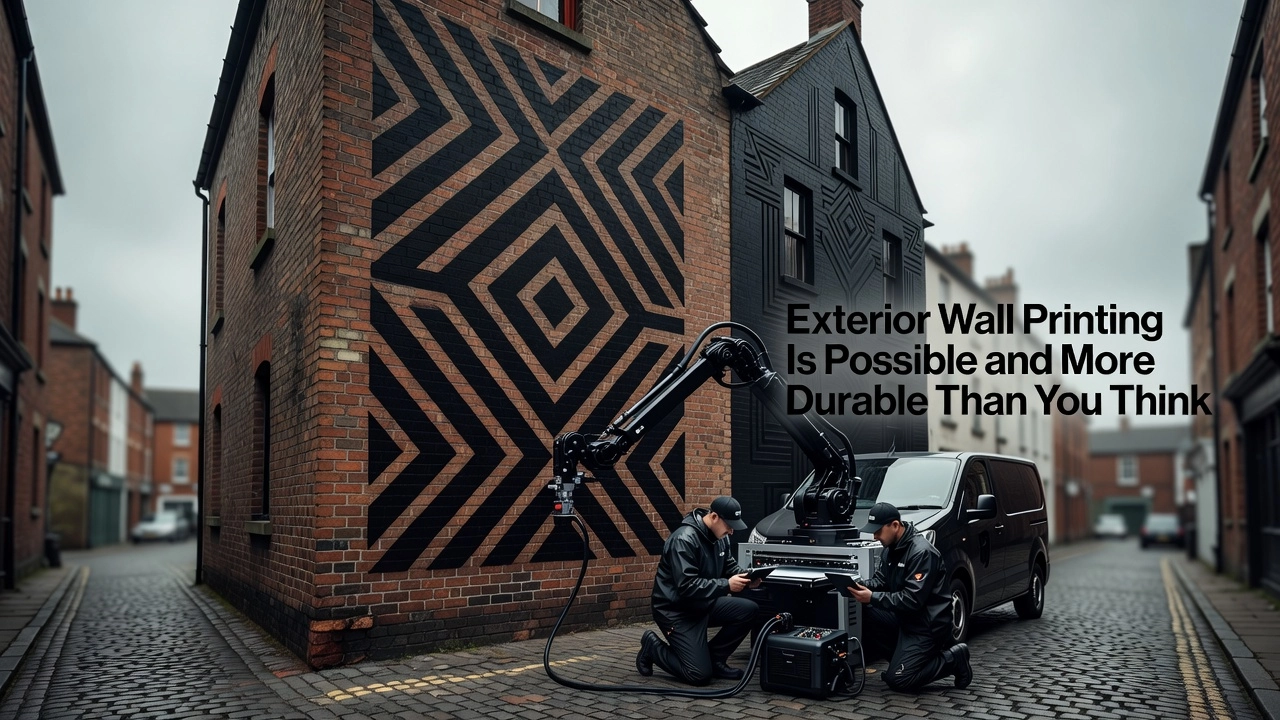
Surface preparation for exterior work follows a consistent process: cleaning, any necessary structural repair, and priming to create a stable, receptive base. From there, the print is applied using the same UV-cured, high-resolution inkjet technology used internally. The critical difference is what comes after. Machine Canvas seals every exterior print with a lacquer-sealed UV-resistant finish drawn from the same coating technology used in outdoor architectural applications and commercial signage. That finish resists rain, frost, UV degradation, and biological growth, giving exterior prints a 3-year guarantee under UK weather conditions.
For commercial clients, an exterior mural does two jobs simultaneously. It transforms a blank or deteriorating facade into a visually compelling asset, and it functions as passive advertising or wayfinding around the clock without recurring media costs. A bold street-facing gable or a branded underpass graphic works continuously in a way no other format matches.
Planning permission is a genuine consideration for some exterior projects. Standard exterior painting does not require consent in England, but listed buildings require listed building consent, and England alone contains over 10,000 designated conservation areas where additional restrictions apply. Scotland and Wales operate under separate devolved planning frameworks. A responsible provider should raise all planning questions during the initial scoping conversation, before any deposit is taken or design work commissioned.
What the Wall Printing Process Looks Like from Enquiry to Finished Print
Understanding the end-to-end process removes the uncertainty that stops many clients from taking the first step. Here is how a wall printing project unfolds from initial contact through to a finished, protected surface.
1. The Enquiry and Design Brief The process starts with a conversation, typically via phone, WhatsApp, or the contact form. That first exchange covers the space dimensions, the desired visual effect, and any brand assets, photography, or design references the client wants to incorporate. Residential clients often arrive with a mood board; commercial clients frequently bring brand guidelines or logo files. Either way, the brief shapes everything that follows.
2. Free Design Mock-Up Before Any Commitment Before a single pound changes hands, Machine Canvas produces a free design mock-up mapped to the actual wall dimensions. This allows clients to see exactly how the finished print will look in context, adjust colours, scale, or composition, and confirm the design is right before approving the project. It is a practical pressure-test of the concept with zero financial risk.
3. Site Assessment and Surface Preparation Once the design is approved, a surface assessment confirms wall condition, precise dimensions, and any preparation work needed before print day. Surface cleanliness and structural stability directly affect print quality, so this step is non-negotiable on larger or more complex jobs.
4. Print Day The printer is positioned approximately 10 cm from the wall and the design is output directly onto the surface. UV-curable inks cure in real time as the printhead traverses the wall, meaning the surface is touch-dry almost immediately. A typical 40 sq ft print completes in around two hours, with no wet-paint waiting period afterwards.
5. Finishing and Handover For exterior work or high-wear interior surfaces, a lacquer protective coat is applied post-print, sealing the image against abrasion, UV degradation, and moisture. The space is then handed back with minimal disruption to building operations.
6. Pricing and Scale Residential feature walls start from around £250. Commercial projects scale with area and complexity, but the free mock-up means clients can evaluate the design and the investment together before committing to either.
Questions to Ask Any Wall Printing Company Before You Book
The wall printing market is growing quickly, and with it comes an influx of new operators entering the sector with varying levels of experience, equipment quality, and professional standards. Before committing to any provider, these five questions will separate credible companies from underprepared ones.
1. What ink technology do you use, and is it UV-cured?
The answer to this question directly predicts how long your print will last. UV-cured inks cross-link on contact with an onboard lamp, bonding at a molecular level across a wide range of substrates. Water-based alternatives may look acceptable initially but offer weaker adhesion on varied surfaces and zero UV resistance for any exterior application. Ask specifically whether the operator owns and operates their own machine or sub-contracts, since equipment ownership determines who is accountable for ink quality decisions.
2. What guarantee covers colour stability and adhesion?
Demand written terms, not reassurances. A credible provider should specify the guarantee duration, what it covers (both colour stability and adhesion), and the remediation process if either fails. Vague verbal commitments are a red flag.
3. Can I see a design mock-up before committing?
Modern wall printing workflows are software-driven, making pre-print visualisation straightforward for any competently equipped operator. A provider who declines to offer this is either working with outdated software or lacks confidence in the result. This should be a baseline standard, not an optional extra.
4. Who handles surface preparation?
Poor surface preparation is the primary cause of adhesion failure in wall printing. A professional company should specify exactly what surface condition they require, who is responsible for achieving it, and whether failing to meet that specification affects any guarantee offered.
5. Do you carry public liability insurance and equipment-specific training?
The low barrier to entry in wall printing means some operators are trading commercially before securing adequate insurance or completing formal training. Commercial clients, including offices, hospitality venues, and retail spaces, should request written proof of public liability coverage and confirm which specific machine the operative is trained on before granting site access.
Ready to Transform Your Space? Here Is Your Next Step
Wall printing in 2026 sits in a precise and useful position: mature enough to be reliable, guaranteed, and commercially repeatable, yet still specialist enough that the provider you choose shapes the outcome more than almost any other variable. The UV wall printer market is projected to grow at 7.7% annually through 2033, and UV-cured ink formulations already account for 34.2% of the broader digital printing market. The technology has arrived. The question is whether the company executing your project has arrived with it.
The differentiators worth prioritising are consistent across every sector and surface type: UV-cured ink technology for durability and adhesion, a formally documented print guarantee, a free design mock-up before any financial commitment, and demonstrable experience relevant to your specific project type.
Machine Canvas delivers on all four. UV-cured 2400DPI printing, a 5-year interior guarantee and a 3-year exterior guarantee, a free design mock-up provided before any commitment is required, and an established portfolio spanning commercial and residential projects across the UK.
The most practical next step is requesting that free mock-up. It costs nothing, requires no commitment, and gives you a concrete visualisation of the finished print on your actual wall, ready to take into any internal approval or budget conversation. Contact Machine Canvas by phone, WhatsApp, or the online enquiry form. Projects are delivered across England, Scotland, and Wales.
Conclusion
Wall printing is a significant investment, and going in informed makes all the difference. To recap the essentials: always verify your surface compatibility before booking, compare suppliers on quality and reputation rather than price alone, understand lead times and aftercare requirements upfront, and get every detail confirmed in writing before work begins.
The UK market offers genuinely impressive options for both residential and commercial projects, but the best results consistently go to buyers who ask the right questions early. Armed with the nine points covered in this guide, you are far better positioned to avoid common pitfalls and achieve a finished result you will be proud of for years to come.
Ready to take the next step? Start gathering quotes from reputable UK suppliers today, and use this guide as your checklist throughout the process. Your walls deserve nothing less than the best.