
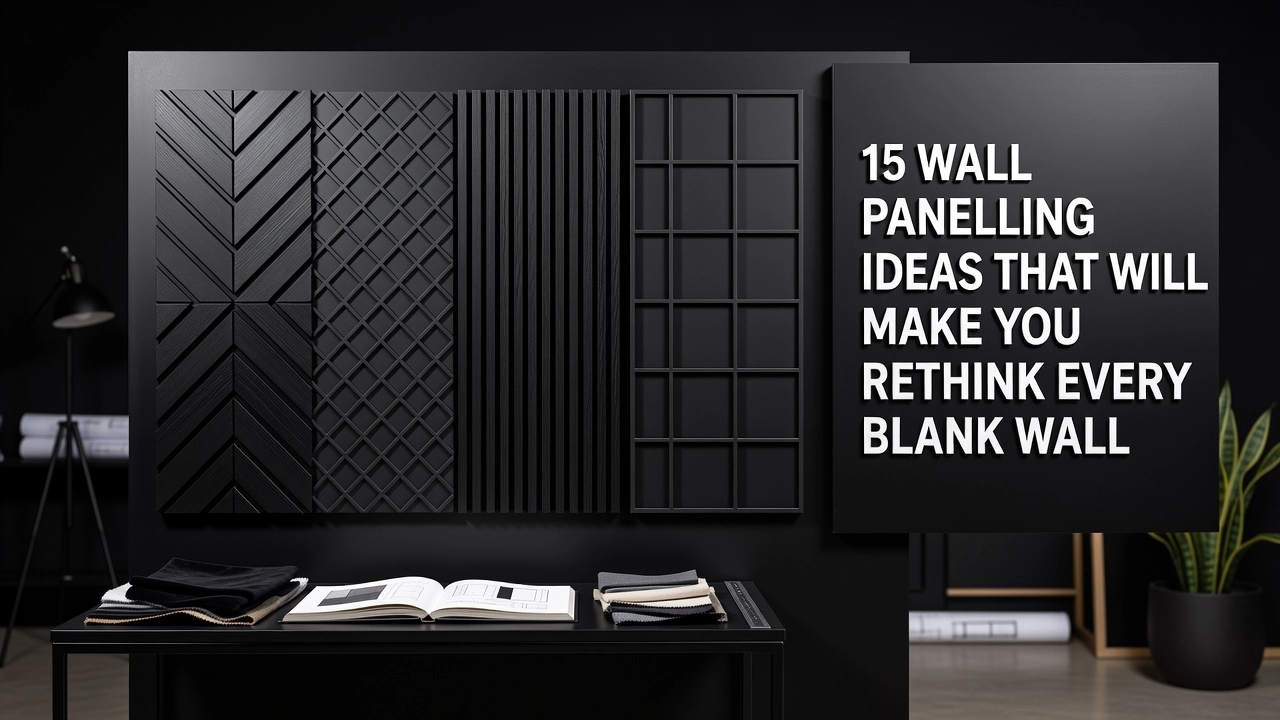
You know that feeling when you walk into a room and something just feels off? The furniture is nice, the lighting is decent, but the walls look like they belong in a waiting room. Blank, flat, and completely forgettable. Sound familiar?
Here is the good news: you do not need a massive renovation budget or years of interior design experience to fix that. Wall panelling ideas have taken the home decor world by storm, and honestly, it is easy to see why. A little bit of texture, some clever shapes, and the right finish can turn a boring wall into the focal point of an entire room.
Whether you are a total beginner who has never picked up a nail gun or someone just looking for fresh inspiration, this list has something for you. We have rounded up 15 stunning wall panelling ideas that cover everything from budget-friendly DIY options to sleek, modern statement walls. By the time you reach the end, you will be looking at every blank wall in your home with completely new eyes. Let us get into it!
What Wall Panelling Actually Means in 2026
If you think wall panelling is just those white dado rails you see in Victorian hallways, it is time for a serious update. In 2026, the category has exploded into something genuinely exciting, and it covers everything from sculptural wood slat walls and stone-effect sheets to acoustic tiles, geometric trim, and fully bespoke direct-to-surface UV printing. The question is no longer "should I bother panelling my walls?" Everyone has already answered that with a resounding yes. The real question now is "which style actually gives me the look I want?"
That shift matters, because it tells you something important: this is a mature, confident design space full of people who know what they want and are ready to make decisions.
The design themes driving 2026 choices are consistent across the board. Warmth, texture, character, and dimensional depth are the words that keep coming up, and the goal is always to add visual interest without making a room feel heavy or cluttered. Vertical slat panels, for example, draw the eye upward and make ceilings feel taller. A printed feature wall can transform a blank surface into a focal point that anchors an entire room. These are not small upgrades; they are genuinely transformative moves.
Every room is now fair game too. Hallways, bedrooms, kitchens, home offices, and commercial spaces are all active targets, not just living rooms. According to 2026 Wall Panel Trends: What's In, What's Out, designers are applying panelling across lobbies, bars, dining rooms, and offices with the same enthusiasm as residential spaces.
Budget-wise, the spectrum is wide. DIY panel packs start from around £49.99 per pack in the UK, while fully bespoke printed surfaces, like those produced by Machine Canvas using UV-cured direct-to-surface technology, start from approximately £250. There is genuinely something viable at almost every price point, and you can explore 35+ Accent Wall Design Ideas for 2026 to see just how broad that creative range has become.
1. Slat Wall Panelling: The Style That Went Mainstream and Stayed
Close your eyes for a second. Picture a hallway wall covered in evenly spaced, warm oak-toned timber slats running floor to ceiling. The vertical lines pull your gaze upward, making the ceiling feel miles away. Now imagine that same treatment on a bedroom headboard wall, with soft warm light glowing between each slat. You did not know you needed this until right now, did you?
That is exactly the magic of slat wall panelling, and it has absolutely earned its place as one of the most searched and installed wall treatments across the UK in 2026. According to current 2026 wall panel trend guides, slat and wood wall panels consistently rank among the most in-demand styles, appearing everywhere from residential living rooms to boutique hotel corridors and co-working lounges.
The clever part is how versatile this style actually is. Natural timber gives a warm, organic feel. Painted MDF wall panelling delivers a crisp, contemporary finish at a friendlier budget. Acoustic-backed versions, available in natural oak or smoked oak with felt backing, absorb sound while looking razor sharp, making them genuinely brilliant for home offices and meeting rooms.
Those gaps between slats are doing serious design work too. They cast shifting shadow lines that create real three-dimensional texture, the kind of subtle depth that no tin of paint can ever replicate. Add recessed warm lighting tucked behind the slats, and an ordinary wall becomes an architectural statement.
2. Stone Effect Panels: The Tactile Luxury Look Without the Masonry Bill
Close your eyes and picture this. A charcoal slate feature wall sitting behind a fireplace, textured, dramatic, and looking like it cost thousands in specialist stonework. Guests run their fingers across it and genuinely cannot tell it is not the real thing. That is exactly what PU stone and SPC stone-effect panels deliver, and they cost a fraction of actual masonry installation.
The finish options alone are worth getting excited about. You can choose from limestone, slate, exposed brick, travertine, and sandstone effects, with surface textures realistic enough to fool a visual inspection at arm's length. According to current design trends in PU stone wall panels, warmer earthy tones like sandstone beige, clay, and soft taupe are replacing the cool grey palettes that dominated recent years, meaning these panels feel genuinely fresh right now.
Practically speaking, they are surprisingly lightweight. That matters enormously for upper-floor bedrooms and rental properties where adding structural load is either complicated or simply not allowed. Installation typically takes hours rather than days, with no cement mixers or specialist contractors required.
Bathrooms and kitchens are another natural home for stone-effect panels. Both PU and SPC formats are moisture-resistant, mould-resistant, and wipe-clean, making them genuinely low-maintenance alongside their good looks. SPC wall panels designed for modern spaces are actively marketed as long-term solutions for exactly these wet-area applications.
Here is the honest limitation though. These panels are mass-produced to fixed catalogue designs, meaning the charcoal slate finish you choose today is the same finish sitting in thousands of other homes. If genuinely unique matters to you, that is where bespoke direct-to-surface printing starts to make a very compelling argument.
3. Fluted and Reeded Panels: Architectural Elegance for Modern Interiors
Close your eyes and picture this. Deep forest green fluted panels running floor to ceiling, their rhythmic vertical channels catching the light, sitting directly behind a marble-topped sideboard with brushed brass hardware. It looks like something from a five-star hotel. It could be your dining room wall by next month.
Fluted panelling gets its sculptural quality from those repeating cylindrical grooves, which create shadow lines that shift as natural light moves through a room. Reeded panels are the close cousin, where fluting cuts inward and reeding raises convex ridges outward, though the two terms are used fairly interchangeably in most UK interior design conversations. The effect in both cases is genuinely architectural, rooted in classical tradition but sitting completely at home in a contemporary space.
These panels absolutely shine in dining rooms and bedroom alcoves, where the goal is that sense of considered, curated luxury rather than just filling a wall. They work in MDF, PVC, and composite formats, all of which take paint beautifully. Midnight navy, warm terracotta, and muted sage are all performing strongly as panel colour choices in 2026, and the paint-ready surfaces on most fluted products make experimenting with bold choices genuinely low-risk.
There is also a practical side worth knowing about. In rooms with hard floors and high ceilings, fluted panels act as quiet acoustic softeners, absorbing reflected sound without any visible compromise to the aesthetic. You get a better-sounding room and a dramatically better-looking one simultaneously.
Commercially, fluted and reeded textures signal quality in ways that reception areas, restaurant feature walls, and boutique hotel lobbies understand instinctively. This is a panel style that communicates considered design without saying a word.
4. Painted Shiplap and Tongue-and-Groove: The Classic That Refuses to Date
Some wall panelling trends come and go. Shiplap and tongue-and-groove simply refuse to leave, and honestly, good for them.
These two profiles remain among the most searched and most installed panelling styles in UK homes right now. Tongue and groove panelling has become one of the most widely used interior design solutions in 2026, appearing in everything from luxury apartments to rental upgrades and coastal cottages. The reason is straightforward: they work everywhere, for everyone, and they never look wrong.
Now close your eyes for a second. Picture a bathroom with floor-to-ceiling tongue-and-groove painted in a warm off-white, slightly chalky, quiet, and calm. A brushed brass mirror sits centred on the wall. The light catches the subtle grooves between each board. It is understated in the most confident way possible. That is the magic of T&G: the profile does the work, and colour does the talking.
Colour really is the primary design lever here. A warm off-white reads timeless and airy. Deep forest green feels intimate and grown-up. Dark, moody tones are gaining serious traction in 2026 for exactly that luxurious, cocooning quality. The boards themselves stay constant; your paint choice transforms the entire mood.
What makes both styles genuinely special is their universal compatibility. Shiplap suits Victorian hallways, new-build kitchen-diners, garden rooms, and utility rooms without missing a beat. Period cottage or contemporary new-build, coastal aesthetic or Scandi minimalism, neither profile feels out of place.
Half-height dado configurations are having a strong 2026 moment specifically in hallways and stairwells. Running boards to approximately 900mm and painting a contrasting colour above the rail instantly adds structure and visual interest to what are often the most neglected spaces in a home.
The practical case is just as strong as the aesthetic one. The interlocking system on T&G panels is often compared to assembling a jigsaw: genuinely beginner-friendly. Even so, the transformation is immediate and very real. Plain wall to structured, characterful surface in a weekend.
5. Geometric MDF Panel Designs: Where Pattern Becomes Architecture
Close your eyes and picture a home office feature wall built entirely from large white geometric frames, clean rectangular and diamond shapes sitting proud of the wall behind them, the whole thing looking like something lifted from an architect's sketchbook. That is what geometric MDF panelling does. Grid, diamond, chevron, and Mondrian-style configurations transform a flat, unremarkable wall into a genuine graphic composition. The Mondrian approach is particularly striking; instead of a regular repeating grid, you divide the wall into asymmetric rectangular sections of varying sizes, creating visual tension that feels intentional and designed rather than formulaic.
Scale is everything with geometric panelling. Small-scale grids suit compact alcoves and recessed chimney breast reveals, where the pattern fills the space without overwhelming it. Larger diamond or hexagonal layouts, by contrast, read with real drama across a full chimney breast or a wide living room wall, the geometry bold enough to hold its own from across the room. Explore the full range of MDF board wall panel design configurations to see how different scales play out in practice.
Here is the technique that separates a good geometric wall from a genuinely sophisticated one. Paint the panels and the wall behind them in exactly the same tone, same colour, same finish. The result is a tone-on-tone textured effect, subtle, tactile, and completely photograph-ready.
For children's rooms, swap neutral tones for bold primaries or soft pastels. You get structured pattern without resorting to busy printed wallpaper. Pre-cut MDF geometric panel kits are widely stocked at UK retailers, and a single accent wall typically takes four to six hours to install, making this a very achievable confident weekend project.
6. Velvet and Soft Fabric Panels: When a Wall Needs to Feel as Good as It Looks
Every other panel on this list is something you look at. This one is something you want to reach out and touch the moment you walk into a room, and that changes everything.
Soft leather, velvet, and upholstered fabric panels are quietly becoming one of the most desirable niches in the entire wall panelling world. They are not for every room, and they are absolutely not for everyone's budget, but once you have seen a wall done properly in this style, it is very hard to go back to flat paint.
Close your eyes and picture this. A master bedroom headboard wall covered in deep teal velvet panels, each one tufted, each one framed in a thin line of brushed brass trim. The whole wall sits behind a low-slung bed with matching brass lamps either side. That is a hotel suite you are imagining, but it is entirely achievable in a domestic space, and it costs considerably less than a night at the kind of hotel that inspires it.
Beyond the looks, there is a genuinely practical reason to consider these panels. Fabric and foam-backed soft panels absorb sound naturally, reducing mid-frequency echo by up to 50% according to acoustic testing data. That makes them a smart, beautiful solution for home cinemas, bedrooms above busy roads, or anyone who has always fancied a properly treated recording space at home. You can explore the acoustic science behind velvet wall panels and their noise-reduction properties before committing to anything.
Commercially, this sub-category punches hard. Hospitality operators, high-end restaurants, and private members clubs use upholstered panels to signal luxury while simultaneously managing ambient noise, two problems solved with a single wall. When a restaurant wants guests to feel wrapped in atmosphere rather than overwhelmed by it, soft panels do the heavy lifting.
The honest limitation is maintenance. Fabric panels need gentle vacuuming and careful spot cleaning, and they have no place in kitchens, bathrooms, or high-traffic corridors where grease, steam, and scuffs would ruin them quickly. Choose the right room, though, and few wall treatments come close to the warmth they deliver.
7. Metallic and Mirror Effect Panels: Light, Space, and Drama in One Surface
Close your eyes and picture this. A narrow hallway, the kind that usually feels like a corridor between rooms rather than a space in its own right, completely lined on one side in brushed champagne gold metallic panels. The light bounces. The walls appear to step back. Suddenly the hallway feels like somewhere you actually want to be. That is the instant, almost unfair power of metallic and mirror-effect panelling, and it is having a serious 2026 moment.
Copper, bronze, brushed silver, and champagne gold are the metallic finishes worth paying attention to right now. In kitchens and utility rooms, they pull double duty beautifully: a metallic splashback panel behind the hob protects your wall from grease and heat while turning a functional zone into something genuinely striking. Apartment Therapy's coverage of the 2026 ASID trend outlook named "melting" metallic finishes the standout trend of the year, so if you were waiting for permission to go bold, consider this it.
Mirror-effect panels are the unsung heroes of difficult rooms. Basements, lower-ground floor rooms, and interior spaces with no natural light all benefit enormously because mirror surfaces borrow and multiply whatever ambient light already exists. Mirror wall panel designs are increasingly framed as transformational tools rather than decorative extras, precisely because of this light-amplifying behaviour.
One honest warning: these surfaces are completely unforgiving. Fingerprints show. Smears show. Any surface irregularity hiding behind the panel will telegraph straight through. Clean walls and precise installation are not optional extras here; they are the entire job.
Commercially, metallic panels carry serious visual weight. Gym reception areas, automotive showrooms, and contemporary offices all benefit from the energy and ambition that a polished metallic feature wall communicates immediately.
8. Acoustic Decorative Panels: The Wall Panelling Idea That Actually Does Something
Every other panel idea on this list does one job: it looks incredible. This one looks incredible and quietly fixes something that every open-plan home and busy commercial space is silently suffering from.
Acoustic panels have completely escaped the recording studio. In 2026, they are a fully mainstream interior design choice for living rooms, home offices, open-plan kitchen-diners, restaurant dining rooms, and co-working spaces. Designers are now treating acoustics as a core design decision rather than an afterthought, and the products available have caught up with that shift.
Here is the part that genuinely surprises people. The best acoustic panels are visually indistinguishable from standard decorative cladding. Felt tiles in warm earth tones, fabric-wrapped frames in dusty sage or charcoal, PET panels made from recycled plastic with subtle surface texturing, acoustic slat panels in Natural Oak or Smoked Oak finishes; none of these read as technical products at a glance. They just look like beautifully considered wall panelling.
Close your eyes and picture a light-filled open-plan kitchen-diner. Hard concrete floors, high ceilings, minimal soft furnishings. Every sound bounces. Conversations feel exhausting. A single acoustic feature wall on the dining end changes everything, absorbing that reverb without a single structural change to the building. That is the power of this category.
Commercially, restaurants, gyms, offices, and hospitality venues have realised that constant background noise creates genuine occupant fatigue. Acoustic panels address that directly, improving the experience for customers and protecting staff wellbeing simultaneously.
In 2026, the best walls do more than one thing. Acoustic panels are proof of exactly where the entire panelling category is heading.
9. Full-Wall Marble Effect Panels: The Luxury Statement Without the Six-Figure Fit-Out
Close your eyes for a moment. Picture a full wall of white Calacatta marble behind a freestanding bath, those sweeping gold veins catching the light, the whole room suddenly reading as something pulled from a five-star hotel suite. Now picture achieving that look without a structural survey, without specialist stone fitters, and without a budget that starts at six figures. That is exactly what modern marble-effect panels are offering in 2026, and the results are genuinely impressive.
Calacatta white with gold veining suits bright, minimal bathrooms and main bedrooms where the goal is airy opulence. Nero Marquina black brings serious drama to powder rooms and feature walls in dining spaces, pairing beautifully with brass fixtures. Emperador brown adds warmth that cooler stone tones simply cannot deliver, sitting perfectly in living rooms and home bars where the feeling needs to be rich rather than clinical.
The technology behind these panels has moved forward significantly. Modern SPC and PVC substrates use high-definition UV printing to replicate veining depth, surface sheen, and tonal variation in ways that earlier-generation panels could not come close to. They are also 100% waterproof, making them a genuinely practical choice for bathrooms and wet rooms where real marble would demand regular sealing and careful upkeep.
There is one honest limitation worth knowing. Because these panels are manufactured with a fixed print file, the veining pattern repeats across multiple panels on a large wall. Up close or at scale, that repetition becomes visible and chips away at the illusion.
For a truly non-repeating, photo-real marble finish across an entire wall, direct-to-surface UV printing solves that problem completely. And that is exactly where this list goes next.
10. Wood Effect Panels: Warmth and Grain Without the Timber Maintenance
Wood-effect wall panels are consistently among the most searched panelling styles across the UK, and honestly, it is not hard to understand why. There is something almost instinctive about the way wood tones make a room feel settled, warm, and lived-in. That appetite for organic texture and natural warmth is not going anywhere in 2026. If anything, it is growing.
Now picture this. An entire chimney-breast wall, floor to ceiling, clad in wide-plank pale oak-effect panels. The grain runs vertically, the tone is soft and honey-warm, and the fireplace beneath it suddenly looks intentional rather than inherited. The room does not just look better. It feels better. That instant calm is exactly what wood-effect panels deliver, and it costs a fraction of what real timber cladding would set you back.
Modern wood-effect panels in SPC and laminate formats are genuinely impressive on the practical side too. No warping when the heating cranks up in January. No splitting, no seasonal movement, no annual oiling ritual. You get all the visual richness of real timber with none of the upkeep anxiety.
Colour direction in 2026 runs in two clear lanes. Dark walnut and smoked oak are having a serious moment in bedrooms and dining rooms, adding depth and drama to feature walls. Lighter birch and ash effects continue to anchor Scandinavian-influenced living rooms and kitchens beautifully.
Commercially, wood tones communicate something valuable: approachability and warmth. Restaurant interiors, hotel bedroom feature walls, spa reception areas, and boutique retail fit-outs all benefit enormously from the grounded, welcoming atmosphere that a wood-effect feature wall creates.
11. Printed Photorealistic Murals: Where Panelling Ends and True Art Begins
Every panel idea on this list so far has involved attaching something physical to your wall. This one is completely different, and once you see what it can do, you might never think about panels the same way again.
Machine Canvas prints directly onto your existing wall surface at 2400 DPI resolution, which is higher than most industry competitors, and the result is photorealistic detail that no board, sheet, or tile product can come close to matching. No installation. No adhesive. No joining panels together and hoping the seams disappear. The image simply becomes part of the wall itself, starting from approximately £250.
Now stop and actually picture this for a moment. A floor-to-ceiling tropical rainforest stretching across your entire living room feature wall. Every single leaf vein rendered in crisp, light-fast UV-cured ink. Shafts of pale gold light filtering down through the canopy. Colours shifting from deep emerald to bright lime as your eye moves across the surface. That level of detail is not possible from a printed tile or a patterned panel sheet. It requires 2400 DPI UV technology printing directly onto plaster or drywall as one single, unbroken composition.
That seamless quality matters more than it sounds. Wallpaper has seams. Vinyl has overlap lines. Repeat patterns interrupt the image every metre or so. With direct-to-surface printing, none of that exists. The mural wraps your wall as one continuous piece of artwork.
The design is entirely yours. A personal landscape photograph, a commissioned illustration, your brand identity, or a concept developed from scratch by the Machine Canvas team. All of it is printable, all of it is backed by a 5-year interior guarantee and a lacquer-sealed finish, and all of it is a long-term investment rather than a trend you will be repainting over in eighteen months.
12. 3D Relief and Burst-Through Printed Effects: The Wall Panelling Idea Nobody Sees Coming
Every panel idea covered so far involves something physical touching your wall. This one involves nothing but ink, and it will make people question their own eyes.
3D relief and burst-through printed effects are genuinely the most dramatic wall design upgrade available in 2026. These are not murals where a forest sits flat against the wall. These are prints engineered to make elements of the design appear to physically project outward from the surface, using graduated shadow, highlight, and perspective to create depth that your brain simply refuses to read as flat.
Stop and visualise this for a second. Picture a safari mural where an elephant's trunk reaches out toward you from the wall. Oversized blooms apparently erupting through the plaster, petals folding outward into the room. A jungle scene where branches push forward into your actual living space. Guests reach out and touch the wall because their eyes are telling them something solid is there. That moment of disbelief is the whole point.
Machine Canvas delivers these effects using UV-cured CMYK printing technology at 2400 DPI. The result is a dimensional illusion that holds up completely at close inspection, because the resolution is genuinely razor-sharp rather than soft and pixelated like older large-format printing.
In children's rooms, school corridors, and nurseries, burst-through effects create genuinely immersive environments. Imaginative, story-driven wall design supports engagement and emotional wellbeing in ways a painted magnolia wall simply cannot.
In commercial settings, the value is immediate and measurable. A burst-through feature wall in a gym, hotel lobby, or restaurant becomes a social media moment the second a guest pulls out their phone. That organic sharing delivers brand exposure no physical panel installation can generate, and it starts from around £250.
13. Perspective Illusions: Printed Walls That Change the Shape of a Room
Close your eyes and imagine a narrow, dark hallway. The kind that feels more like a passage than a room, where you hold your breath slightly as you move through it. Now picture that same wall printed with a perspective scene: a wide, light-filled colonnade of stone arches stretching away into warm afternoon sun, the floor tiles receding perfectly into the distance, the whole thing reading as a genuine opening in the wall. Nothing physical has changed. Not one centimetre of space has been added. But the felt experience of moving through that hallway is completely and utterly different.
That is exactly what perspective illusion printing delivers, and it is one of the most remarkable things you can do to an interior wall right now.
The technique draws on trompe l'oeil, a tradition that literally translates from French as "deceives the eye" and stretches back to Renaissance fresco painters who made flat ceilings look like open skies. What Machine Canvas brings to that tradition is UV-cured, CMYK, 2400 DPI precision printed directly onto your surface, no wallpaper, no vinyl, no joins to break the illusion. A corridor wall becomes a window overlooking a mountain range. A bedroom end wall becomes a forest path vanishing softly into morning light.
The critical detail is calibration. These designs are not generic images scaled up and applied. They are built specifically around your room's dimensions and the typical viewing distance of the person standing in that space, so the illusion holds convincingly from the angles that actually matter.
For commercial spaces, the value here is enormous. Basement bars, narrow hotel corridors, compact meeting rooms and small retail units all share the same architectural frustration: they feel tight and closed. A single perspective-printed wall, delivered through the same bespoke design process Machine Canvas applies to every project, can make those spaces feel larger, lighter and genuinely more generous without touching the floor plan. Free mock-up included before you commit to a thing.
14. Printed Feature Walls for Commercial Spaces: Hotels, Gyms, Offices and Beyond
Everything covered so far in this guide has been about your home. But here is the thing: every single one of these wall panelling ideas translates directly into commercial spaces, and in many cases it hits even harder when the stakes are higher.
First impressions in commercial environments carry real commercial weight. A hotel guest, a gym member walking through the door for the first time, a client stepping into a reception area: they form an opinion in seconds, and that opinion affects bookings, memberships, and contracts. A printed feature wall does not just look good in these spaces; it communicates brand identity before a single word is spoken.
Picture a hotel reception printed with a sweeping landscape mural referencing the local coastline or countryside. Or a dramatic abstract composition that signals contemporary luxury. Or a burst-through botanical that stops arriving guests mid-step and reaches for their phones. That single wall earns its investment every single day through the impressions it creates and the social content guests generate naturally.
Gyms and leisure centres respond brilliantly to high-energy printed walls. Mountain terrain, urban cityscapes, bold typographic murals, abstract motion graphics: these designs sync with the motivational purpose of the space and push performance in a way that plain painted walls simply cannot.
Offices are increasingly waking up to the idea that the return to physical workspaces requires spaces genuinely worth returning to. A printed mural in a breakout area or meeting room signals culture, creativity, and real investment in the people inside.
Machine Canvas serves hotels, gyms, offices, schools, restaurants, retail fit-outs, and automotive showrooms across England, Scotland, and Wales. A free design mock-up is available before any commitment, with a 3-year guarantee on exterior surfaces.
15. Exterior Printed Walls: Taking the Feature Wall Outside
Every wall panelling idea in this guide has lived indoors. This one steps outside, and it might just be the boldest move on the entire list.
The exterior wall is the final frontier of the feature wall concept, and it is almost completely ignored in mainstream interior design content. That gap is surprising, because commercial and public realm projects are already embracing exterior printed walls at serious scale. The global wall printing market was valued at USD 1.97 billion in 2024 and is projected to reach USD 3.86 billion by 2033. This is not a niche experiment; it is a rapidly growing industry.
Close your eyes and picture this. The exterior wall of a gym, facing a busy high street, printed floor to ceiling with a high-contrast typographic mural: bold, black letterforms on white, the gym's name woven into the design, visible from fifty metres in either direction. Now picture a school's playground wall, grey rendered concrete transformed into a vivid forest landscape, rich greens and warm browns, children playing in front of a wall that makes the outdoor space feel genuinely alive.
That is what Machine Canvas's direct-to-surface UV printing delivers on exterior walls. Protected by a lacquer-sealed finish and backed by a 3-year exterior guarantee, these prints resist British weather, UV degradation, and moisture without peeling or fading. No adhesive vinyl bubbling off in the rain. No hand-painted mural cracking after one winter.
Machine Canvas also prints car park floor graphics: UV-printed directional markings, branded zones, and navigational graphics that combine function with identity in a single seamless surface.
For any business with an exterior wall facing footfall, this is a permanent identity asset. No cladding product, panel system, or signage board matches the resolution, continuity, or visual impact of a fully printed exterior wall. It is not a sign. It is a statement.
What Does Wall Panelling Actually Cost? A Transparent Look at the Options
Let's talk money, because nobody likes a surprise bill halfway through a project.
Entry-level DIY panel packs (think PVC, PU stone, and foam board options) start from around £49.99 to £60 per pack in the UK, which sounds like a bargain until you add adhesive, decorator's caulk, wood filler, sandpaper, primer, and finishing trim. A realistic DIY materials budget for a single feature wall lands closer to £177 to £302 once everything is included. Still very achievable, but it is worth going in with eyes open.
Mid-range options like geometric MDF frames, fluted profiles, and acoustic tiles push the budget further. Professionally installed feature walls in these styles typically cost between £400 and £1,800 depending on room size and material choice, with specialist timber and bespoke geometric work climbing considerably higher. Add a professional decorator to prime, fill, and finish the surface and you are looking at a further £200 to £600 on top.
Here is where the comparison gets genuinely interesting. Machine Canvas's direct-to-surface printing starts from approximately £250 for a fully bespoke printed surface. No panel packs to source, no adhesive, no finishing trim, no repeat-pattern constraints, and no second visit to clean up. A single installation, one day, and the wall is done.
That price also includes a free design mock-up before you commit to anything, plus a 5-year interior guarantee on the finished print backed by a lacquer-sealed UV-cured finish. There is no ongoing maintenance requirement whatsoever.
For commercial spaces, where a feature wall is a brand asset rather than simply decoration, this value equation shifts even further. The longevity, photorealistic resolution, and absolute uniqueness of a UV-printed mural simply cannot be replicated by any standard panel product at any price point.
How to Choose the Right Wall Panelling Idea for Your Space
With so many panel styles covered in this guide, the decision can feel overwhelming. Here are five practical filters to help you land on the right choice.
Start with the room's job. Kitchens and bathrooms need moisture-resistant surfaces, so stone effect, wood effect PVC, and metallic splashback panels are your safest starting point. Living rooms, bedrooms, hallways, and commercial spaces give you far more freedom. Slat walls, geometric MDF, printed murals, and burst-through effects all thrive in dry environments where creativity can lead the decision.
Think about how long your choice will actually last. Slat walls and fluted profiles are genuinely beautiful right now, but they are mass-produced, widely available, and tied to a specific moment in interior design history. A fully bespoke printed mural designed around your exact wall, your specific dimensions, and your personal taste is not a generic product. It cannot age the way a generic product can, because it was never generic to begin with. That is a meaningful distinction worth sitting with.
Be honest about installation. DIY panel kits work brilliantly for confident home improvers tackling straightforward walls. Complex full-height geometric configurations are a different story, and professional installation adds both time and cost. Direct-to-surface printing from Machine Canvas is a single-visit professional process. No adhesives, no panel alignment, no DIY stress whatsoever.
Commercial clients, this one is specifically for you. No physical panel product carries your brand colours, your values, or your story. A printed feature wall does all three simultaneously, making it both an interior design decision and a genuine marketing investment.
Finally, remove all risk before you commit. Machine Canvas offers a completely free design mock-up so you can see exactly how your chosen design will look on your specific wall before spending a single penny. That is the simplest possible reason to take the first step today.
The Blank Wall Is an Opportunity, Not a Problem
You have made it through fifteen wall panelling ideas, from classic shiplap to perspective illusions that bend the shape of a room. The landscape in 2026 is genuinely breathtaking. Slat walls, stone-effect panels, fluted profiles, acoustic tiles, printed photorealistic murals, 3D burst-through effects that make objects appear to physically leap from the surface; the options have never been more varied, more accessible, or more exciting.
And if you are weighing up where to go next, here is the honest case for printed surfaces. No seams. No repeat patterns. No two walls ever the same. A fully bespoke design that belongs entirely to your space, backed by a 5-year interior guarantee and a lacquer-sealed finish built to last. All starting from approximately £250, with a free design mock-up offered before you commit to a single penny.
Visit the Machine Canvas portfolio and see real before-and-after transformations of printed feature walls in homes, hotels, gyms, and commercial spaces. Then request your free mock-up and see exactly how your idea looks on your actual wall before making any decision.
Here is the truth. Every blank wall in your home or business is a missed opportunity. It is a chance to create something that stops people mid-sentence, holds their attention, and makes the space genuinely unforgettable. In 2026, the technology to do exactly that is right here, and it has never been more accessible.
Conclusion
Blank walls do not have to stay blank. As you have seen, wall panelling ideas come in all shapes, styles, and price points, meaning there is genuinely something for every home and every budget. Whether you gravitate toward bold geometric patterns, soft Shaker-style elegance, or rustic wood textures, the right panelling can completely transform how a room feels.
The key takeaways are simple: texture adds depth, panelling creates character, DIY options make it accessible, and even a single accent wall can change everything.
Now it is your turn. Pick the idea that made you stop scrolling, grab your measurements, and start planning. You do not need to tackle every wall at once. Start with one room, see how it feels, and let the results speak for themselves. Your walls have been waiting long enough.