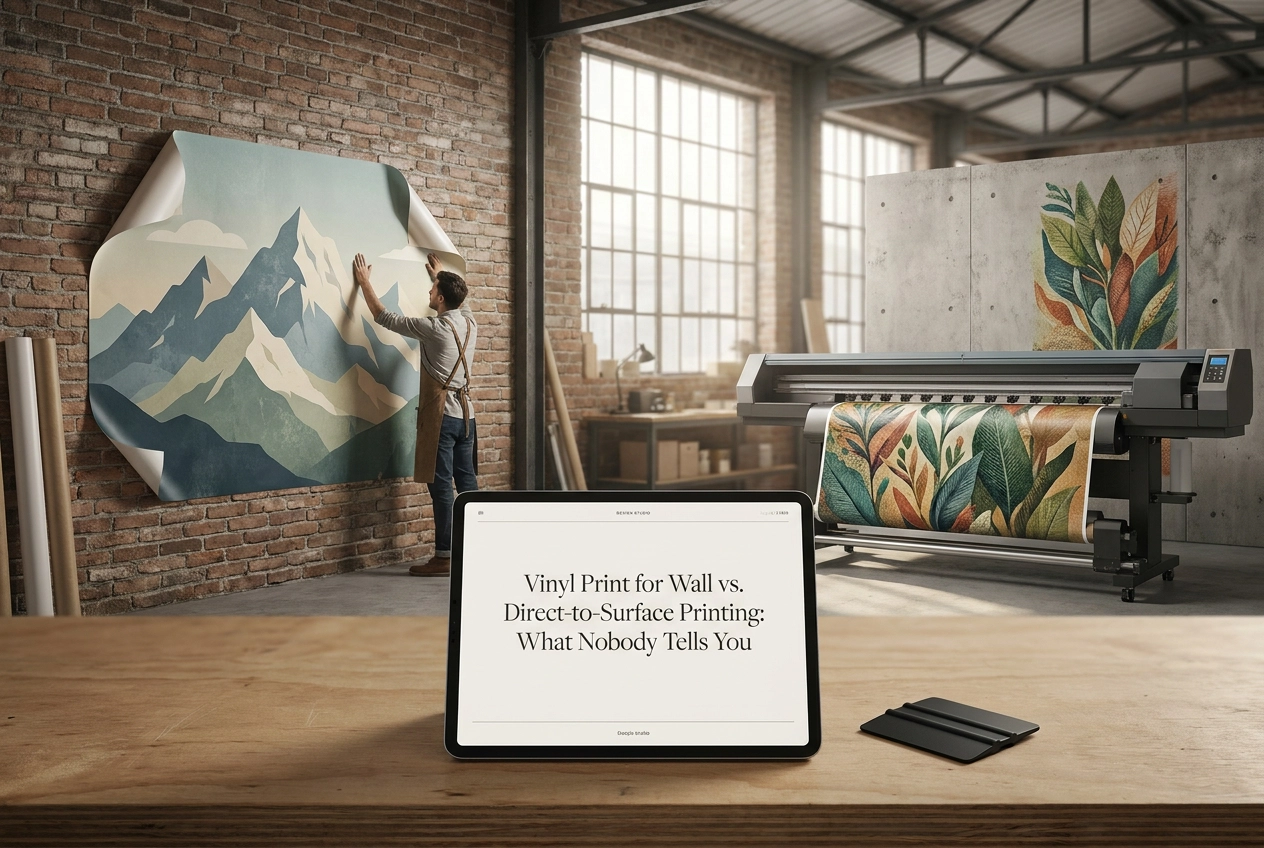
You've probably stood in a print shop or scrolled through supplier websites, wondering why two seemingly similar wall graphics can vary so dramatically in price, durability, and final appearance. The answer almost always comes down to one fundamental choice: vinyl print for wall applications versus direct-to-surface printing. And yet, most guides gloss over the details that actually matter when you're making that decision.
This isn't a beginner's overview. If you already understand the basics of large-format printing and you're ready to dig into the real trade-offs, this comparison is built for you. We'll break down how each method handles different wall textures, what happens to color accuracy over time, which option holds up in high-traffic environments, and where each technique quietly falls short. We'll also tackle the hidden costs and installation challenges that suppliers rarely volunteer upfront.
By the time you finish reading, you'll have a clear, practical framework for choosing the right approach based on your specific project requirements, not just what's cheapest or most convenient at the moment.
What Is Vinyl Wall Printing and Who Is It Actually For?
Search for a vinyl print for wall and you will find a familiar product: adhesive-backed PVC sheeting, printed off-site onto rolls, and applied to your wall using a pressure-sensitive adhesive layer. The construction is straightforward. A printed film sits on top of an adhesive, which sits on top of your wall. That layered system is precisely what you are buying, and it is also precisely where the product's limitations begin.
Vinyl has entirely legitimate applications. Short-term retail point-of-sale displays benefit from its low cost and easy replacement cycle. Temporary event backdrops can be installed and removed without permanent modification to a venue. Rental properties where lease terms require full reversibility at handover make vinyl a practical choice, provided removal happens before the adhesive degrades. Industry data puts that degradation window at 18 to 36 months, after which the product curls, peels, and leaves residue on the wall. Within those specific scenarios, vinyl does its job.
The problem is that most people searching for a vinyl print for wall are not planning a temporary display. They are imagining a feature wall in a hotel lobby, a motivational mural in a gym, a breath-taking landscape wrapping a living room. They are searching for visual transformation that lasts. What they are actually purchasing is a film layer bonded to the wall by adhesive alone, restricted to smooth primed drywall, interrupted by seam lines wherever the graphic exceeds roll width (typically 54 to 60 inches), and working against a countdown clock from the moment it is installed.
Direct-to-surface UV printing operates on a fundamentally different physical principle. As UV printing specialists explain, UV-curable inks are deposited directly onto the receiving surface and immediately polymerised by UV lamp exposure, creating a molecular bond with the substrate itself. No adhesive layer. No seam lines. No surface restriction. Brick, concrete, textured plaster, timber and glass all become printable surfaces.
Vinyl is the default assumption. Direct-to-surface printing is the informed upgrade. The comparison that follows will show you exactly why.
The Problem With Vinyl Walls That Nobody Warns You About
Nobody tells you about the timeline. The salesperson shows you the sample, the colours look vivid, the finish looks sharp, and you sign off. What they rarely walk you through is what happens at month eight, year two, and year three.
The degradation sequence for vinyl wall graphics follows a predictable pattern. Within months of installation, the seam lines that run between panels on any multi-section mural begin trapping fine particulates and moisture. That gap is structural, not a fitting error, and no amount of careful installation eliminates it entirely. Then, around the two-year mark, adhesive bubbling becomes a visible problem. Heat cycles, humidity, and surface contaminants beneath the vinyl layer begin softening the adhesive bond, producing the telltale raised patches that no amount of smoothing will permanently fix. In humid commercial environments, this timeline accelerates dramatically. Gyms, restaurant kitchens, and hotel bathrooms subject vinyl to sustained steam, grease vapour, and moisture exposure. Moisture trapped behind low-permeability vinyl creates the conditions for adhesive failure, and in worst cases, concealed damage to the wall surface beneath.
What UK Weather Does to Exterior Vinyl
Exterior applications face a compounding set of problems that are particularly acute in the British climate. UV exposure degrades colour vibrancy progressively. Thermal expansion and contraction, driven by the UK's frequent cycling between cold wet winters and mild damp summers, stress adhesive bonds at every edge and corner. Moisture ingress behind the adhesive layer during sustained rainfall penetrates at the weakest points first: edges, cut lines, and seams. According to documented common issues with adhesive vinyl applications, bubbling, wrinkling, edge lifting, and colour fading are the predictable outcomes of this environmental pressure. For exterior commercial installations, a 3-year useful lifespan is a realistic expectation, not a pessimistic one.
The Removal Problem Nobody Budgets For
When vinyl fails, removal introduces a second wave of costs that are rarely factored into the original decision. Chemical stripping agents are typically required once adhesive has hardened over years of heat exposure. Even with careful technique, the process risks tearing plaster, stripping paint, and leaving adhesive residue that must be fully remediated before any replacement surface treatment can be applied. As research into why decals peel confirms, adhesive residue and surface damage are well-documented removal outcomes, not edge cases. Vinyl installation itself takes 2 to 3 days per wall. Every replacement cycle means paying that installation cost again, on top of stripping and remediation.
Picture This Scenario, Then Picture the Alternative
Close your eyes for a moment. Visualise the mural you commissioned, chosen carefully and installed at real cost, beginning to lift at the lower corner by year three. The seam has collected two years of grime. The adhesive has softened behind a kitchen extraction unit. You peel back the edge and find stained plaster underneath. That is not a failure scenario. That is the documented lifecycle of vinyl.
Now picture the alternative. Machine Canvas bonds pigment directly into the substrate using UV-cured technology sealed with a protective lacquer coat. There is no adhesive layer to fail, no seam lines to collect moisture, and no PVC film sitting on top of your wall waiting for heat to release it. The result is a 5-year interior guarantee and a 3-year exterior guarantee backed by the physics of the finish rather than the optimism of an installer. Nothing has moved, faded, or lifted, because nothing was ever sitting on the surface to begin with.
Vinyl Print for Wall vs. Direct-to-Surface UV Printing: A Straight Comparison
The numbers tell the story cleanly. Here is where vinyl print for wall and direct-to-surface UV printing actually stand against each other across the ten dimensions that matter to anyone making a permanent decision.
Dimension
Vinyl Print for Wall
Direct-to-Surface UV (Machine Canvas)
Resolution
Standard dot-pattern print
600+ DPI / 2,400 DPI UV system
Seams
Visible roll seams every 54 inches
Seam-free up to 100 linear feet
Installation Time
Days of prep, alignment, and curing
Under five hours, immediate foot traffic
Lifespan
Bubbling begins around two years
5-year interior / 3-year exterior guarantee
Removal
Chemical stripping, wall damage risk
Simply paint over
3D and Trompe-l'Oeil
Impossible with flat adhesive sheets
Burst-through, relief, and perspective illusions
Multi-Site Colour Consistency
Variance between print batches and locations
Zero variance across all sites
Material Waste
High PVC offcuts, landfill on removal
Up to 78% less material waste
Five-Year Cost of Ownership
Higher due to replacement cycles
40-50% less costly over five years
Design Preview
Not standard
Free mock-up before any commitment
Resolution: The Difference Between a Graphic and Fine Art
Stop and picture this properly. At 2,400 DPI, a Machine Canvas print does not approximate a fresco; it renders the individual brushstrokes. It does not suggest a meadow; it reproduces individual blades of grass, each one distinct at arm's length. In a wildlife portrait, you can see the separation between individual fur fibres on a lion's mane or the micro-detail of feather structure on a bird of prey. This is not a marginal improvement over vinyl. It is a categorically different class of output, and it is bonded directly into your wall. According to direct-to-wall printing research, standard vinyl print produces visible dot patterns at close range, a limitation no upgrade in vinyl material resolves. The medium itself is the constraint. UV printing at 2,400 DPI removes that constraint entirely.
3D and Trompe-l'Oeil: Exclusive Creative Territory
This is the dimension that separates a wall treatment from an architectural event. A flat adhesive sheet has one physical capability: it lies flat. That is not a criticism; it is a physical fact. No vinyl print for wall, regardless of specification or price, can create the illusion that a lion is physically breaking through your boardroom wall. It cannot make a narrow hotel corridor appear to extend three times its actual length through precision perspective calibration. It cannot make oversized florals appear to burst outward from the surface in physical relief. Direct-to-wall UV printing achieves all three through layer-by-layer ink deposition and perspective-mapped artwork that exploits the direct bond between print and substrate. This creative territory is not premium-tier vinyl; it does not exist within the vinyl category at any price point. For hotels, gyms, restaurants, and corporate environments that want a space people photograph and share, this single differentiator changes the return on investment calculation entirely.
Five-Year Cost of Ownership: The Financial Case
The first-cost comparison is close. The five-year comparison is not. Vinyl begins degrading in commercial high-traffic environments within approximately 18 to 36 months, with peeling edges, adhesive failure, and delamination requiring full replacement. Each replacement cycle compounds: you pay for chemical stripping labour, adhesive residue remediation, surface preparation, new material, and new installation. On a commercial-scale project, seam management alone adds 20 to 40% to vinyl installation labour on large-format walls. A single direct-print installation from Machine Canvas requires nothing beyond a coat of paint to update, with no chemical agents, no wall remediation, and no structural disruption. Over a five-year window, direct-to-surface UV printing is 40 to 50% less costly than the replacement cycle vinyl demands.
Sustainability: 78% Less Waste and UK Procurement Alignment
For fit-out managers operating under BREEAM assessment frameworks or working within the UK Government's Construction Playbook circular economy commitments, the material waste figure is procurement-relevant. Direct-to-wall UV printing produces up to 78% less material waste than vinyl wall coverings. Vinyl generates PVC offcut waste during installation and becomes landfill waste on removal, with adhesive-contaminated sheeting unrecyclable through standard waste streams. UV-cured inks are low-VOC and PVC-free, positioning direct-to-surface printing as a credible specification under BREEAM Mat 01 material credits and circular economy plan requirements under BREEAM New Construction 2018. For commercial tenants and landlords managing ESG commitments, that is not a peripheral benefit; it is a line item that belongs in the procurement justification.
Machine Canvas offers a free design mock-up before any commitment, so the decision to move beyond vinyl starts with seeing exactly what your wall becomes.
Vinyl or Direct Printing? The Right Answer Depends on Your Space
For Homeowners: Stop Settling for a Wall That Won't Last
If you are a homeowner who has spent real time imagining a feature wall that genuinely transforms a room, picture it now. A floor-to-ceiling botanical mural in ultra-high definition. A moody, photorealistic cityscape behind your bed. A burst-through effect that makes it look like the wall has dissolved into another world entirely. Now imagine that image still looking exactly like that on day one, in year five. Not peeling at the corner. Not bubbling along the skirting. Not yellowing where two panels were joined. That is the difference direct-to-surface printing delivers for your home, and it is not a marginal improvement over vinyl; it is a fundamentally different category of result. Vinyl is a short-term solution to a long-term aspiration. Direct-to-surface UV printing is the investment that matches how permanently you feel about that wall.
For Commercial Fit-Out Managers Across the UK
If you are managing a fit-out programme across hotel corridors in Manchester, gym feature walls in Edinburgh, school receptions in Cardiff, or restaurant dining rooms in Bristol, the operational numbers matter as much as the visual result. A 15-location rollout using direct-to-surface printing completes in 4 to 5 weeks. The same project using vinyl with regional installers takes 8 to 10 weeks, and that figure does not account for surface preparation delays, adhesive curing, or seam corrections between sites. Beyond speed, direct-to-wall printing achieves zero colour variance between locations, which is a specification requirement that vinyl, with its regional print batching and panel-by-panel application, cannot reliably meet. There is also the end-of-lease question. Machine Canvas's direct-to-surface finish is paint-over-ready, meaning future rebrands require nothing more than a standard repaint. No chemical strip-back. No adhesive residue damaging the substrate. No dispute with your landlord over reinstatement costs.
For Interior Designers and Specifiers
Direct-to-surface printing expands what you can credibly promise a client. The 3D relief effects, burst-through designs, and perspective corridor illusions that are physically impossible with flat vinyl sheets are fully achievable, and the results at 2,400 DPI are indistinguishable from reality at close range. Machine Canvas removes the speculative risk from your recommendation entirely by providing a free design mock-up before any commitment is made. You present the client a photo-accurate visualisation of their finished space before a single penny is spent.
Exterior Applications: Where Vinyl Simply Cannot Compete
For shopfronts, outdoor murals, car park walls, and building facades, British weather ends the vinyl conversation quickly. UV fade and edge-lifting begin within months under sustained exposure. Machine Canvas's lacquer-sealed exterior prints carry a 3-year guarantee, delivering colour and adhesion integrity that vinyl cannot approach in an outdoor UK environment.
The real choice here is not vinyl versus technology. It is a short-term compromise versus a permanent transformation that looks as extraordinary on year five as it did on day one.
The Visual Effects Vinyl Can Never Deliver
Close your eyes for a moment. Picture a leopard. Not a photograph on canvas, not a poster behind glass. A leopard that appears to be physically erupting through your wall, its shoulders forward, claws extended, the layered relief of its coat rendered at 2,400 DPI so that every rosette, every individual whisker, every cast shadow reads as something your hand could touch. The fur has depth. The eyes have weight. The surface itself appears to have fractured outward around the animal. Now open your eyes and understand this: no adhesive vinyl sheet, at any specification, at any price point, can produce what you just imagined. The physics will not allow it. Vinyl is a flat film applied to a flat surface, and flat is its absolute ceiling.
Burst-Through and 3D Relief
Machine Canvas produces exactly this kind of installation. Its 3D safari murals and floral burst-through feature walls use UV-cured, layered ink deposition directly onto the wall substrate, building dimensional effects that read as architecturally real because they are printed into the surface rather than placed on top of it. A floral burst-through wall, where oversized blooms appear to push forward through the plaster, carries a visual authority that stops people mid-stride. These are not decoration; they are spatial events. UV printing delivers advantages over vinyl across versatility, durability, and dimensional effect that flat film simply cannot replicate.
Perspective Corridors and Trompe-L'oeil
Now visualise a hotel corridor, physically eight metres long, whose far wall is printed with a receding architectural perspective so convincing that every guest instinctively looks twice. Machine Canvas has executed perspective illusion corridors for hotel lobbies, school entryways, and office receptions across the UK, transforming constrained architectural spaces into environments that feel considered, expensive, and worth photographing. Trompe-l'oeil of this quality is not a gimmick; it is a high-end interior design instrument that generates organic social visibility every time a guest points a phone at it. That visibility has measurable commercial value for hospitality and retail operators.
The Creative Ceiling of Vinyl vs. The Range of UV
Vinyl tops out at flat, seamed, and resolution-limited. At close range, dot patterns become visible. Panel joins collect dust. Edges lift within 18 to 36 months. The creative conversation ends before it properly begins. Direct-to-surface UV printing operates in an entirely different register: seam-free across up to 100 linear feet of continuous output, photoreal at architectural scale, capable of live-printed landscape murals that cover entire room perimeters without a single break. The comparison between UV and vinyl consistently resolves the same way for permanent, large-format, dimensional work: UV occupies a category vinyl cannot enter. Machine Canvas's portfolio, from 3D safari walls to perspective illusion corridors to live-event landscape printing, represents the full span of what becomes possible when the creative ceiling is removed entirely.
How Machine Canvas Delivers What Vinyl Wall Printing Cannot
Machine Canvas operates at 2,400 DPI using UV-cured CMYK pigment technology that bonds directly into the wall substrate rather than sitting on top of it. This is not a semantic distinction. It is the structural difference between a finish that is permanently part of your surface and an adhesive film that is merely resting against it. The pigment cures into the material itself, producing edge-to-edge continuity across the entire wall with no panels, no overlaps, and no seams. At that resolution, you are looking at photographic precision that renders individual textures, gradients, and fine details with a clarity that flat vinyl print simply cannot reproduce at close range.
What Machine Canvas Actually Delivers
The scope of output goes considerably further than a feature wall. Machine Canvas works across interior and exterior surfaces, bringing the same UV-cured technology to full-room murals, corridor illusions, 3D relief compositions, and the burst-through effects described in the previous section. Beyond vertical surfaces, the service extends to floor graphics built for commercial environments: car parks, retail floors, gyms, and public spaces where durable, high-definition ground-level print adds a layer of visual identity that most spaces never consider. For businesses running events and exhibitions, Machine Canvas also provides large-format live printing on location, turning blank walls into finished artwork in a single session.
Guarantees That Vinyl Cannot Come Close To
The lacquer-sealed finish is what makes the guarantees credible. Interior prints carry a 5-year guarantee. Exterior work carries a 3-year guarantee. Given that standard vinyl graphics typically begin to bubble and peel within 18 to 36 months, these figures are not modest claims; they represent a fundamentally different product lifecycle.
UK-Wide Reach, One Point of Contact
Operating from Lytham St Annes in Lancashire, Machine Canvas serves homes and businesses across England, Scotland, and Wales. Commercial projects span hospitality, gyms, offices, schools, retail, restaurants, automotive showrooms, and public realm installations, all delivered with consistent colour output regardless of location.
The Free Mock-Up Changes Everything
Before spending a single pound, you can see exactly what your wall will look like. Machine Canvas provides a free design mock-up with no commitment required, and pricing starts from £250. That combination, complete visual certainty before any financial commitment, makes the decision genuinely effortless.
Vinyl Print for Wall: Frequently Asked Questions
Can vinyl print be applied to a textured wall?
Not effectively. Vinyl is an adhesive film that bonds to the surface sitting beneath it, which means the quality of that bond is entirely dependent on substrate smoothness. On textured plaster, brick, concrete, or cinder block, the adhesive makes only partial contact, creating micro-gaps that accelerate edge lift and moisture ingress. Direct-to-surface UV printing eliminates this problem entirely. The ink bonds into the substrate rather than onto it, making rough, porous, and irregular surfaces fully printable without preparatory work. Brick, plaster, concrete, stucco, and MDF are all compatible surfaces, none of which are reliably served by adhesive vinyl.
How long does a vinyl wall print last?
Vinyl typically begins bubbling and lifting at around the two-year mark, particularly in humid environments, high-traffic corridors, or spaces with temperature fluctuation. That is not a defective product; it is the predictable behaviour of an adhesive film under real-world conditions. Machine Canvas backs its direct-to-surface prints with a 5-year interior guarantee and a 3-year exterior guarantee, with a lacquer-sealed finish protecting every installation. That is a concrete, documented performance commitment against a product category that cannot make the same promise.
Is vinyl wall printing cheaper than direct-to-surface printing?
Vinyl carries a lower entry price, and that initial figure is genuinely appealing. But the five-year cost of ownership tells a different story. Each vinyl replacement cycle brings material costs, removal costs, adhesive residue remediation, and two to three days of installation labour per wall. Factor those figures in and direct-to-surface printing is 40 to 50 percent less costly over a five-year period. The upfront saving on vinyl is typically erased by the first replacement cycle, and the costs compound from there.
Can you print fully custom designs directly onto walls?
Yes, and the process is designed to remove all guesswork. Submit your space details and Machine Canvas produces a photorealistic digital mock-up of your proposed design rendered on your actual wall, before any commitment is required. You review it, approve it, and the team arrives and prints. The comparison between wall printer and vinyl wall graphics confirms that direct printing delivers a seamless, film-free finish that makes custom depth and detail read convincingly at every scale.
Is direct-to-wall printing available across the UK?
Machine Canvas operates nationwide across England, Scotland, and Wales from its base in Lancashire, serving residential feature walls and large-scale commercial fit-outs with equal capability. Geographic location is not a barrier to enquiring.
Can you create 3D murals or burst-through effects on a wall?
Emphatically yes, and this is where direct-to-surface UV printing stands entirely alone. Burst-through effects, trompe l'oeil perspective illusions, and 3D relief designs are signature capabilities of this technology. These effects depend on photorealistic depth rendered at ultra-high resolution, printed directly into a seamless, film-free surface. Flat adhesive vinyl cannot replicate them. Vinyl sits proud of the wall with a visible laminate edge that immediately breaks any illusion of depth. If a 3D mural is on your list, vinyl is simply not a product category that can deliver it.
Ready to See What Your Wall Could Look Like?
Direct-to-surface UV printing delivers three advantages vinyl simply cannot match: 2,400 DPI resolution that makes genuinely photoreal detail possible at any scale, a guaranteed lifespan that outlasts vinyl's two-year failure threshold by years, and creative effects including 3D burst-through murals and perspective illusions that no flat adhesive sheet can replicate regardless of budget.
Now picture your specific space. The hotel reception that stops guests mid-step. The gym feature wall that charges the room with energy before a single rep is lifted. The school corridor that turns a walk to class into something worth remembering. The restaurant dining room where the artwork is the atmosphere. The living room feature wall you have been imagining for longer than you would admit. Picture all of it rendered at 2,400 DPI in seam-free, UV-cured pigment, still looking extraordinary five years from now because it is guaranteed to.
Machine Canvas makes the next step effortless. Pricing starts from £250, the service covers homes and businesses across the whole of the UK, and you can reach the team right now by WhatsApp or click-to-call. Before you spend a penny, you receive a free design mock-up showing exactly what your wall will look like.
Request Your Free Wall Mock-Up
Conclusion
Choosing between vinyl print for wall applications and direct-to-surface printing is rarely straightforward, but it becomes manageable once you know what to prioritize. Keep these takeaways in mind: vinyl offers flexibility and removability, making it ideal for temporary or frequently updated spaces; direct-to-surface printing delivers superior durability and texture integration on permanent installations; color longevity and wall surface compatibility should drive your decision as much as budget; and hidden costs like installation labor and surface prep can shift the true value of either option significantly.
Now it is time to put this framework to work. Audit your specific wall conditions, usage expectations, and timeline before your next conversation with a supplier. The right choice is always the informed one. Start with the surface, work outward from there, and never let a vendor skip the details that matter most.