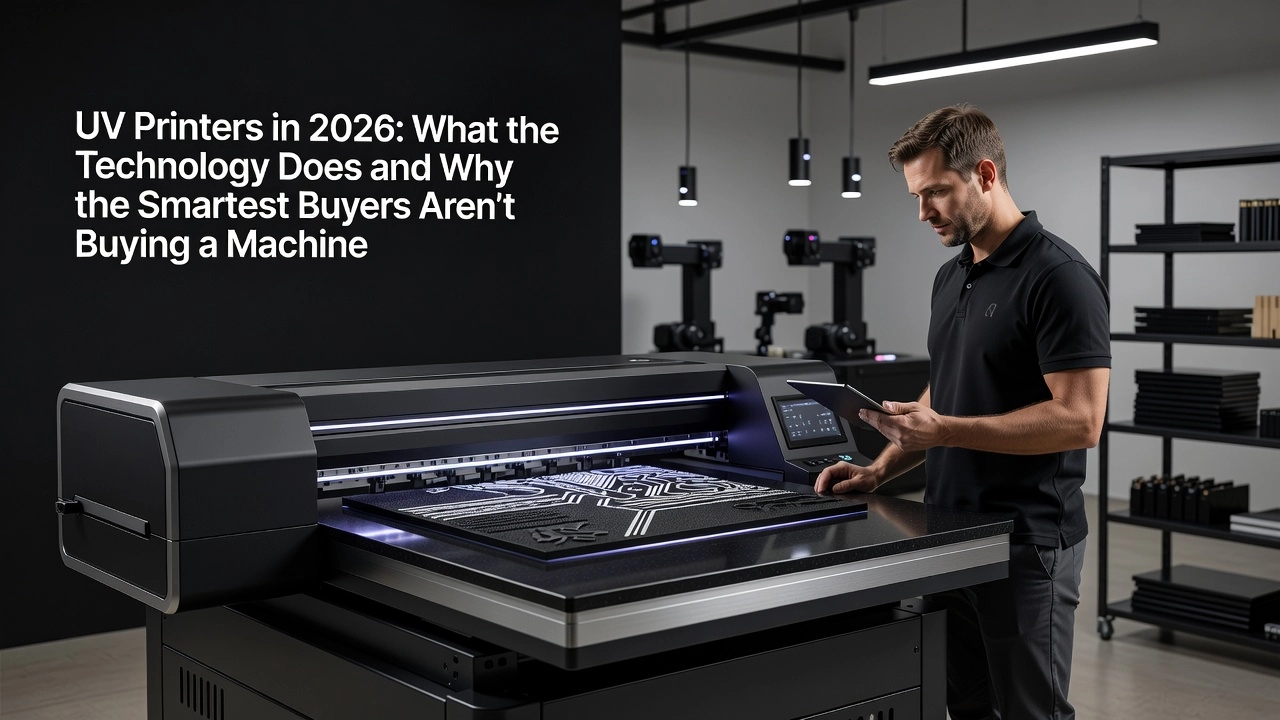
Something interesting is happening in the printing industry. The UV printer has never been more capable, more accessible, or more competitively priced than it is right now in 2026. Yet the most sophisticated buyers, the ones scaling print operations and protecting their margins, are increasingly choosing not to own one at all.
That might sound counterintuitive. But once you understand what modern UV printing technology actually delivers, and how the economics of ownership stack up against alternatives like print-on-demand services and outsourced fulfillment partners, the math starts telling a very different story.
In this post, we will break down exactly how UV printers work, what separates entry-level machines from industrial-grade systems, and which applications genuinely justify the investment. More importantly, we will examine why a growing number of smart operators are getting all the benefits of UV printing without absorbing the capital costs, maintenance burden, or operational complexity that comes with owning the equipment. By the end, you will have a clear framework for deciding which path actually makes sense for your business.
What Is UV Printing? The Technology Explained in Plain Language
Think of the last time you peeled a gel nail coating under a UV lamp. That near-instant hardening from liquid to solid is the same photochemical principle powering the most advanced surface printing technology available today. UV printing fires pigment-rich ink precisely onto a surface, then cures it in milliseconds using ultraviolet light. The ink does not evaporate, and it does not soak into the material beneath it. Instead, it undergoes a molecular bond with the surface, locking colour into place with a permanence and vibrancy that conventional solvent or water-based printing simply cannot match. The result is colour that is sharper, more saturated, and more dimensionally rich than anything produced by traditional methods.
UV-LED: The Technology Running the Industry in 2026
By 2026, UV-LED light sources have comprehensively replaced older mercury-lamp UV systems as the professional standard. The reasons are compelling across every metric that matters to serious operators. UV-LED systems consume significantly less energy, generate far less heat during the curing process (which protects heat-sensitive surfaces like thin vinyl, acrylic, and coated boards from distortion), and carry an operational lifespan that makes mercury lamps look disposable by comparison. As this beginner's guide to UV printing confirms, UV-LED is no longer an emerging alternative; it is the current baseline for any professional-grade equipment worth considering. If a UV printing service is not operating on LED-based curing in 2026, that is worth noting.
Three Configurations, One Critical Distinction
UV printers exist in three hardware configurations, and understanding the difference matters. Flatbed printers hold the substrate rigid and flat beneath the print head, making them ideal for boards, tiles, glass panels, and ceramic surfaces. Roll-to-roll printers feed flexible media on a continuous roll, suited to banners and large vinyl runs. Hybrid systems handle both. As Printful's overview of UV printing illustrates, each configuration serves fundamentally different use cases. No single machine type does everything equally well.
Resolution, Colour Fidelity, and the Detail That Changes Everything
CMYK printing at resolutions reaching 2400 DPI produces output where photographic fidelity is not an aspiration; it is the baseline. Close enough to touch, you can see the texture of a painted brushstroke, the grain running through tropical hardwood, the individual petals of a hand-illustrated botanical print rendered with complete and unwavering accuracy. Now picture that level of detail scaled across an entire wall. Because UV-cured ink bonds to surfaces rather than absorbing into them, the same process that produces a museum-quality canvas reproduction can print directly onto a concrete floor, a glass partition, a ceramic tile, or a painted brick wall. The substrate range is, for all practical purposes, unlimited. That is the quiet revolution built into this technology, and it is exactly what Machine Canvas has built its entire service around.
The UV Printer Market in 2026: What the Numbers Actually Mean
The numbers behind UV printing in 2026 are not just impressive; they are directional. The global UV flatbed printer market was valued at $$1.8 billion in 2025 and is projected to reach $$3.6 billion by 2034, expanding at a compound annual growth rate of 7.9%. The UV wall printer segment specifically is forecast to grow at 7.7% annually through to 2033. Markets do not double on a whim. That trajectory signals something structural: the way human beings design and inhabit spaces is changing, and UV printing is the technology at the centre of that change.
Where the Market Weight Actually Sits
Large-format applications currently hold the largest share of the UV flatbed printer market at 42.3%. This is the segment that encompasses wall printing, floor graphics, and direct-to-surface interior work. For years, industry insiders described this category as untapped, an almost paradoxical label for a technology this capable. That description no longer applies. Agfa UK's Bobby Grauf captured the shift plainly: "The scope of UV wide-format printing is enormous, and not a week goes by where we don't discover new and innovative applications." The interior décor vertical is now one of the fastest-growing adoption areas in the entire print industry, and the acceleration is not slowing.
Why Generic Interiors Are Losing
Customisation is identified as the primary growth driver across every segment of the UV print market, and the logic is not complicated. Businesses and homeowners alike have grown increasingly resistant to interiors that feel assembled rather than designed. Paint offers colour but no narrative. Mass-produced wallpaper offers pattern but no originality. UV printing offers something neither can: a surface that is entirely, unrepeatable yours, printed at 2,400 DPI with photographic precision directly onto the wall or floor you already own.
In the UK, this demand is being driven by a remarkably diverse set of buyers. Hospitality operators are transforming guest-facing spaces with bespoke murals that become social-media backdrops. Retail fit-out teams are using floor and wall graphics to define brand environments without the cost of a full refit. Office interior designers are commissioning perspective illusions and burst-through effects that make functional corridors feel like curated experiences. Schools and nurseries are investing in immersive, stimulating environments that support learning and wellbeing. Residential homeowners are simply refusing to settle.
Visualise a wall that does not hang art but becomes the art. That is not aspiration. According to large format printer market analysis from Mordor Intelligence, it is the fastest-growing category in print. The market is not waiting.
What Can UV Printing Actually Print On? The Surface List Will Surprise You
Close your eyes for a moment. Imagine a raw brick wall in a Manchester hotel lobby, printed floor to ceiling with a photorealistic tropical forest at 2400 DPI. Every leaf edge crisp. Every shadow layered. Now imagine the floor beneath it carrying the same scene, the roots apparently growing across the polished concrete beneath your feet. That is not a concept render. That is what UV printing onto physical surfaces actually delivers today, and the list of surfaces it works on will almost certainly reshape how you think about interior and exterior space.
Every Surface You Already Have Is a Candidate
UV-cured ink adheres to an extraordinary range of substrates without requiring specialist base coats or pre-treatment in most cases. Interior walls, whether painted plaster, raw brick, smooth render, or timber panelling, accept direct UV printing with no vinyl intermediary. Exterior rendered concrete, brick facades, and cladding panels are equally viable. Move to floors and the list continues: sealed concrete, resin screeds, ceramic tile, and sealed hardwood all receive UV-cured ink and can be finished with a protective lacquer layer that makes the result both slip-tested and traffic-resistant. Glass partitions, aluminium and steel surfaces, acrylic panels, porcelain tiles, MDF, and composite board are all confirmed substrates across direct-to-substrate printing platforms. The practical implication is significant: virtually every surface inside or outside a building is printable without structural modification.
The Vertical Printing Distinction That Changes Everything
There is one capability that separates a direct-to-surface UV service from any conventional print shop: the printer physically travels across a standing wall in situ, depositing ink layer by layer directly onto the surface itself. No graphic is produced in a factory, rolled up, transported, and pasted. The wall is the medium from the first pixel to the last. This distinction matters enormously in practice. Seams disappear because there are no panels to align. Texture is preserved because nothing is layered over it. Scale becomes irrelevant because the printer simply covers more wall. As described in community discussions among direct-to-surface practitioners, the process applies equally to a domestic feature wall and a commercial reception spanning fifteen metres, with no change in method.
Floor Graphics: The Application Growing Fastest
Floor printing for car parks, gym surfaces, retail floors, and commercial reception areas represents one of the highest-growth applications in the UV sector right now. UV-cured floor graphics can carry directional wayfinding, brand identity, safety markings, or purely decorative pattern work at any scale. The finish is lacquer-sealed, trafficked-surface rated, and meets slip-resistance requirements for public spaces. For a gym operator, a branded performance zone printed directly onto the rubber or resin floor is a brand asset. For a car park operator, colour-coded bay numbering at full-floor scale is a functional and commercial one.
The Question That Should Start Every Brief
The substrate-agnostic nature of UV printing forces a genuinely different creative conversation. The brief does not begin with "what material can we print on?" It begins with "what do you want your space to feel like?" That shift sounds subtle but it is transformative in practice. For anyone who has ever looked at a stunning large-format print and assumed it must first exist on paper or vinyl before reaching a wall, the revelation that the wall itself is the canvas is a genuine paradigm shift. Machine Canvas's direct-to-surface approach sits precisely at that intersection: the surface you already have, the image you want to own, and no intermediary between them.
Owning a UV Printer vs. Commissioning a UV Print Service: An Honest Comparison
Let's address the question directly, because the confusion in this space is costing businesses real money and real quality.
A professional-grade UV wall and floor printer is not a business accessory. It is a manufacturing asset. Commercial-grade direct-to-surface equipment capable of printing at resolutions that actually matter — we are talking 2400 DPI with calibrated colour management — sits at £20,000 to £80,000 or more at the point of purchase. That figure does not include installation, ventilation requirements, dedicated power supply, ink inventory, maintenance contracts, operator training, or the considerable floor space these systems demand. Every one of those cost lines belongs to the buyer, with no guaranteed return in sight unless printing is genuinely the core activity of the business.
The Equipment Manufacturers Are Not Talking to You
The companies producing professional UV flatbed and wall-printing systems are targeting one specific buyer: a business that intends to run a print operation at volume. Their sales materials assume sustained weekly output, production throughput targets, and a commercial printing context. They are not addressing the hotel operator who wants a single feature wall in the lobby. They are not speaking to the gym owner who has visualised a floor-to-ceiling motivational mural in the weights room. They are not writing for the homeowner who wants a 3D burst-through botanical design in a hallway that stops every visitor cold. Those buyers have an entirely different need, and the ownership model does not serve that need at any sensible cost-to-outcome ratio.
What Commissioning Actually Means
Commissioning a direct-to-surface UV print service like Machine Canvas changes the entire structure of the transaction. You are not buying a machine. You are buying a finished, printed surface, with all complexity managed on your behalf. Surface preparation, colour profiling, ink density calibration, UV curing parameters, and post-print lacquer sealing are all handled by trained operators running calibrated commercial equipment. The result is backed by a 5-year guarantee on interior prints and a 3-year guarantee on exterior work. No machine owner operating outside a professional print environment can replicate that guarantee structure, because replicating it requires the exact expertise and process control that takes years to build.
The Quality Argument Is Not Subjective
At 2400 DPI, the margin for error in colour management and surface preparation is essentially zero. Operators who work at this level daily understand how substrate porosity, ambient temperature, ink viscosity, and curing lamp intensity interact to produce a result that either meets the brief or does not. UV printing technology involves a precise photochemical process where every variable compounds. The skill development curve for an owner-operator is steep and documented clearly across the industry. Community forums dedicated to prosumer UV printing are filled with creators managing reprints, troubleshooting head alignment, and developing workarounds for colour drift. That learning curve is real, and it shows in the output.
The Break-Even Reality
The volume threshold that justifies owning commercial UV print equipment is significant. Businesses that have validated ROI on UV ownership are already active in print production, already have a customer pipeline, and already understand how to cost a print job. For anyone outside that profile, the numbers do not work. If you are not producing multiple printed surfaces each week as a baseline, the capital expenditure, operational burden, and quality risk make ownership a losing proposition. Commissioning a specialist service is more cost-effective, produces a demonstrably superior result, and carries zero operational liability. That is not a marginal difference. The comparison is not close.
What UV Wall and Floor Printing Looks Like at Its Best — Close Your Eyes and Picture This
Picture a blank magnolia hallway in a hotel. The kind of corridor that guests walk through without looking up, noticing nothing, feeling nothing, counting doors until they reach their room. Now replace every centimetre of that corridor with a floor-to-ceiling tropical rainforest running its full length, printed at 2400 DPI directly onto the plaster. Every leaf edge is sharp enough that you instinctively step back. Every gradient of green shifts with the precision of a photograph taken in golden-hour light. And the roots of the trees do not stop at the skirting board; they break through it, crack across the floor, and reach toward your feet. That is a burst-through mural. It is not a concept. It is not a render. It exists in real buildings, in real corridors, right now, and the people who walk through those corridors do not feel nothing.
The Difference Between Decoration and Transformation
Burst-through effects and 3D relief murals are built on perspective, shadow rendering and trompe-l'oeil geometry. The technique makes design elements appear to physically project beyond the wall surface, using the same optical principles that Renaissance painters used to make ceilings look like open sky. A lion's face emerging from cracked plaster. A floral arrangement appearing to spill off a feature wall and into the room. A sports car arriving nose-first through a showroom wall at full speed. These are not digital novelties applied as an afterthought; they are considered interior design choices, planned in collaboration with the space, and they fundamentally change how a room feels to the people inside it. The wall stops being a boundary and becomes an event.
Every Surface Is Now a Canvas
The logic extends straight to the floor. Photorealistic floor graphics transform car park decks, gym studios, reception areas and retail floors into branded environments that reward attention rather than demanding it. Directional arrows become part of a graphic landscape. Safety markings are integrated into a visual system rather than applied over one as an ugly compliance obligation. A gym floor becomes a motivational environment. A car park deck communicates brand identity at the moment a customer first steps out of their vehicle. The floor is as much a canvas as any wall, and UV vertical wall printing technology now makes printing both surfaces in a single visit entirely practical.
Resolution That Removes Doubt
At 2400 DPI, the print resolution is comparable to, and in many cases exceeds, professional photography printing standards. At normal viewing distances inside a room, the human eye cannot perceive individual ink dots. What it perceives is a seamless, continuous image that reads as a physical surface treatment, not as something printed onto one. The distinction matters enormously, because the moment a viewer detects the print, the illusion collapses. At this resolution, the illusion holds.
Brand Infrastructure, Not Interior Decoration
The emotional impact of a well-executed UV-printed environment is not subtle. Visitors stop. They photograph it. They post it. They tell people. They return. For a hotel, a gym, a restaurant or a retail space, this is not decoration in the conventional sense; it is an active commercial asset. Environments that generate organic social sharing are environments that market themselves. That is brand infrastructure, built directly into the walls.
Durability, Eco-Credentials and the Sustainability Case for Direct-to-Surface UV Printing
Let's be direct about something the wider decorating industry would rather you did not think too hard about. Every roll of wallpaper you hang, every vinyl sheet you apply, and every adhesive film you fix to a surface comes with a hidden waste cost that does not appear on the invoice. Machine Canvas's direct-to-surface UV printing does not.
The Guarantee Is a Contract, Not a Claim
UV-cured ink does not dry. It undergoes photopolymerisation, a chemical reaction triggered by UV light that converts liquid ink into a hard, bonded solid layer in a fraction of a second. The result behaves fundamentally differently from any water-based or solvent-applied alternative. It resists fading, moisture, cleaning agents, and physical abrasion because it has become part of the surface rather than sitting on top of it. Machine Canvas's lacquer-sealed finish reinforces this further, and the output is backed by a five-year guarantee on interior prints and a three-year guarantee on exterior work. Those are not marketing assertions; they are contractual commitments. In a commercial specification context, that distinction matters significantly.
UV-LED Curing: The Environmental Upgrade the Market Has Been Waiting For
Not all UV printing is equal on environmental terms, and the distinction is worth understanding. Traditional mercury-lamp UV systems produce ozone as a byproduct of operation. Ozone is a recognised respiratory hazard and an air quality concern under UK environmental permitting frameworks. UV-LED curing systems produce zero ozone emissions and operate at substantially lower energy consumption than their mercury-lamp predecessors. LED UV systems also produce no VOC emissions during curing, which matters both for occupant safety during installation and for compliance with UK and EU air quality regulations. Growing procurement pressure across commercial sectors is making these credentials a genuine purchase driver, not a secondary consideration on a specification checklist.
The Sustainability Argument Nobody Else Is Making
Here is the part worth sitting with. UV direct-to-substrate printing produces no substrate waste whatsoever. No vinyl sheet. No wallpaper roll. No backing paper. No adhesive film. The ink is applied directly onto the surface that already exists, and the curing process generates only air and light as byproducts. By contrast, a conventional full-room vinyl installation generates off-cuts, backing waste, adhesive packaging, and the disposal of whatever it replaced; all of it heading to landfill.
For businesses operating under BREEAM assessments, ESG reporting obligations, or corporate environmental targets, the ability to specify a decorative treatment with a zero-substrate-waste profile and a low-VOC, LED-cured process is a concrete procurement advantage. Machine Canvas can evidence that position with the specifics of its technology rather than the vague sustainability language that fills most fit-out brochures.
The UK Sectors Being Transformed by UV Wall and Floor Printing Right Now
Hospitality: Where Printed Walls Become Marketing Assets
Visualise a hotel corridor in Edinburgh. Not the standard magnolia stretch with numbered doors and a thin carpet runner. Instead, picture a full-length Highland landscape mural printed at photorealistic scale directly onto the plaster, misty peaks dissolving into dark lochs, every water reflection rendered in exquisite detail at 2400 DPI. Guests do not walk past that wall. They stop. They photograph it. They post it. Hotels and hospitality operators across England, Scotland and Wales are waking up to a fundamental truth: in an era where a single Instagram post reaches thousands of potential guests for free, a signature printed environment is not a decorating cost. It is a marketing channel with a measurable return per square metre. Feature-wall dining rooms, branded bedroom schemes, corridor murals that make a three-star property feel boutique and intentional — UV wall printing is how forward-thinking hospitality businesses are manufacturing desirability rather than waiting to be discovered.
Gyms and Fitness Spaces: Immersive Environments That Train the Mind First
Now picture a gym floor in Manchester. Not grey rubber tiles and a motivational poster curling at the corners. Picture motivational typography printed directly into the surface, bold letters spanning the full width of the sprint lane, a mountain trail graphic that makes every treadmill feel like an outdoor run. UV floor and wall printing is transforming fitness spaces from functional boxes into immersive training environments that members describe as vibrant, bold, and full of life. Indoor cycling studios with landscape murals that dissolve the walls entirely, box gyms where the branding is built into the architecture rather than stuck on top of it — this is not decoration. It is psychology. Spaces that feel purpose-built command higher membership fees, reduce churn, and fill social media feeds with unpaid advocacy.
Education, Retail and the Commercial Mainstream
Schools and nurseries across the UK are commissioning UV-printed learning environments that would have been logistically impossible five years ago. A world map printed at full wall scale in a geography classroom. A woodland floor graphic in a nursery that children can sit on, play on, and learn through. Science corridors lined with cellular illustrations that make abstract molecular biology tangible and visible. The evidence base for stimulating environments improving learning outcomes is substantial, and UV printing is making it affordable at scale.
Retail fit-outs, restaurant interiors, automotive showrooms and office receptions follow identical commercial logic: a space that feels designed and intentional retains people longer, commands higher prices, and generates the kind of social sharing that no paid advertising budget reliably replicates.
Residential: The Mural That Costs Less Than a Sofa
Perhaps the most significant shift is happening in living rooms, hallways and home offices across the UK. A bespoke, photorealistic mural printed directly onto a feature wall, starting from around £250, costs less than most people spend on a single piece of furniture. Homeowners renovating a bedroom or home office are discovering that a UV wall print turns a blank surface into vibrant, high-resolution art in just hours, with results that no show-home catalogue can replicate. This is personalisation at a scale the interior design industry has never previously made accessible to ordinary budgets.
How to Get a UV-Printed Wall or Floor in the UK: The Process From First Idea to Finished Surface
The most common reason people do not commission bespoke print work is not the cost. It is the fear of committing to something they cannot fully visualise until it is already on the wall. Machine Canvas removes that barrier entirely before a single pound changes hands.
The process starts with a free design mock-up, not a quote. You describe your space, share your creative direction, or simply point to a reference image that captures the feeling you are after. The team then produces a photorealistic digital render overlaid on your actual wall or floor, at true scale, so you can see precisely how the finished result will look in your specific room before making any financial commitment. That single step changes the entire dynamic of commissioning bespoke work. The uncertainty disappears. What replaces it is clarity.
Surface assessment and creative briefing happen in the same conversation. While the design direction is being discussed, the team is simultaneously evaluating the substrate: wall condition and texture, floor type, indoor or outdoor setting, height, width, and total surface area. Whether you arrive with a fully resolved design file, a loose concept, or nothing more than a mood board, the process accommodates it. The mock-up that comes back is not a generic preview; it is your design, on your surface, rendered with the precision that 2400 DPI CMYK UV technology makes possible. At that point, what you are approving is not an approximation. It is the plan.
Once the mock-up is signed off, the print visit is scheduled. The printer attends the site directly. The design is applied to the surface in a single continuous process, with no off-site production phase, no separate physical substrate to install, and no adhesive or fixing materials involved. UV ink cures instantly on contact with the surface, producing no VOCs and requiring no drying time, which matters considerably in occupied commercial spaces, schools, or hospitality environments where disruption needs to be minimised.
Pricing starts from around £250 and scales transparently with surface area, design complexity, and lacquer sealing, which is included as standard and underpins a five-year guarantee on interior prints. The pricing model is published openly on the Machine Canvas website, which is worth noting: in a market where opaque pricing remains a widespread frustration, that transparency is itself a differentiator.
Coverage spans the whole of the UK. England, Scotland, and Wales are all served. Whether the project is in Manchester, Edinburgh, Cardiff, or a market town in between, the same technology, the same resolution, and the same guaranteed result are available.
The Bottom Line: UV Printing Is Not About the Machine
Every guide about UV printing eventually arrives at the same truth: the machine is irrelevant to you. What matters is the wall in front of you, the floor beneath your feet, the corridor your clients walk through every single day without once looking up. UV printing is the instrument; the transformed surface is the result, and that result changes something fundamental about how a space feels, how long people choose to stay inside it, and what they say about it afterward.
If you searched "UV printer" because you were curious about what the technology could actually do to a surface, the honest answer is this: more than you imagined, at a resolution that will make you physically lean in and question whether it was printed at all.
Machine Canvas offers a free design mock-up with absolutely no commitment required. You see your specific space, your specific scale, your specific design, rendered before a single drop of ink is committed to your wall. It is the lowest-risk decision in interior transformation.
Pricing starts from £250. The interior guarantee runs to five years. The blank wall you are looking at right now is already a canvas. Contact Machine Canvas via WhatsApp or the click-to-call button, and start the conversation today.
Conclusion
UV printing technology in 2026 is genuinely impressive, but impressive technology does not automatically mean smart ownership. The key takeaways are clear: UV printers deliver exceptional versatility and quality; ownership carries significant capital, maintenance, and operational costs; and print-on-demand partnerships increasingly offer the same output without the financial exposure.
The smartest operators are not avoiding UV printing. They are simply accessing it more strategically.
If you are scaling a product line, testing new markets, or protecting your margins, the question is not whether UV printing belongs in your business. The question is whether a machine belongs in your building.
Evaluate your actual volume, run your numbers honestly, and explore what a fulfillment partner can offer. The technology is working for you either way. The only variable is how much of your capital you risk to access it.