Think about the last time a restaurant stopped you in your tracks before you even glanced at the menu. The lighting felt just right, the seating invited you to stay, and every detail whispered something about the experience ahead. That reaction was not accidental. It was the result of deliberate, strategic restaurant interior design.
In a competitive dining landscape, ambiance is no longer a luxury, it is a necessity. Studies consistently show that diners make judgments about a restaurant within seconds of walking through the door, and those judgments directly influence how long they stay, how much they spend, and whether they return.
This post breaks down nine bold interior design ideas that go beyond surface-level aesthetics. Whether you are a restaurateur looking to refresh your space or a designer working with food and beverage clients, you will walk away with actionable concepts that create emotional connections with guests. From lighting psychology to spatial flow, these strategies are proven to transform casual visitors into loyal devotees who keep coming back, and bring others with them.
The Restaurant Wall Is Your Most Underworked Asset
Picture the back wall of your restaurant right now. Hold that image. If what you see is painted plasterboard, tired cladding, or bare brickwork that was never meant to be a design feature, that wall is costing you covers, spend, and return visits with every single service you run.
Design is not aesthetic; it is revenue. Poor atmosphere directly affects how long guests stay and how much they order. That is not opinion. That is the commercial reality of operating a dining room in 2026, where visually memorable environments are no longer a luxury differentiator. They are the baseline expectation of any diner deciding where to spend their money tonight.
Industry analysis of commercial and hospitality design confirms this shift plainly: restaurants are now expected to deliver an experience worth remembering, photographing, and returning for. Fifty-eight percent of diners will actively choose a restaurant they consider social media-worthy over one that is less visually appealing. Smart interior design choices have been shown to increase customer spending by 15 to 20 percent compared to generic setups. Walls are the largest fixed visual surface in any dining room, and they are almost universally the last element considered and the first budget line cut.
The gap between a forgettable dining room and a destination restaurant that fills its tables on a Tuesday night frequently comes down to a single decision: what you do with your walls. The list that follows will show you exactly how to make that decision count.
Bold Feature Walls: Stop Being Background Noise
Trade intelligence confirms it: statement feature walls are the number one priority for hospitality buyers in 2026. Trowbridge Gallery's commercial interiors research identifies wall art as the defining force shaping how restaurants, hotels, and bars invest in their spaces this year, with feature wall treatments leading the consideration list for trade clients across the sector. This is not a soft trend. It is a commercial directive.
Now stop for a moment and think about what a feature wall actually does in a working restaurant. It is not decoration in any passive sense. It is the first thing a diner raises their phone to photograph before the food arrives. It is the image that lands on Instagram, sits on Google reviews, and circulates in the kind of organic, unpaid social content that no marketing budget can reliably buy. 2026 hospitality design is explicitly intention-driven: as wall printing specialists working across the hotel and hospitality sector confirm, direct-to-wall environments are being specified precisely because they create memorable visual anchors that guests return to and share. Your feature wall is infrastructure, not ornament.
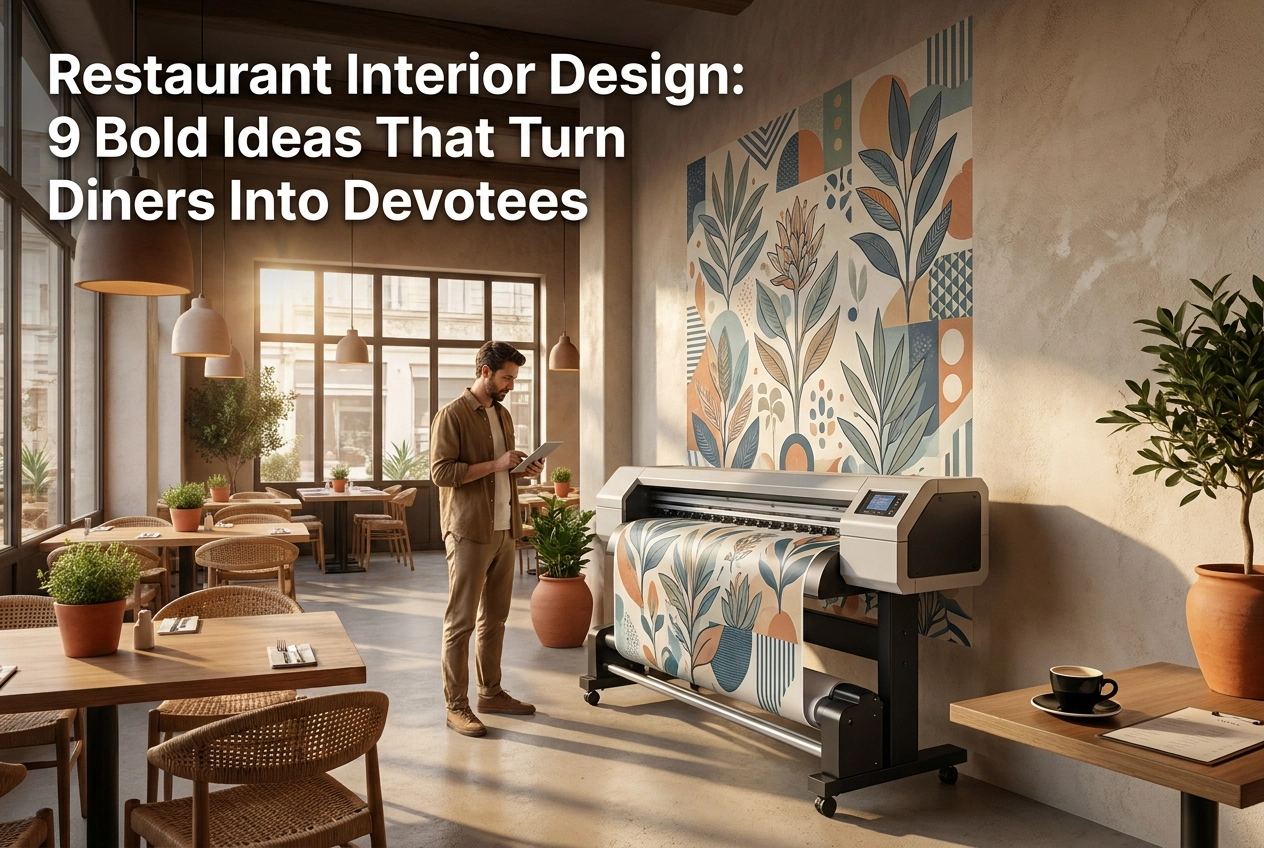
Now visualise this. Take that one empty wall in your dining room, the flat, forgotten one that nobody looks at twice. Imagine it transformed overnight into a floor-to-ceiling, edge-to-edge artwork at photographic resolution. No frames interrupting the image. No seams breaking the composition. No hanging hardware, no peeling edges, no joins. Just an unbroken visual field that your regulars will walk in and genuinely not recognise. That is what direct-to-surface UV printing at 2400DPI delivers, applied directly to your existing wall using CMYK colour technology that achieves saturation levels, contrast depth, and fine detail that paint effects, wallpaper panels, and hanging canvas simply cannot match. Those conventional treatments look visually thin once you have seen what UV-cured printing produces at this resolution. The difference is not subtle.
2026 restaurant interior design trends are unanimous on one point: flat walls are finished. The venues gaining ground this year are the ones whose walls do the work.
Biophilic Design: Bring the Outside In Without the Maintenance
Biophilic design has been confirmed as one of the defining commercial interior movements of 2026, and restaurants are ground zero for its adoption. Diners are actively seeking environments that feel restorative rather than transactional; spaces that connect them to something calmer, greener, and more elemental than the urban surroundings they arrived from. The industry has moved decisively away from the cold, minimal "gray era" interiors that dominated the last decade, pivoting instead toward earth-rooted, nature-anchored spaces that actively support guest wellbeing. For restaurant owners, this is not an abstract trend. It is a direct response to what customers now expect when they choose where to spend their money.
The practical challenge with biophilic design has always been cost and upkeep. Live plant walls require irrigation, specialist lighting, and regular horticultural maintenance. Grow-light systems consume energy continuously. Moss installations fade. Real greenery wilts under kitchen heat and humidity. The solution that sidesteps every one of those problems is printing botanical environments directly onto your walls. Forest canopies, coastal panoramas, wildflower meadows, and dense rainforest scenes, all rendered at extraordinary fidelity, deliver the full visual and atmospheric impact of a nature-connected environment with zero ongoing maintenance costs. Wall art trends for 2026 confirm that botanical and landscape formats are among the most commercially sought-after wall treatments this year, precisely because the format resolves the maintenance problem completely.
Close your eyes. Picture floor-to-ceiling ancient woodland running the full length of your restaurant's longest wall. Every vein in every leaf rendered in 2400DPI UV-cured clarity. Light filtering through a canopy so convincingly detailed it reads as a physical environment rather than a decorative surface. Diners will instinctively settle. Conversations will soften. Phones will come out. Spring 2026 wall mural styles are already showcasing exactly this category of immersive botanical installation as a leading format for commercial spaces, and the reason is simple: at this resolution, the scene feels present rather than printed.
Murals as Brand Storytelling Tools
Botanical and landscape themes carry a second layer of commercial value that goes beyond atmosphere. For farm-to-table restaurants, the provenance story begins the moment a diner walks in. A printed panorama of the Yorkshire Dales, the Scottish Highlands, or a specific regional coastline communicates terroir before the menu is opened. Organic-concept restaurants can reinforce their identity through meadow and wildflower imagery that signals natural provenance at a glance. Regionally themed venues gain an instant visual anchor that no amount of framed photography can replicate. Direct-to-surface printing at 2400DPI means the micro-detail of foliage texture, water reflections, and natural light gradients is reproduced with the kind of photographic precision that makes the scene genuinely credible. The wall stops being decoration and starts being the restaurant's most persuasive brand statement.
Maximalism and Immersive Environments: Go All the Way
Biophilic design brings nature to the walls. Maximalism swallows the room whole. These are two very different moves, and 2026 is the year the hospitality industry stopped hedging and started committing to the latter with full conviction.
Vogue's 2026 interior design forecast documents maximalism and immersive environments crossing decisively from residential into commercial hospitality settings, and the momentum behind that shift is impossible to ignore. As Siren Betty Design's 2026 interior design trend analysis articulates it, "ornament is returning with intention" and "the spaces people return to are the ones that know how to hold energy." That is not a decorating tip. That is a commercial strategy framed as design philosophy.
Crucially, 2026 hotel and restaurant interior design research from Mingsun Group lists immersive and multisensory environments as the first and most dominant trend category shaping hospitality spaces this year. Not an emerging interest. A baseline expectation. Restaurants that deliver only a clean, pleasant room are already falling behind. The spaces earning repeat bookings and social shares are those that wrap diners inside a complete visual world, where the artwork is not hanging on the wall but is the wall itself.
This is where full-room direct-to-surface printing transforms the conversation entirely. Machine Canvas's UV-cured, 2400DPI technology scales seamlessly from a single feature wall to murals that span all four walls, extend across ceilings, and continue down onto the floor. Every surface becomes part of the same cohesive, bespoke composition, sized precisely to the room's exact dimensions. There is no vinyl seam to catch the eye, no wallpaper join to pull the illusion apart. The diner does not sit beside the artwork. The diner sits inside it.
Maximalism done well is not clutter. It is intentional visual abundance, a layered environment constructed so that guests notice something new on their second visit, and again on their third. That quality is what drives dwell time, repeat bookings, and the kind of organic social coverage that no paid campaign can replicate. Direct-to-surface printing is the only method that delivers this at full-room scale, with bespoke artwork and a guaranteed finish, from £250 to complete transformation. The question is not whether your restaurant can afford immersive design. It is whether it can afford to be forgettable.
Textured and Tactile Surfaces: The Depth Illusion That Changes a Room
Textured and tactile surfaces have arrived as one of the most decisive directions in restaurant interior design for 2026. Both American Tin Ceilings and Vogue's 2026 trend analysis place texture and dimensional surface aesthetics firmly at the centre of commercial hospitality interiors, and the reasoning is straightforward: guests in 2026 are not just eating, they are experiencing. As Dunne Kozlowski's layered design research confirms, spaces without dimensional depth "feel cold or impersonal," regardless of how polished the finishes are. Texture is the variable that separates a room guests remember from one they forget before they reach the car park.
Now close your eyes for a moment. Run your hand along a wall that looks exactly like aged reclaimed brick, weathered stone, or hand-carved timber relief. Feel the grain, the shadow lines, the cool suggestion of raw material. Then open your eyes, because that wall is completely flat. It is sealed, smooth, and wipes clean with a damp cloth. That is what UV-cured direct-to-surface printing at 2,400 DPI delivers. Machine Canvas prints stone, concrete, aged timber, brushed metal, woven fabric, and bas-relief textures with such tonal precision that guests physically reach out to confirm what their eyes are telling them is impossible.
The commercial logic is undeniable. Recreating a restaurant interior with genuine stone cladding, reclaimed timber panelling, or textured plaster involves specialist trades, significant lead times, and material costs that rarely survive a realistic budget conversation. Direct printing transforms standard plasterboard into a surface that reads as expensive raw material, starting from £250, with zero specialist installation required beyond the print process itself.
This approach is particularly powerful in rustic, industrial, and artisan restaurant concepts where material authenticity is not a decorative afterthought but a core brand signal. When your concept is built around provenance, craft, and honest ingredients, your walls need to carry that same story convincingly. A printed concrete wall in a craft beer taproom, or a carved-stone render in a farm-to-table bistro, does not feel like a shortcut. It feels intentional, deliberate, and entirely on-brand.
3D and Burst-Through Effects: Make Guests Stop Mid-Sentence
Here is the one area where 2026 restaurant interior design trends have left the entire industry with a completely open field. Scroll through every trade forecast, every hospitality design roundup, every surface-materials guide published this year. You will not find a single mention of 3D relief printing, burst-through wall effects, or trompe l'oeil corridor illusions. Not one. That absence is not a signal that these treatments are irrelevant. It is a signal that any restaurant commissioning them right now is operating in visual territory that none of its competitors have discovered yet.
What a Burst-Through Effect Actually Does to a Room
Close your eyes for a moment and picture this. A tiger, mid-lunge, emerging from dense jungle foliage directly above your corner booth. A wave cresting the wall plane above the bar, frozen at the exact point of breaking. A vintage locomotive punching through a brick surface at the far end of the dining room, headlamp blazing, smoke trailing across the ceiling. These are not flat prints. Burst-through designs use advanced perspective rendering and UV-printed depth cues to create the convincing illusion that elements of the artwork are physically projecting out of the wall surface. The effect at 2,400 DPI is not decorative. It is visceral. Guests do not look at it; they react to it.
The Spatial Trick That Makes Small Dining Rooms Feel Monumental
Perspective illusion and trompe l'oeil corridor effects solve a problem that costs restaurant operators real money: the compact dining room that feels cramped before a single cover is seated. A correctly designed architectural perspective illusion printed directly onto a facing wall does not merely suggest depth; it creates it, tricking the eye into reading an additional ten or fifteen feet of space that does not exist. A spatial liability becomes an architectural talking point. Guests photograph it. They describe it to friends. They specifically request to be seated near it.
The Wall That Pays for Itself
The moment a guest pulls out their phone before they have touched the menu is the moment the wall is paying for itself. Burst-through and 3D relief treatments are consistently the most photographed wall treatment in any commercial dining environment that commissions them, generating unprompted social content that no paid campaign can reliably replicate. Machine Canvas has a documented portfolio of 3D safari murals, floral burst-through effects, and architectural perspective illusions delivered into exactly these kinds of commercial environments, with work starting from £250 and backed by a five-year interior guarantee. The trompe l'oeil tradition has over 500 active pins being curated right now in 2026, confirming the appetite. Your restaurant could be the place people are pinning.
The Instagrammable Restaurant: Design as a Marketing Budget
Momentum's 2026 hospitality forecast is unambiguous: restaurants are expected to deliver visually memorable environments as a baseline commercial requirement, not a luxury upgrade. The commercial logic sitting underneath that expectation is even more compelling. A paid Instagram campaign buys impressions once, from a defined budget, against an algorithm that deprioritises brand content by default. A striking interior earns impressions continuously, from every diner who pulls out a phone, and that content carries something no paid ad can manufacture: personal social endorsement.
The Big Mamma Group built the clearest available proof of this thesis. Their maximalist interiors, saturated colour palettes, theatrical crockery and deliberately over-designed environments turned paying guests into unpaid content creators at scale. The result was documented in their financials: turnover grew from approximately £26 million in 2022 to £40 million in 2023. That is not a brand story. That is a P&L argument for treating your walls as marketing infrastructure.
The mechanism behind those numbers is worth understanding precisely. Every diner who photographs a striking wall and shares it delivers a word-of-mouth endorsement to their entire social network, typically with a location tag attached. Instagram and TikTok surface location-tagged content to local users through their discovery and explore functions, meaning a single well-photographed post can reach hundreds of prospective diners who have never heard of the restaurant. According to 26 restaurant marketing ideas for 2026 that actually drive revenue, the National Restaurant Association's research confirms that guest experience outweighs price as a retention driver for the majority of diners. The visual environment is a core component of that experience stack.
The design brief for a wall that performs commercially is specific. It must be visually arresting at phone-camera distance, communicate something without requiring explanation, and look more compelling in a photograph than anything else in the frame. Bold colour contrast, narrative depth, and a subject with genuine visual authority are non-negotiable. This is precisely where direct-to-surface printing at 2400DPI with full CMYK colour depth earns its position. The technology produces imagery with the kind of tonal range and fine detail that photographs exceptionally under warm restaurant lighting conditions: bold enough to cut through a crowded social feed, intricate enough to reward the closer look that turns a casual scroll into a saved post.
As restaurant promotion strategies for 2026 make clear, successful operators this year are prioritising experiences that feel personal and distinctive at a time when digital platforms are increasingly congested. The alternative is stark. Restaurants in competitive dining markets that lack a distinctive visual identity are functionally invisible on the platforms where their target customers are actively making booking decisions. Invisibility on social feeds is not a branding problem. It is a covers problem, and it compounds every week the walls stay unremarkable.
Hygiene, Durability, and Food-Safe Finishes: The Practical Reality
Every 2026 restaurant design guide you will find online has the same blind spot. The forecasts cover biophilic walls, immersive maximalism, textured surfaces, and social-media-ready interiors with genuine authority. Not one of them tells you what happens to your beautiful new feature wall when the kitchen extraction system fails for an evening, grease aerosol settles across the dining room, and your cleaning team goes in the next morning with commercial-grade degreasers. That practical silence is not a minor omission. For restaurant owners making capital investment decisions, it is the single most consequential gap in available guidance in 2026.
The commercial reality is this: hospitality hygiene standards require wall surfaces in food-adjacent areas to be smooth, non-absorbent, and cleanable. Conventional canvas art is porous. Standard wallpaper is porous at both the seam and the substrate level. Uncoated murals, whether painted or printed without a sealed topcoat, absorb moisture, trap grease residue, and degrade rapidly under the chemical cleaning cycles that any commercial kitchen or busy dining environment demands. These materials fail not dramatically but incrementally, through discolouration, bubbling, and surface breakdown that quietly destroys your design investment over twelve to eighteen months.
Why the Lacquer Seal Changes Everything
Machine Canvas's UV-cured prints are sealed with a lacquer finish that creates a genuinely non-porous, wipeable surface. That construction is resistant to grease splatter, condensation cycling, and the commercial cleaning chemicals used daily in food service environments. The lacquer seal is the critical differentiator here. It is the property that elevates a decorative wall print from artwork into a compliant food-adjacent surface finish. UV-curing also locks ink at the molecular level rather than leaving it sitting on the surface, which is why the technology resists fading, chemical degradation, and moisture penetration in ways that solvent or latex-printed alternatives cannot match. The 2026 State of the Restaurant Industry confirms that independent operators are navigating sustained cost pressure, making the longevity of every capital investment directly relevant to financial sustainability. A wall treatment that requires replacement in under two years is not a design decision; it is a recurring liability.
The 5-year guarantee on Machine Canvas interior prints is not a marketing number. It reflects the documented, real-world performance of UV-cured, lacquer-sealed printing applied at 2400DPI resolution onto properly prepared surfaces. At that resolution, substrate coverage is complete, with no micro-gaps in ink density that could allow moisture ingress over time. That guarantee is, in practical terms, a risk-management instrument for any restaurant owner who cannot afford unplanned refurbishment spend. Even low-budget restaurant interior design guidance for 2026 acknowledges that material choices define long-term operational costs, yet none of it specifies finish durability criteria.
Three Questions Every Restaurant Owner Should Ask
Before committing to any wall treatment supplier, ask three questions without exception. First: is the finish lacquer-sealed? Second: is it rated for commercial cleaning products, including degreasers and antibacterial solutions used in food service environments? Third: what is the guaranteed lifespan, and is that guarantee in writing? The answers to those three questions will filter out every surface option that looks right in a mood board but fails within a commercial kitchen's orbit. The design trends of 2026 are genuinely worth pursuing; the immersive environments, the bold feature walls, the biophilic depth. But the format in which you deliver those visuals must survive the environment you are actually operating in.
Speed, Disruption, and Cost: The Numbers Restaurant Owners Actually Need
Every design decision covered in this guide comes with a practical question that most trend forecasts never bother to answer: what does it actually cost, and how long will your restaurant be closed while it happens?
The Disruption Problem Is Real
Restaurants trade on consistency. A multi-week closure for re-tiling a feature wall, installing decorative panelling, or waiting for a commissioned hand-painted mural to be completed is not a minor inconvenience; it is lost covers, lost revenue, and a broken relationship with regulars who find somewhere else while you are shut. Traditional surface treatments demand exactly that kind of disruption. Direct-to-surface wall printing does not. Machine Canvas completes feature wall installations in a fraction of the time required by any of those alternatives, working directly onto the surface without stripping, priming, or lengthy curing windows that keep a space out of action.
The Numbers in Plain Sight
Machine Canvas direct-to-surface printing starts from £250. Hold that figure against the realistic cost of the alternatives. Re-tiling a restaurant feature wall typically runs from £500 to well over £1,500 once materials and labour are combined. A commissioned hand-painted mural in a commercial space routinely starts at £1,000 and scales to £10,000 or beyond depending on scale and the artist involved. Decorative panelling installations carry similar material and fitting costs, and large-format framed artwork sourced through trade channels adds procurement time on top of the price.
The Guarantee Makes the Maths Work Harder
The 5-year guarantee on Machine Canvas interior prints reframes the cost entirely. At the entry price point, spread across sixty months, the cost per year of a complete feature wall transformation becomes genuinely difficult to argue against. No other surface treatment at this price delivers that longevity commitment in writing.
Before any of this requires a financial decision, Machine Canvas offers a free design mock-up showing exactly what the finished print will look like on your specific wall. You see the result before a single pound is committed.
UK Restaurants, Northern Expertise, Nationwide Reach
Machine Canvas is headquartered in Lytham St Annes, Lancashire, sitting at the centre of one of the UK's most energised regional hospitality corridors. That geography is not incidental. Northern England's dining scene has spent the last decade evolving from a complement to London's restaurant culture into a genuine rival, with Manchester's Northern Quarter, Leeds' independent dining strips, and Yorkshire's rapidly expanding collection of destination restaurants all treating interior identity as a non-negotiable part of their commercial strategy. Bold visual environments are not aspirational here; they are the baseline expectation.
Post-pandemic refurbishment pressure has sharpened that demand considerably. UK hospitality operators emerged from successive closures facing a clear commercial reality: reopen faster, look better, and give people a reason to return. Traditional fit-out contractors, with their structural timelines and supply chain delays, were not built for that urgency. Direct-to-surface printing removes the bottleneck entirely, delivering a transformed interior without structural alteration, lengthy site works, or the kind of disruption that costs a restaurant weeks of trading revenue.
This matters even more when UK lease conditions enter the conversation. Commercial leases routinely prohibit structural changes, require landlord approval for significant alterations, and carry dilapidations clauses that penalise operators who leave a space in a different structural state to how they found it. A surface-applied print sidesteps every one of those constraints. The wall remains intact. The lease stays clean.
Machine Canvas serves the full breadth of the UK, from Manchester and Edinburgh to Cardiff and Cornwall, with the same 2400DPI print quality and 5-year interior guarantee applied without exception. Northern expertise, delivered nationwide.
See Your Restaurant Wall Transformed Before You Spend a Penny
Before a single penny is committed, Machine Canvas will show you exactly what your walls will look like. Submit photos of your space and receive a free design mock-up rendered at 2400DPI ultra-high-definition detail, placing your chosen effect, whether a floor-to-ceiling biophilic mural, a 3D burst-through composition, a bold feature wall, or a deep textured illusion, precisely onto your actual restaurant walls. Not a generic showroom visual. Your space, your walls, your transformation. The uncertainty that has historically stopped restaurant owners from making this move is eliminated before any financial commitment is required.
Reaching the Machine Canvas team is straightforward. Contact via WhatsApp or click-to-call for a no-obligation conversation covering the concept, the specific space, and the timeline. The conversation costs nothing and commits you to nothing.
The commercial case is equally direct. Pricing starts from £250, and every interior print is backed by a 5-year guarantee with a lacquer-sealed finish built for real hospitality environments. The risk profile of commissioning a feature wall has never been lower, particularly against the brand equity, footfall, and social media return a defined interior generates.
The restaurants that will define the UK dining scene over the next five years are being designed right now. The biophilic murals, the immersive feature walls, the effects that stop guests mid-sentence are going up on walls across the country at this moment. The question is straightforward: will your walls be part of that story?
Conclusion: Your Walls Are a Decision, Not a Default
Nine design directions. One commercial argument. A single surface that changes everything.
Bold feature walls, biophilic murals, maximalist immersion, textured illusions, 3D burst-through effects, Instagrammable environments, food-safe durability, cost efficiency, and UK-specific expertise. Every direction covered in this guide points to the same conclusion: in 2026, a restaurant's visual environment carries the same commercial weight as its menu. Diners choose with their eyes before they order with their mouths, and the walls are the highest-leverage surface you control.
Here is your actionable step. Walk your restaurant today. Photograph every wall. Ask one question about each: is this surface earning its place? If the answer is no, or even hesitant, request a free design mock-up from Machine Canvas. There is no commitment, no cost, and no risk. Transformation starts from £250, with a rendered 2400DPI preview showing exactly what your space will become before any work begins.
The UK dining market is intensifying. The restaurants that will stand out are not waiting for a full refit budget. They are making deliberate decisions, wall by wall, right now.