There is something deeply satisfying about pressing an inked surface onto paper and lifting it to reveal a crisp, bold image beneath. Relief printing is one of humanity's oldest mark-making traditions, yet it remains one of the most relevant and exciting techniques in contemporary art and interior design. From the woodblock prints of ancient China to the jaw-dropping hand-printed wallpapers transforming homes across modern Britain, this craft has never lost its power to captivate.
In this tutorial, we will trace that remarkable journey and put the knowledge directly into your hands. You will learn the core principles that underpin every relief printing method, understand the materials and tools that produce professional results, and discover how contemporary British artists and designers are scaling these techniques to create truly spectacular printed walls. Whether you have already experimented with linocut or you are ready to push your practice into ambitious new territory, this guide will sharpen your understanding and expand what you thought was possible. Relief printing is not simply a historical curiosity; it is a living, evolving craft with enormous creative potential.
What Relief Printing Actually Means
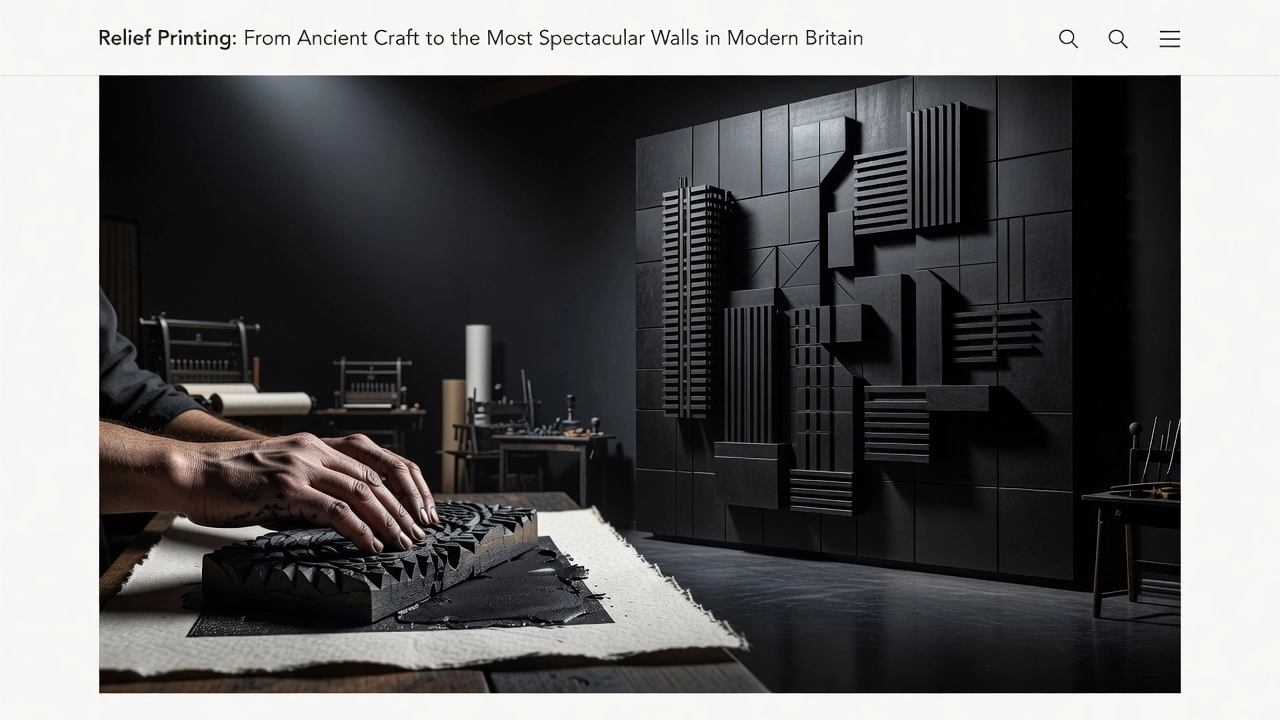
At its most fundamental, relief printing is a technique in which ink is transferred from the raised portions of a carved or cast matrix onto a receiving surface through direct contact pressure. The artist removes material from the block, whether wood, linoleum, or metal, so that only the design elements remain elevated above the carved recesses. Ink is rolled or pressed onto those raised areas exclusively; the cut-away channels receive none, and appear as white space in the finished print. Every mark, every edge, every contour in the final image originates from something that physically projects outward. This is not a metaphor. It is the mechanical logic of the oldest printing tradition in human history, and it produces something no flat-plane method can replicate.
The four canonical forms share this logic absolutely. Woodcut, the most ancient of the group, cuts design elements into side-grain planks using steel gouges and knives. Linocut substitutes linoleum as the matrix, a medium adopted as a serious fine-art vehicle by the German Expressionist group Die Brücke between 1905 and 1913. Wood engraving, credited to Thomas Bewick in Newcastle in 1768, works on dense end-grain boxwood with fine metal tools, achieving extraordinary tonal delicacy. Letterpress, the form that transformed Western civilisation, transfers ink from raised metal or wooden type onto paper at industrial scale, a technology that underpinned every printed text from Gutenberg's Bible onward. Different materials, different scales, identical principle: only the high ground carries the image.
The historical reach of that principle is staggering. Conceptually, it begins with prehistoric handprints pressed in pigment onto cave walls, the raised palm acting as the matrix itself. Practically, it formalises in Han Dynasty China around 200 AD, where woodblock printing enabled the mass reproduction of religious and cultural texts. Movable type followed in China around 1041 CE. By the fifteenth century, Gutenberg's press carried the technique into Europe as a mass-communication engine, and by the twentieth century, artists in movements from German Expressionism to American WPA printmaking had reclaimed it as a vehicle for raw emotional power.
What unites every one of these forms is the dimensional relationship between image and surface. Intaglio holds ink in recessed grooves. Lithography and screen printing operate on chemically or mechanically treated flat planes. Relief printing alone makes the image project outward, and that physical projection has profound perceptual consequences. Light catches the edges of a raised surface at an angle, casting micro-shadows into recessed areas. The human visual system reads those shadows as depth, triggering the same neural pathways engaged by genuinely three-dimensional objects. A relief-printed mark does not simply sit on a surface; it appears to inhabit space, to have weight, to assert its own physical presence.
This is why the emotional impact of relief printing has always exceeded what flat methods can achieve. The response is not aesthetic preference. It is visual physics. Raised edges interrupt light. Shadow implies volume. Depth perception activates an older, more instinctive register of attention than a flat image ever can. The core ambition of relief printing, from the cave wall to the letterpress studio, has always been to make an image feel as though it genuinely exists in the physical world rather than merely describing it. Every development that follows in this guide is the evolution of precisely that ambition, pursued now at scales and resolutions the original woodblock carvers could never have imagined.
Why Our Brains Are Wired to Respond to Dimensional Design
Your brain has never been passive. From the moment light enters your eyes, your visual cortex is not recording a flat image; it is constructing a three-dimensional spatial map of everything around you. Depth perception research confirms that the brain continuously integrates multiple cues, including perspective, occlusion, scale gradients, and binocular disparity, into a rapid, automatic model of space that operates largely below conscious awareness. This is the architecture that kept your ancestors alive in complex, layered environments. And it is precisely the architecture that dimensional wall design hijacks. When a surface carries convincing depth cues, your brain does not classify it as decoration; it reads it as space. The engagement response is immediate, involuntary, and neurologically powerful in a way that a flat, uniform wall simply cannot trigger.
This impulse to manufacture depth on flat surfaces is not a modern design trend. It is one of the oldest drives in human aesthetic culture. The ancient Romans painted elaborate false columns, receding archways, and illusory garden vistas directly onto plastered walls, stretching cramped interiors into apparent grandeur. The Renaissance took the obsession to its logical extreme: Andrea Mantegna's Camera degli Sposi ceiling (1473) dissolved solid plaster into a painted oculus open to the sky, complete with figures peering down, while Andrea Pozzo's vault at Sant'Ignazio di Loyola in Rome (1694) extended the actual architecture into a painted continuation so seamless that visitors consistently misread the boundary. Trompe l'oeil, French for "deceives the eye," was not a trick. It was a civilisation-wide acknowledgement that humans are fundamentally unsatisfied with enclosed, flat surfaces.
Now picture this. You step into a corridor. The far wall does not close the space; it opens it. Perspective lines draw your eye forward into an apparent infinity of receding distance. Or picture a hotel reception where a stone archway appears to frame a sun-flooded courtyard beyond, warm light falling across worn flagstones, the suggestion of open air where a painted wall should be. Hold that image.
That feeling is commercially significant. Environmental psychology research consistently links emotionally engaging spaces to extended dwell times, heightened brand memorability, and sharply increased rates of organic social media sharing. In hotels, gyms, restaurants, and offices, a space that stops people and makes them feel something generates measurable returns: guests linger longer, staff perform better in stimulating environments, and customers reach for their phones to photograph and share what they have experienced. The global wall mural market is projected to double to USD 12.4 billion by 2032 precisely because businesses increasingly understand that spatial emotion is not a luxury finish; it is a commercial instrument.
The Modern Evolution: UV-Cured 3D Relief Printing on Walls
Traditional relief printing placed a carved matrix between the artist and the final surface. Every mark required a physical intermediary. The modern successor to that technique removes the intermediary entirely, and what replaces it is something that would have seemed implausible to even the most forward-thinking printmaker of a century ago.
From Carved Block to Robotic Print Head
Today's direct-to-surface UV printing operates on a principle that mirrors the logic of relief printing while discarding its physical limitations entirely. Instead of a raised block transferring ink through contact pressure, a robotic print head traverses the wall surface in precisely controlled passes, depositing UV-curable ink in layered sequences that build dimensionality without any physical raised substrate. The process is entirely digital from file to finished wall. No plate, no matrix, no intermediate transfer medium of any kind. The wall itself becomes the receiving surface, and the depth is created not by carving away material but by encoding it into light and ink.
The Chemistry Behind the Finish
Understanding why UV-cured prints perform so differently from conventional painted or pasted wall finishes requires a brief look at the chemistry involved. When ultraviolet light hits UV-curable ink immediately after deposition, it triggers a photopolymerisation reaction: the photoinitiators within the ink absorb UV energy and initiate rapid crosslinking between monomer and oligomer molecules, forming a dense, solid polymer network bonded directly to the surface. This is not evaporative drying, where a solvent gradually escapes into the air over hours. This is an instantaneous molecular transformation. The resulting finish is scratch-resistant, waterproof, and resilient enough for high-traffic surfaces, meeting AC4 and AC5 abrasion resistance standards that are typically demanded in commercial flooring and wall applications. It is a finish built for permanence, not decoration that tolerates use grudgingly.
The Illusion of Physical Depth at 2400 DPI
Close your eyes for a moment and picture a stone wall with ivy growing from it, the leaves casting soft shadows across the mortar lines, the closest stems appearing to lean forward into the room. Now open your eyes and consider that what you visualised was a flat surface. That is exactly what perspective mapping software achieves at 2400 DPI resolution. The system calculates precisely how light would fall, where shadows would gather, and how perspective foreshortening would alter the geometry of a genuinely three-dimensional object, then encodes every one of those cues into a single flat-surface print. Your visual cortex, drawing on a lifetime of interpreting environmental depth signals, reads the result as real projection from the wall. The resolution at which this is executed is critical; at 2400 DPI, the tonal gradations required to simulate credible shadow fall and surface texture are rendered with a precision that lower-resolution processes simply cannot achieve.
A Market Built on Serious Commercial Demand
This technology is not a niche curiosity. The global wall printing market was valued at USD 1.97 billion in 2024 and is projected to reach USD 3.86 billion by 2033, growing at a CAGR of 7.73%. The broader digital printed wall mural market sits larger still, estimated at USD 5.8 billion in 2023 and forecast to reach USD 12.4 billion by 2032. These are the figures of a mature, accelerating industry driven by commercial demand for personalisation, brand expression, and experiential interiors across hospitality, retail, healthcare, and education. Businesses are not decorating their walls. They are investing in them.
Why UV-Cured Printing Is the Sustainable Choice
The sustainability case is equally compelling. Vinyl wallcovering installation generates material offcuts, solvent-based adhesive waste, and during installation VOC off-gassing that lingers in interior spaces. UV-cured direct-to-surface printing produces none of that. No substrate is cut to size and discarded. No adhesive is applied. The UV curing chemistry itself releases no solvents into the air. For UK businesses and specifiers who are increasingly prioritising low-waste production as a procurement criterion in 2026, this distinction carries real procurement weight.
Machine Canvas is the UK specialist bringing precisely this technology to walls and floors across England, Scotland, and Wales, printing at 2400 DPI with UV-cured CMYK technology directly onto interior and exterior surfaces. This is where centuries of printmaking logic and 21st-century materials science converge into something you do not just look at. You feel it pulling you in from across the room.
Close Your Eyes. Now Picture This on Your Wall.
Close your eyes. Not for long. Just long enough to build the image properly.
You are standing in front of a wall. On that wall, a cluster of giant monstera leaves is forcing its way through cracked plaster, the fracture lines catching the painted golden light behind them. Birds of paradise rise between the gaps, their orange and violet heads backlit as though a late-afternoon sun exists somewhere inside the wall itself. Every vein on every leaf is rendered with such precision that the surface appears to cast a shadow onto itself, the kind of perceived depth your eye insists is physical even when your hand tells you otherwise. This is not a framed print. It is not a length of peel-and-stick botanical wallpaper you found at three in the morning. It is a direct-to-surface UV-cured mural, printed at 2400 DPI resolution directly onto your existing wall, and biophilic mega-floral designs exactly like this are confirmed as one of the defining interior movements of 2026 by mural and relief trend analysis for the current year.
Now move the scene. You are in a nursery. Low morning light. The wall opposite the cot carries a savannah horizon, warm ochre and dusty gold, and from that horizon a giraffe neck rises. Its head leans into the room at child eye level, close enough that the reticulated pattern of its coat is visible in detail at close inspection, each polygon of colour separated by fine cream lines. This is the image a child photographs on their first day in the room. It is the image a parent shares before they have even unpacked the boxes. It requires no frame, no fixings, no adhesive layer curling at the corner six months later. It lives in the wall, for the wall.
Take the same technology into a narrow office corridor. The walls close in, the ceiling feels low, the space communicates nothing except the distance between two rooms. Now picture a receding sequence of stone archways, each one rendered in the pale limestone of a Mediterranean courtyard, the arches diminishing in size at the precise perspective angle that signals depth to the human visual system. Painted light falls at a three o'clock angle, raking across the stone surfaces, suggesting a world that continues beyond the final wall. A distant courtyard sits at the vanishing point, composed and still, the kind of image that makes people slow their walking pace and actually look. The corridor has not been extended physically. But to every person who moves through it, it has. The wall printing service market identifies commercial spaces as one of its primary growth verticals precisely because this category of transformation cannot be achieved by any other means at this cost point.
Now place yourself in a hotel lobby. On the feature wall behind reception, a field of hexagonal forms occupies the full surface. Each hexagon appears to project outward from the wall by fifteen centimetres, its faces angled differently, each one catching a different tone of the room's ambient lighting as the day moves and the overhead sources shift. The combined effect reads simultaneously as architectural installation and contemporary art. Guests stop in front of it. They check in while looking at it. According to current wall murals market research, texture-forward geometric design is among the fastest-growing categories in the sector, driven by consumer demand for surfaces that communicate depth rather than simply filling space.
Here is the pivot you have been building toward. Every image described above, the cracked plaster botanical, the savannah giraffe, the archway corridor, the projecting hexagons, is printed directly onto the existing wall surface. None of them involve raised plasterwork, adhesive vinyl, or stretched canvas. None require a fitter to seam lengths of material in a room corner, and none will peel, bubble, or delaminate. The print is UV-cured, sealed, and guaranteed for five years on interior surfaces. The starting price sits below what most people spend on a single weekend away in a UK city. You do not need this. You simply, immediately, and very specifically want it.
Where 3D Relief Printing Is Transforming Commercial Spaces in 2026
The commercial interior design landscape of 2026 is no longer satisfied with painted walls and framed prints. Across the UK's most forward-thinking hotels, gyms, offices, schools, restaurants, and showrooms, brand-aligned spaces are being built to communicate personality through layered storytelling, subtle cues, and sensory experiences. The technology making that possible at scale, at speed, and with a permanence that traditional installation methods simply cannot match, is UV-cured direct-to-surface 3D relief printing. These are the spaces where it is happening right now.
Hotels and Hospitality
Picture the reception of a boutique hotel. Not a generic feature wall covered in repeat-pattern wallpaper with visible seams at every panel join. Instead, a full-height Art Deco botanical mural bursting from the plaster, gilded palm fronds and oversized flora appearing to project physically into the room at different depths, the whole composition lacquer-sealed and guaranteed for five years from the day it was printed. There are no adhesive failure points, no peeling corners six months into a humid season, and no replacement cycle to budget for. Guests stop. They photograph it. They tag it. That single wall becomes the hotel's most-shared social asset, anchoring brand identity at the first point of contact and costing a fraction of what bespoke wallcovering installation would demand.
Gyms and Leisure Centres
Walk onto the floor of a high-performance strength training suite where Machine Canvas has printed a stadium crowd perspective illusion across the entire floor plane. The visual compression makes the ceiling feel further away, the room feel charged, the atmosphere feel earned. Look up at the main studio wall: a UV-cured motivational mural rendered in bold CMYK contrast, geometric 3D relief effects embedded into the typography and form, every angle catching the overhead LED rigs in a way that photographs with extraordinary intensity. Members post it before they lift a weight. That wall does more for member retention and social proof than any piece of conventional gym signage ever could.
Offices and Co-Working Spaces
A blank corridor in a co-working building is one of the most wasted surfaces in commercial architecture. Replace it with a 3D trompe l'oeil forest canopy printed directly onto the plasterboard, the tree canopy receding into apparent distance, light filtering through layers of foliage rendered at 2400 DPI with the company's brand colour palette mapped subtly into the greens and golds of the leaves. Commercial interior design in 2026 increasingly demands that spaces reflect brand identity without resorting to logo saturation. A corridor like this communicates everything about a company's values: openness, growth, craft, and attention to detail. No logo required. No installation seams. No maintenance schedule.
Schools and Nurseries
In a primary school reading corner, an underwater world mural extends the room into imagined ocean depth. Sea creatures hover at different apparent distances from the wall surface, light refracts from a water surface implied above the viewer's eyeline, and the spatial effect transforms a functional corner into an immersive environment that changes how children relate to the act of reading. Environments that engage the senses, that reward curiosity with visual discovery, produce measurably different behavioural responses in young learners. Ofsted inspectors who assess early years environments are trained to notice the quality of physical learning spaces. A room like this leaves an impression that no classroom display board ever will.
Restaurants and Cafés
A 40-cover urban restaurant with a terrace wall printed with a Mediterranean hillside perspective scene does not need a seasonal refresh, a licensing agreement for the imagery, or a maintenance contractor on retainer. The Amalfi Coast is on that wall permanently, UV-cured and lacquer-sealed, requiring nothing more than an occasional wipe-down. That is not decoration. That is brand atmosphere made physical.
Retail and Automotive Showrooms
Car dealership showroom floors printed with brand-coloured racing stripe graphics and a reflective-effect UV coating transform the customer experience from the ground up. Every vehicle displayed above that floor appears to stand on a motorsport podium. The customer's eye travels from floor to car in a single unbroken visual narrative, and the prestige of the brand is communicated before a single word is spoken.
Surface Suitability, Longevity and What to Expect in Practice
If you have reached this point in the decision process, the practical questions matter just as much as the visual ones. What surfaces will actually take a UV-cured print? How long will it genuinely last? And what does the preparation process involve?
What Surfaces Are Compatible
UV-cured direct printing adheres to painted plaster, bare concrete, brick, render, MDF boarding, glass, and sealed wood. The direct-to-wall printing technology confirms reliable adhesion across drywall, sealed concrete, glass, metal, and finished wood, with the decisive qualifier being substrate condition rather than substrate type. The surface must be clean and structurally sound. It does not need to be perfectly smooth. Light, uniform texture works well. Heavily textured surfaces may benefit from a skim coat or bonding sealer applied during preparation, but that is a straightforward pre-print step, not a barrier to eligibility. The vast majority of commercial interior and exterior wall types qualify without modification.
Preparation Is Straightforward
The preparation process involves three stages: cleaning the surface, completing any structural repairs, and applying a bonding primer where the substrate requires it. No specialist substrate is installed. No permanent alteration is made to the underlying wall architecture. For leased commercial premises, this matters considerably; the surface is not damaged and reinstatement at the end of a lease does not require structural remediation. For listed buildings or heritage properties where planning consent and reversibility are active concerns, the absence of adhesives, fixings, or substrate penetration keeps the process sympathetic to original fabric. According to frequently asked questions from direct-to-wall practitioners, the pre-print check covers surface condition, spot-priming where needed, and paint sheen verification, keeping the entire preparation window tight and the disruption to a commercial environment minimal.
Longevity Against Traditional Alternatives
Standard vinyl wallcovering in high-humidity commercial environments, including kitchens, gym changing areas, and hotel lobbies with sustained door traffic, typically begins lifting at seams within three to five years. Over a ten-year window, the total expenditure on traditional wall treatments often exceeds two and a half times the original installation cost once replacement cycles, contractor fees, and business disruption are factored in. UV-cured direct printing bonds at a molecular level and is lacquer-sealed post-print, integrating with the substrate rather than sitting on top of it. Machine Canvas backs interior work with a five-year guarantee and exterior work with a three-year guarantee, providing commercial clients with a defined, contractually supported performance horizon rather than an optimistic estimate.
Maintenance and Ongoing Care
Lacquer-sealed UV-cured surfaces wipe clean with standard commercial cleaning products. They resist scuffing, moisture ingress, and UV fading in normal interior conditions. There is no re-application cycle, no seasonal replacement programme, and no specialist aftercare product required. In hygiene-sensitive environments such as healthcare facilities, nurseries, and commercial kitchens, the non-porous, disinfectant-resistant finish is a practical advantage rather than an incidental one.
Interior Versus Exterior Performance
Exterior applications use weather-resistant ink formulations sealed with a UV protective topcoat designed to resist British weather cycling, including frost, sustained rainfall, and solar UV degradation. This makes Machine Canvas's exterior capability relevant to building facades, car park walls, outdoor hospitality terraces, and public realm projects where conventional print media would degrade within a single winter season. Interior prints operate in a more controlled environment and benefit from the full colour stability range that UV-cured inks deliver, with indoor performance extending well beyond the guaranteed period under normal conditions.
How to Commission 3D Relief Printing for Your Space
Step 1: Design Consultation and Free Mock-Up
The process begins with a conversation, not a contract. Contact Machine Canvas with your wall dimensions, a brief description of the space, and a rough sense of the direction you have in mind. Whether that is a jungle burst-through effect for a hotel lobby, a geometric depth illusion for a gym floor, or a photorealistic landscape wrapping an entire office wall, the team translates that brief into a photorealistic digital mock-up placed directly onto an image of your actual wall. You see exactly what the finished relief effect will look like in your specific space, at true scale, before a single penny changes hands. This mock-up service costs nothing and commits you to nothing.
Step 2: Design Refinement and Approval
Once the initial mock-up lands in your inbox, the real creative work begins. Every variable is adjustable at this stage: the scale of the design relative to the wall, the colour palette, the intensity of the 3D depth effect, and the overall composition. Want the leaves larger, the shadows deeper, the colours shifted warmer? Those changes are made before the design is locked. The final version goes to print only when you are completely satisfied. This iterative stage is where clients routinely discover that what they thought they wanted evolves into something more ambitious, and more precise, than their original brief.
Step 3: Installation Day
On print day, the robotic print head moves across your wall surface in controlled, overlapping passes, depositing UV-cured ink layer by layer at up to 2,400 DPI resolution. A built-in UV lamp cures each layer the instant it is laid down, which means no wet paint smell, no drying time between passes, and no waiting around after the job is done. Surrounding surfaces are masked and protected throughout. Most residential and mid-scale commercial projects complete within a single day, and many within a few hours. The disruption is minimal compared to conventional wallpaper installation, which typically requires a decorator, multiple site visits, adhesive drying time, and inevitable seam corrections.
Step 4: Lacquer Seal and Immediate Handover
Once printing is complete, the finished surface receives a protective lacquer coat selected for the environment: matte, satin, or gloss for interior spaces; a heavy-duty weather seal for exterior applications. This is the layer that underpins Machine Canvas's five-year interior guarantee and three-year exterior guarantee. The space is ready for immediate use upon handover. No curing period, no cautionary tape, no return visit required.
Pricing and the Real Cost Comparison
Projects start from around £250, scaling with surface area and design complexity. Frame that against the true cost of conventional wallcovering: decorator day rates, material costs, repeat installation when panels peel or seams split, and the full replacement cycle that adhesive products inevitably demand. According to industry analysis of the 3D wall printing sector, demand for direct-to-surface printing has accelerated precisely because clients have calculated that eliminating the replacement cycle delivers better long-term value than a lower upfront material cost. Direct-to-surface printing is a single installation with a guaranteed lifespan, not a recurring maintenance obligation.
Contact Machine Canvas now via WhatsApp or phone to request your free mock-up. Seeing your design rendered onto your actual wall costs you nothing. It commits you to nothing. It simply shows you what is possible, and in most cases, that is all the convincing anyone needs.
Relief Printing Has Always Been About Making Images Feel Real
From the first carved woodblock pressed into cloth to a 2400 DPI UV-cured image burned permanently into a wall, the ambition behind relief printing has never shifted. It has always been about one thing: making an image feel like it belongs to physical space rather than sitting passively on a surface. That instinct is as old as the handprint pressed into cave stone at Chauvet 30,000 years ago, and it is as current as the 3D burst-through murals being commissioned across UK hotels, gyms, offices, and schools right now.
The practical reality is simpler than most people expect. Direct-to-surface UV relief printing works on most interior and exterior surfaces, requires no specialist substrate, starts from £250, and carries a five-year guarantee on interior work. A free photorealistic mock-up is available before any commitment is made.
Now picture the blank wall you walk past every day. Picture what it could hold. The distance between those two images is a single free consultation. Request your free mock-up from Machine Canvas today.
Conclusion
Relief printing is far more than a historical curiosity. It is a living, evolving craft with the power to transform both your creative practice and your physical spaces. Throughout this guide, you have discovered the rich lineage behind the technique, mastered the essential tools and materials, and seen how contemporary British artists are scaling these methods into breathtaking wall installations.
The key takeaways are simple: start with strong fundamentals, choose quality materials, embrace the beautiful imperfections that make hand-printing unique, and never underestimate the impact of bold, repeated pattern at scale.
Now it is your turn. Gather your tools, choose your surface, and make your first mark. Share your results with the growing community of relief printers pushing this ancient craft forward. Your most spectacular wall is waiting to be printed.