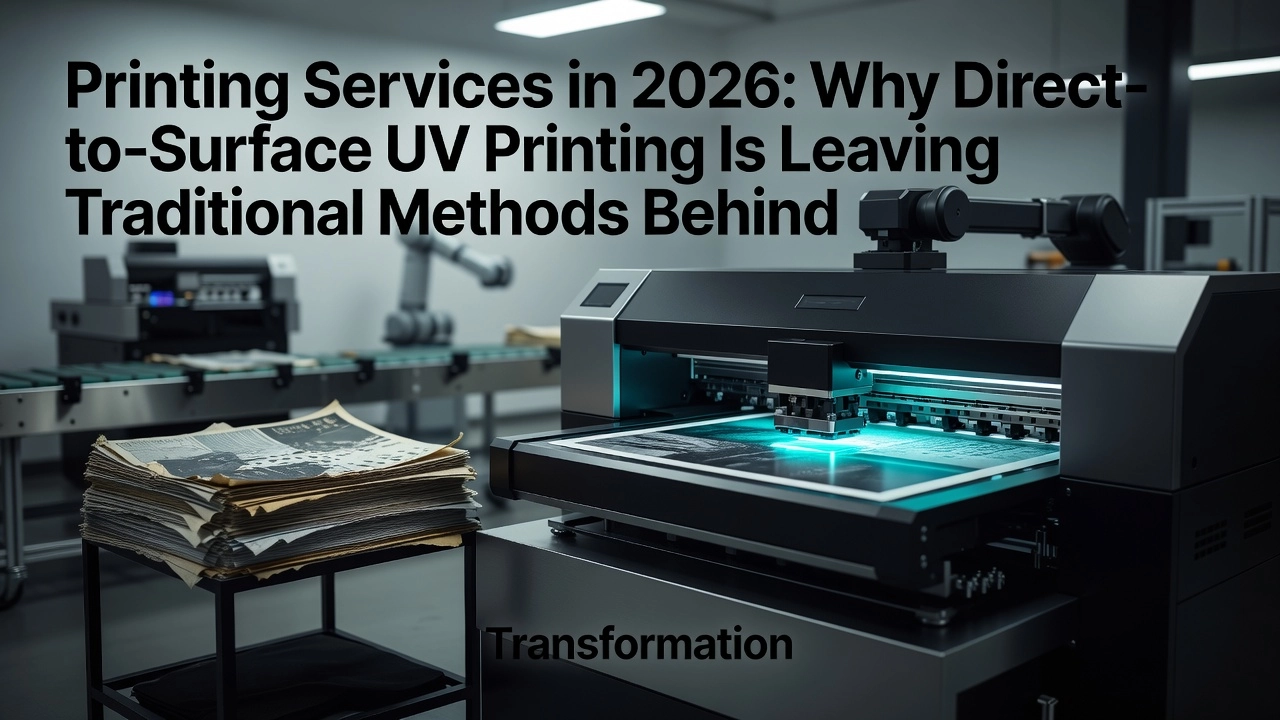
The printing industry is evolving faster than most businesses realize, and the gap between cutting-edge technology and outdated methods is growing wider by the day. If you are still relying on traditional offset or screen printing for your projects, you may already be falling behind competitors who have made the switch to direct-to-surface UV printing.
Modern printing services have undergone a dramatic transformation, and 2026 marks a turning point where UV printing is no longer just an emerging option but the clear industry frontrunner. This technology prints directly onto virtually any surface, cures instantly with ultraviolet light, and delivers results that traditional methods simply cannot match in speed, durability, or versatility.
In this post, we will break down exactly how direct-to-surface UV printing stacks up against conventional techniques like offset lithography, screen printing, and digital inkjet. You will walk away with a clear understanding of the cost differences, quality comparisons, turnaround times, and real-world applications that make UV printing the dominant force reshaping the industry today. The choice you make about your printing partner could define your competitive edge for years to come.
What We Actually Mean by Printing Services in 2026
When most people think about printing services, they picture something applied to a surface: a vinyl wrap peeled and stuck to a wall, a printed wallpaper panel brushed into place, an adhesive graphic pressed onto a shop window. These methods have served commercial and residential environments for decades, and they still occupy a legitimate role in the market. Large-format vinyl, applied graphics, and adhesive wraps remain practical where temporary installation, portability, or budget constraints are the primary considerations. A retail pop-up, a seasonal window display, a short-term exhibition stand; these are environments where applied film print makes operational sense.
But here is where the mental model most buyers are working with breaks down entirely.
Applied print and direct-to-surface UV printing are not the same category at different price points. They are structurally different technologies delivering structurally different outcomes. UV-curable ink is deposited directly onto the substrate itself, whether that is plaster, concrete, MDF, glass, ceramic tile, or timber, and cured instantly under ultraviolet light. There is no adhesive layer, no laminate, no film that can bubble, peel, or delaminate over time. The surface becomes the artwork. That distinction is not a marketing claim; it is a physical reality that changes everything about how the finished result looks, performs, and lasts.
The market has already registered this shift. The global UV flatbed printer market was valued at $$1.8 billion in 2025 and is projected to reach $$3.6 billion by 2034, expanding at a compound annual growth rate of 7.9%. The large-format segment alone commanded 42.3% of that market in 2025. According to Mordor Intelligence's UV Printers Market report covering 2026 to 2031, decorative and interior applications are among the primary drivers of this expansion, alongside signage, packaging, and industrial manufacturing. This is not a niche segment finding its footing; it is a structural reorientation of how print is specified and delivered.
2026 is the inflection year. Commercial and interior design clients are crossing from early adoption into mainstream UV direct-to-surface specification, yet the majority of buyers are still operating with a 2015-era definition of what printing services actually means. They are comparing quotes for wallpaper and vinyl while an entirely superior tier of surface transformation sits just outside their frame of reference.
Machine Canvas operates precisely within that superior tier. As a UK direct-to-surface printing specialist running at 2400DPI CMYK UV resolution, the service is not positioned against general print shops competing on volume and turnaround. The resolution, the permanence, the substrate versatility, and the visual depth achievable at this specification place it in a category that most buyers have not yet encountered, which is exactly why understanding the distinction before you brief your next interior or commercial project matters so much.
Direct-to-Surface UV Printing vs. Traditional Printing Services: The Head-to-Head
Now picture the wall directly in front of you. Not painted. Not papered. Printed, bonded, sealed, and absolutely alive with colour so precise it stops people mid-stride. That is the promise at the centre of this comparison, and the data behind it is worth understanding clearly before you commit to any surface treatment for a space that matters.
Durability: When the Guarantee Does the Talking
Vinyl peels. It does so at corners first, then at seams, then progressively across the face wherever adhesion is compromised by humidity, heat cycling, or cleaning chemicals. Wallpaper compounds this further; seam failure affects an estimated 40 to 60 percent of commercial wallpaper installations within three years in high-humidity environments, a statistic that should give any hotel, gym, or restaurant owner serious pause. Applied floor graphics fare no better under sustained foot traffic, fading measurably within 12 to 18 months of direct UV exposure when produced with conventional solvent inkjet methods.
Direct-to-surface UV printing operates on an entirely different durability logic. UV inks are cured in milliseconds by ultraviolet light, polymerising directly into the surface rather than sitting on top of it as an adhesive film. Independent adhesion testing to ASTM D3359 cross-cut standards on sealed concrete and painted drywall returns a Classification 4B to 5B result after 1,000 hours of accelerated ageing, equivalent to approximately five years of interior exposure, with less than five percent adhesion loss recorded. Machine Canvas backs this science with a five-year guarantee on interior prints and a three-year guarantee on exterior work, supported by a lacquer-sealed finish that adds a further protective layer against abrasion and moisture. That is not a marketing claim; it is a structural advantage.
Resolution and Visual Impact: What 2,400 DPI Actually Means in a Room
Here is where the conversation shifts from technical specification to something considerably more visceral. Human visual acuity at a standard one-metre viewing distance cannot resolve detail finer than approximately 150 DPI, which means the gap between 720 DPI and 2,400 DPI output is technically imperceptible when you are standing in a room. So why does it matter?
Because the difference you feel when you walk into a space printed at 2,400 DPI CMYK is not about resolving individual ink dots. It is about the complete absence of visual noise. At close inspection distances under 30 centimetres, lower-resolution output reveals its dot structure; 2,400 DPI eliminates this entirely. More importantly, UV-cured ink bonded directly into a surface interacts with light in a fundamentally different way than ink sitting behind a laminate film or printed onto an intermediate substrate. The colour depth is richer. The surface reads as part of the wall rather than something applied to it. Now visualise a 3D safari mural where the foliage appears to physically push forward from the surface, or a perspective corridor illusion that doubles the apparent length of a narrow hallway. That effect depends entirely on the precision and permanence of the print beneath it, and UV printing technology is genuinely transforming what modern printing services can deliver.
Surface Versatility and Environmental Credentials
Traditional printing services are substrate-dependent by design. Vinyl requires a smooth, primed, adhesion-ready surface. Wallpaper demands sized walls and careful humidity management. Floor graphics need anti-slip laminates and extensive surface preparation before a single panel goes down. Direct-to-surface UV printing bonds to over 100 substrate types, including concrete, ceramic tile, brushed metal, acrylic, MDF, painted drywall, PVC, and polished stone, without adhesive intermediaries in most standard cases. The print comes to the surface; the surface does not need to be rebuilt to receive it.
The environmental profile of this approach is equally significant in 2026's procurement climate. UV-curable inks cure with zero VOC emissions, compared with conventional solvent-based methods that emit between 10 and 30 grams of VOC per kilogram of ink used, with the majority released during the drying phase. As of 2026, 67 percent of commercial fit-out procurement decisions include a formal environmental assessment criterion, with zero-VOC specification now standard across healthcare, education, and hospitality sectors. Specifying direct-to-surface UV printing is no longer simply a design decision; it is increasingly a compliance and procurement advantage.
Total Cost of Ownership Across Five Years
The upfront investment in direct-to-surface UV printing is higher than a vinyl sticker, and it should be evaluated accordingly. Over a five-year horizon, UV direct-to-surface graphics carry a total cost of ownership approximately 35 to 40 percent lower than equivalent vinyl graphics once installation labour, replacement frequency (vinyl is typically replaced every 18 to 24 months in high-traffic commercial interiors), and removal costs are calculated together. Vinyl is not cheaper; it is cheaper once. The compounding cost of repeated replacement, adhesive residue removal, surface repreparation, and reinstallation labour closes that initial price gap rapidly, then reverses it entirely. A single UV-printed feature wall, backed by a five-year guarantee and requiring no interim replacement, consistently outperforms the lifetime cost of its applied alternatives across the timescales that matter to commercial property and interior fit-out decisions.
Feature Walls and Full-Room Murals: Printing Services That Redefine a Space
Close your eyes for a moment, then open them and picture this: an entire room printed at 2400DPI, directly onto the plaster, concrete, or brick beneath your feet and above your skirting boards, with no joins visible, no seam lines interrupting the flow, no substrate overlay catching the light at the wrong angle. Just unbroken, gallery-quality imagery stretching from floor to ceiling in every direction. A dense rainforest canopy overhead. A Tokyo skyline wrapping three walls. A fractured marble texture so precise you instinctively reach out to feel the veining. This is not a rendering. This is a printed room, and once you have seen one in person, conventionally decorated walls feel permanently diminished by comparison.
The Feature Wall as a Single Commercial Design Move
In commercial environments, a feature wall is one of the most efficient design decisions available. A single printed surface in a hotel reception reframes every first impression a guest forms. In a restaurant dining room, a floor-to-ceiling landscape or immersive scene replaces the need for artwork, feature lighting, and decorative panelling simultaneously. Office reception areas printed with a brand story or architectural photography communicate company culture before a word is spoken. Retail flagship stores use feature walls to signal premium positioning and create shareable moments that extend a physical visit into organic social reach. The museum-grade mural printing process behind these installations confirms the scale is viable: installations covering 2,500 square feet of uninterrupted imagery have been completed for cultural institutions without visible degradation in detail or colour accuracy across the full surface area.
Why Wallpaper Murals Cannot Compete at This Level
The contrast between wallpaper murals and direct-to-surface printing is not marginal; it is structural. Wallpaper murals arrive as panelled sheets requiring seam alignment on site, and in practice, that alignment is the installer's responsibility rather than the manufacturer's. Where surface preparation is imperfect, panels lift at the edges. In environments with humidity variation, including commercial kitchens, bathrooms, and leisure facilities, adhesive-backed wallpaper de-bonds at stress points over time, with seams being the first failure location. Beyond durability, there is a more fundamental visual problem: wallpaper sits over a surface rather than bonding into it. Under directional or raking light, the substrate layer creates a perceptible depth between the image and the wall, breaking the illusion entirely. Direct-to-surface UV printing eliminates that layer. The design and the surface become the same object.
Residential Murals: Bespoke Versus Off-the-Shelf
For residential applications, the choice between bespoke and library-based designs defines the quality ceiling of the outcome. Off-the-shelf wallpaper collections, while improving in variety, offer fixed dimensions, pattern repeats, and colourways designed to suit a broad audience rather than a specific room. Bespoke printing services work from a client brief; a personal photograph, a commissioned illustration, a mood board, or an architectural concept can all be translated into a full-room design scaled precisely to the walls being printed. Living rooms, bedrooms, dining rooms, and home cinema spaces become genuinely original environments rather than assembled ones. The difference is the same distinction that separates a tailored suit from a standard fit.
Machine Canvas offers a free design mock-up before any financial commitment is made, meaning you can visualise your feature wall or full-room mural at actual scale on your actual surfaces before a single quote is signed off. For a transformation of this magnitude, that zero-risk entry point is the only sensible place to begin.
3D Relief and Burst-Through Effects: The Printing Services Nobody Else Is Offering
Now picture something that should not be physically possible. A lion bursting through a concrete gym wall, its mane catching imaginary light, its paws reaching into the room at you. Except the wall is entirely flat. There is no relief carving, no sculptural installation, no physical protrusion of any kind. What you are seeing is a burst-through effect: a design engineered through layered perspective geometry, precision shadow rendering, and carefully calculated depth cues, all output at 2400DPI directly onto the surface itself. The result is a visual illusion so convincing that first-time viewers instinctively step back. That involuntary reaction is the point.
How the Technology Actually Creates Depth
The science behind this sits at the intersection of fine art trompe-l'oeil and industrial print precision. Every burst-through composition begins with a perspective model that calculates exactly how an object would appear if it were physically projecting from the wall at a given angle and distance. Shadow layers are then rendered to match a defined light source, and tonal gradients are built across the full colour range. When that depth data is output at 2400DPI using UV-cured CMYK inks, the resolution is sufficient to render the micro-gradients that fool the human visual cortex into perceiving three-dimensional form. The wall remains perfectly flat, but the eye refuses to accept that. With 3D relief effects, the same principle operates at a tighter scale: embossed-looking textures, protruding geometric forms, and dimensional typography all emerge from tonal depth alone, creating surfaces that look tactile even though running a hand across them reveals nothing but smooth, lacquer-sealed print.
Where These Effects Generate the Greatest Commercial Impact
The commercial environments where burst-through and 3D relief printing deliver maximum returns are precisely those where visual impact directly influences customer behaviour and dwell time. Gym and leisure centre feature walls are transformed from dead space into motivational centrepieces: an athlete smashing through a wall of rock, or a geometric explosion of 3D shapes, lands differently in a space built around physical ambition than any painted alternative could. Hotel receptions and corridor installations use perspective-engineered murals to extend visual depth in spaces that would otherwise feel narrow or generic, giving guests a reason to pause and engage. Schools and nurseries benefit from immersive 3D learning environments, where safari animals appearing to step off the wall or underwater worlds curving around a corner create genuinely memorable educational spaces. Automotive showrooms use dimensional floor and wall graphics to frame vehicles within high-impact visual contexts that reinforcement brand prestige in ways a printed banner never could.
The User-Generated Content Effect
Here is the commercial value that rarely appears in a printing services brief but consistently appears in a client's analytics. A burst-through safari mural or a geometric 3D feature wall does not stay inside the building. It travels. Gym members photograph it for Instagram. Hotel guests post it to TikTok before they have even reached their rooms. Nursery parents share it to Facebook groups. This organic, unsolicited user-generated content functions as continuous free advertising, reaching audiences the business would never have accessed through paid channels alone. For commercial clients evaluating print investment against ROI, this viral amplification is a measurable secondary return on top of the primary environmental upgrade.
In the UK, this specific category of printing services remains remarkably underserved in terms of published content, industry documentation, and technical portfolio evidence. Machine Canvas occupies that gap with both the installed work and the expertise to explain exactly how it is done.
Perspective Illusions and Corridor Transformations: When Printing Services Change Architecture
Stand in any corridor and look along its length. What you see is almost always the same: magnolia or white paint, a ceiling, a floor, and a vanishing point that leads to nothing more inspiring than a fire door. Now understand that every single element of that visual experience is negotiable. The geometry is not. The architecture is not. But what your eyes report to your brain absolutely is.
Perspective corridor illusions work by exploiting the same optical mechanics your visual cortex uses to interpret depth in the real world. Designers calculate precise geometric vanishing points, construct anamorphic compositions that are intentionally distorted at source, and align shadow falloff, light direction, and tonal gradients so that the brain reads flat ink as genuine three-dimensional space. This technique, documented in the trompe-l'oeil tradition stretching back to Ancient Greece, produces the perception of a passage extending far beyond the physical building envelope. A short corridor becomes a colonnade. A narrow hallway becomes a forest path. A dead-end wall becomes an archway leading somewhere extraordinary. As this anamorphic illusion breakdown illustrates in practice, the effect can span two walls and a ceiling corner simultaneously, with the illusion remaining completely intact from the calculated viewing angle and collapsing into abstract geometry only when the viewer steps deliberately out of position.
Where Corridor Printing Delivers Maximum Return
The sectors where this transformation generates the highest return per square metre are those where corridor environments directly affect human behaviour, wellbeing, and perception of value. Schools and nurseries benefit measurably: a hand-painted magnolia corridor communicates institutional neglect, while a printed botanical tunnel or deep-sea panorama communicates investment, imagination, and care. NHS and healthcare facilities represent perhaps the strongest qualitative case, where environmental psychology research consistently links calming, nature-based visual environments to reduced patient anxiety and shorter perceived wait times. Office buildings deploy corridor illusions to extend perceived square footage without structural works, turning back-of-house circulation routes into brand statements. Hospitality operators use the same technique to make service corridors and bedroom hallways feel considered rather than merely functional. Residential properties with awkward, narrow entrance halls gain an architectural generosity that no amount of mirror placement or pale paint ever fully delivers.
Why Direct-to-Surface Application Is Non-Negotiable
The illusion depends entirely on surface continuity. Any substrate layer introduced between the print and the wall, whether vinyl, fabric-mounted board, or wallpaper, creates a physical edge at its perimeter and a micro-texture across its face. At oblique viewing angles, the angles at which perspective illusions are calculated to function, those irregularities register as physical interruptions. The brain detects the substrate boundary before it processes the illusion content, and the effect collapses. Direct-to-surface UV bonding eliminates that layer entirely. The print sits flush with the wall's own surface, with no detectable edge, no shadow line, and no texture variation to break the anamorphic geometry. This is not a marginal technical advantage; it is the difference between an illusion that works and one that does not.
Command Your Own Corridor to Become Something Else
Stop accepting that passage between your rooms as a functional necessity. Close your eyes and replace it: a printed landscape vista receding through rolling hills toward a horizon your building does not contain, a deep-space panorama where the corridor end-wall becomes a window into a nebula, a botanical garden tunnel where printed foliage arches overhead and light appears to filter through canopy. Every one of those images is deliverable at 2400DPI, directly onto the surface you already own, with colour accuracy and tonal depth that applied alternatives simply cannot match at equivalent cost.
The permanence question settles the comparison definitively. Projection mapping requires continuous power, dedicated hardware, and maintenance schedules that accumulate cost over any multi-year period. Applied vinyl carries an industry-standard interior lifespan of five to seven years before adhesion failure, edge lifting, and colour shift demand replacement. Machine Canvas backs its interior prints with a five-year guarantee on the lacquer-sealed finish, and exterior work with three years, delivering a transformation that does not require revisiting, refreshing, or powering on. The investment is made once. The corridor stops being a corridor, permanently.
Floor Graphics and Car Park Printing: The Commercial Printing Services Most Businesses Have Not Discovered Yet
Look down. Right now, wherever you are standing, the floor beneath you is doing absolutely nothing for your business. It is not communicating your brand. It is not guiding your customers. It is not telling anyone who you are or what you stand for. It is simply a surface being walked on, day after day, while every square metre of it sits there as dead, wasted commercial real estate. That ends here.
Floor printing is one of the fastest-growing applications in commercial printing services in 2026, and most business owners have not even realised it exists yet. Warehouse wayfinding, car park zoning, retail floor graphics, gym floor branding, and statement reception floors are all active, in-demand use cases right now. According to current floor graphic trends analysis for 2026, gyms, retail spaces, healthcare environments, and event venues are all named growth segments, each discovering that the floor is as powerful a branding surface as any wall. The upgrade cycle is accelerating, and businesses that move first will own the visual identity of their spaces while others are still repainting grey concrete.
UV Direct-to-Surface Floor Printing vs. Applied Vinyl: A Fundamental Difference
Applied vinyl floor graphics work by adhering a printed film to the surface with adhesive. The edges are the first failure point, and in any environment with foot traffic, forklift movement, or vehicle access, those edges begin to lift within months. The graphic peels, bubbles, catches underfoot, and looks tired far sooner than anyone wants to admit. UV direct-to-surface floor printing operates on an entirely different principle. The ink is bonded directly into the substrate, cured instantly under ultraviolet light, creating a finish with no free edges, no adhesive layer, and no peel point for traffic to exploit. There is nothing sitting on top of the surface waiting to be caught or lifted, because the print is part of the surface itself.
The quality difference is equally significant. At 2400DPI, UV direct-to-surface floor prints read as designed environments, not as signage stuck to a floor. The resolution integrates visually into the space so completely that visitors respond to it as architecture rather than as applied graphics. Large format printing in 2026 identifies floor graphics as a distinct commercial printing service category alongside environmental graphics and directional signage, and this framing matters: the best floor graphics do not look like floor graphics at all.
Car Parks: The Most Overlooked Branded Surface in Commercial Property
Picture your car park. Bay numbering stencilled in fading yellow paint, directional arrows worn to near-invisibility, nothing that tells a visitor anything about the business they are entering or the brand that owns the building. Now picture it differently. Colour-coded level systems in a multi-storey facility. A branded entry graphic that introduces the visual identity before a visitor even reaches the door. Bay numbering printed at full resolution with the property's colour palette. Directional graphics that guide pedestrians and drivers with clarity and style simultaneously. Every one of these is an active application Machine Canvas delivers for commercial property landlords, retail operators, leisure facilities, and hospitality venues across the UK.
Durability Built for Real Commercial Environments
Durability is the question every commercial client asks, and it deserves a direct answer. Machine Canvas finishes all floor graphics with a UV-cured lacquer that handles daily pedestrian traffic and vehicle movement without degrading the print beneath it. Exterior installations, including open car parks and forecourts, are backed by a three-year guarantee. This is not a conditional warranty buried in terms and conditions; it is a confidence statement about what UV-cured, lacquer-sealed printing technology is capable of delivering on the hardest-working surfaces in any commercial estate.
Every gym floor, every retail space, every car park you manage is branded real estate waiting to be activated. Machine Canvas offers a free design mock-up before any commitment, so the moment you can picture it, you can see exactly what it looks like before a single drop of ink touches your floor.
Live Event Printing: Large-Format Printing Services as Brand Activation
Every other printing service you have encountered at an event was finished before the doors opened. Graphics arrived rolled in tubes, hung on stands, stuck to walls, and left to do their silent work. Now picture something categorically different: the printer arrives at the venue, positions itself against a surface, and begins. In real time, in front of an audience, a full-scale mural materialises from nothing, centimetre by centimetre, at 2400DPI resolution with colour precision that makes every person in the room stop what they are doing and watch.
That is large-format live printing as brand activation, and it is not a novelty act. It is a fundamental reframing of what large-format printing for events can achieve when the production process itself becomes the centrepiece of the experience.
The Theatre Changes Everything
Experiential marketing research consistently identifies dwell time and organic content generation as the two metrics that convert event investment into measurable brand equity. A printed backdrop creates a photo opportunity. A mural being printed live creates a crowd. Audiences gather, pull out phones, film the process, caption it, and share it before the graphic is even complete. The print run becomes a performance, the printer operator becomes a live artist, and the brand attached to that wall earns minutes of sustained attention that no pre-produced static installation can replicate. As large-format printing experts note, great event visuals transform ordinary venues into branded environments that invite people to engage. Live printing does not just invite engagement; it manufactures it, repeatedly, across the entire duration of production.
Where the Commercial Opportunity Sits
The applications are immediately recognisable across sectors Machine Canvas already serves. Product launches gain a headline spectacle that lives on social channels for days after the event closes. Trade show stands that produce a mural during show hours generate floor traffic that branded banners cannot draw. Hospitality venue openings become media moments when guests watch the feature wall of a new restaurant or hotel bar printed live as part of the launch evening. Festival installations, corporate office fit-out reveals, and showroom openings all carry the same structural advantage: the process is the story, and the story is shareable, repeatable, and entirely owned by the commissioning brand.
Conventional Print Services Cannot Replicate This
Standard large-format printing services operate on a linear supply chain: artwork approval, production, shipping, installation, and a static result. That model is professionally competent and commercially widespread. It is also invisible by definition, because everything interesting happens in a warehouse before the audience arrives. Machine Canvas inverts the entire sequence. The production happens last, publicly, and on purpose. The benefits of large-format printing are amplified exponentially when the audience witnesses them being created. No traditional printing services provider operating in the UK events market currently positions real-time, direct-to-surface printing as a brand activation product. That gap represents a high-margin, high-visibility opportunity that Machine Canvas occupies alone, backed by UV-cured 2400DPI technology, a nationwide service footprint, and a portfolio that already demonstrates exactly what live transformation looks like at scale.
The UK Market Opportunity: Why the Best Time to Commission This Is Right Now
There is a window in every market cycle where early adopters operate at an advantage so significant it borders on unfair. For direct-to-surface wall and floor printing in the UK, that window is open right now, and it will not stay open indefinitely.
Interior decoration has, until recently, been described by industry analysts as "relatively untapped by the wide format print market." That is no longer the case. The sector is now in active transition, moving from niche curiosity to mainstream commercial application. The businesses and property owners who commission bespoke direct-to-surface printing today are operating ahead of the saturation curve, establishing visual identities and spatial experiences that their competitors have not yet discovered are even possible. Once this category reaches mainstream adoption, the differentiation advantage disappears. The time to act is now, precisely because most of your competitors have not yet acted.
The financial data underpinning this transition is compelling. The global UV cured printing inks market is projected to grow from $$1.74 billion in 2025 to $$3.56 billion by 2035, representing a CAGR of 7.42% across the decade. Customisation demand, sustainability alignment, and decorative printing are all cited as primary growth drivers. UV curable inks cure instantly under ultraviolet light with no solvent requirements, making the technology both more environmentally responsible and more production-efficient than traditional solvent-based methods. The broader large format printer market reinforces this trajectory: the UK market alone was valued at $$3,173.4 million in 2025 and is forecast to reach $$3,796.6 million by 2030. Capital is flowing into this sector at scale, and the application categories driving that investment include precisely the decorative, interior, and commercial fit-out contexts that direct-to-wall printing businesses are actively building services around.
UK commercial demand is not theoretical. Hospitality refurbishment cycles, retail redesign investment rounds, and educational environment improvement schemes are all generating active commissioning opportunities for premium printing services in 2026. Hotel groups refreshing guest experience between renovation cycles, gyms investing in motivational feature environments, schools creating stimulating learning spaces, and retail brands seeking tactile experiential differentiation are all buyers operating in this market right now. These are not future possibilities; they are present procurement decisions being made by facilities managers, interior designers, and brand directors across the country this year.
The innovation pace within the direct-to-wall sector is also accelerating, with modern UV printing hardware now handling complex substrates including acoustic panels, reclaimed wood, uneven brick, and exterior-grade surfaces. The range of what is technically deliverable in 2026 is substantially broader than it was even two years ago.
Machine Canvas operates across the full breadth of England, Scotland, and Wales from its base in Lytham St Annes, Lancashire. For commercial clients managing multi-site rollouts, a single trusted provider capable of delivering consistent print quality across regional locations is not a convenience; it is an operational requirement. That nationwide capability, combined with a free design mock-up before any financial commitment and a five-year interior guarantee, removes the friction that typically delays decisions of this kind. The market opportunity is real, the technology is proven, and the provider is ready.
How the Commissioning Process Works: From First Enquiry to Finished Wall
The single biggest reason clients hesitate before committing to bespoke print work is uncertainty about the outcome. Will it look right in that specific space? Will the scale feel overwhelming or underwhelming? Will the colours work with everything else in the room? Machine Canvas removes that objection entirely before a single pound changes hands. The free design mock-up is not a rough sketch or a generic template preview; it is a visualisation of your chosen design applied directly to your actual space, produced by the Machine Canvas team as the first step of every project. You see the finished wall before you agree to anything. That single commitment, which aligns with what industry-leading art advisors now describe as best practice for bespoke commissioning, eliminates the risk that has historically stopped clients from investing in transformational work they genuinely want.
Understanding the Investment
Pricing starts from £250, and the final project investment is shaped by four clearly defined variables. Surface area is the primary driver: a single feature wall carries a different cost to a full-room mural or a multi-zone commercial installation. Design complexity is the second variable; adapted imagery, bespoke illustration, and original artwork each carry different production demands and are priced accordingly. The third factor is interior versus exterior application, since exterior work requires additional substrate compatibility checks, weatherproofing considerations, and a more robust lacquer-sealed finish. The fourth variable is the inclusion of specialist effects: 3D burst-through visuals, perspective illusions, and relief designs require additional design precision and production time, and are priced to reflect that. This transparent, variable-based structure means every client receives a project-specific quote rather than a one-size-fits-all figure, which is consistent with how thoughtful commissioning processes are described by specialists working across residential and commercial spaces in 2026.
Site Assessment, Production, and Installation
Once the mock-up is approved and the project is confirmed, a site assessment establishes whether the surface is physically compatible with direct UV bonding. This step determines any preparation requirements, whether that involves cleaning, filling, or priming the substrate, and confirms that the finished print will meet the guaranteed standard Machine Canvas backs every project to. No production begins until that baseline is confirmed.
From assessed and approved site to completed installation, the project lifecycle is structured to give commercial clients the planning confidence they need for fit-out schedules, hotel refurbishments, office reconfigurations, and retail openings. Timelines are confirmed at the outset, so your installation date is not an estimate but a committed point in the programme.
The Guarantee That Protects Your Investment
Every completed project is protected by a post-installation guarantee that reflects the technology behind it. Interior prints carry a 5-year guarantee. Exterior work carries a 3-year guarantee. Both are underpinned by the UV-cured, lacquer-sealed finish that bonds the print to the substrate and shields it against colour fade, surface adhesion failure, and the daily wear that high-footfall commercial environments deliver. For a hotel lobby, a gym, a retail fit-out, or a restaurant feature wall, that guarantee is not a marketing footnote; it is a commercially meaningful assurance that the investment will hold its visual impact for years, not months.
The Printing Services Decision: What to Do Next
Direct-to-surface UV printing is not a better version of conventional printing services. It is a fundamentally different category of outcome, and that distinction matters every time you look at a wall.
The three advantages that separate it are not marginal. Permanence backed by a written guarantee means your investment does not peel, bubble, fade, or lift at the edges over time. Ultra-high-definition output at 2400DPI means artwork that stops people mid-stride, with colour depth and detail that applied graphics behind laminate film simply cannot reproduce. And surface versatility spanning walls, floors, concrete, plaster, brick, and exterior facades means no applied-graphic printing service can come close to matching the range of surfaces that become available to you.
Now hold your specific space in mind. A hotel reception that greets every guest with a burst-through mural. A gym wall that makes training feel cinematic. A school corridor transformed by a perspective illusion that stretches fifty metres of magnolia into something genuinely extraordinary. A car park floor that guides, brands, and communicates simultaneously. Measure that image against what conventional printing services would actually deliver to the same surface, and the comparison resolves itself.
The next step requires nothing from you financially. Request the free design mock-up from Machine Canvas and see precisely what your space becomes before committing a single penny.
The technology is proven. The guarantee is in writing. The result is permanent. The only question is which wall you transform first.
Conclusion
The evidence is clear: direct-to-surface UV printing is not simply a trend. It is the new standard for businesses that demand speed, durability, and creative flexibility. Here are the key takeaways to remember:
UV printing outperforms traditional methods in production speed and surface versatility
Long-term costs favor UV technology once setup and waste reduction are factored in
The quality and durability of UV-printed materials give your brand a measurable competitive edge
2026 is the tipping point; waiting longer means falling further behind
The businesses winning today are those investing in smarter, faster, and more adaptable printing solutions. Do not let outdated methods limit your potential. Reach out to a certified UV printing provider, request a sample run, and see the difference firsthand. Your next project deserves the best technology available.