Most people think of a printing company as a place that churns out business cards, brochures, and banners. You hand over a file, they run it through a machine, and you pick up a stack of printed materials. Simple, right? But the printing industry is far more diverse than that narrow definition suggests, and one category of specialist is quietly transforming how businesses and homeowners think about their spaces entirely.
Wall printing has emerged as a legitimate and growing sector within the broader print world, and understanding where it fits, how it compares to traditional print services, and what it actually delivers can help you make smarter decisions for your next project. Whether you are a business owner looking to refresh a commercial space or a homeowner wanting something beyond standard wallpaper, knowing the difference between print formats matters.
In this post, we break down what defines a printing company, how wall printing specialists compare to conventional providers, and why printing directly onto surfaces offers advantages that flat media simply cannot match. By the end, you will have a clear picture of which approach suits your needs.
What Most People Mean by a Printing Company
When most people search for a printing company, they are thinking about one of three things: offset lithography for high-volume publications and packaging, digital sheet printing for shorter commercial runs, or wide-format signage for banners, exhibition stands, and PVC wraps. The British Printing Industries Federation (BPIF) tracks the UK printing sector across all of these segments, with the industry generating £13.7 billion in annual turnover, employing 93,000 people across approximately 6,800 companies. That is a substantial, well-established industry producing genuinely useful output every single day.
Wide-format and signage printing pushes the visual ambition further, creating large-scale graphics that can cover entire wall surfaces. The BPIF's quarterly Printing Outlook monitors business confidence across these segments, reflecting an industry that continues to evolve technically, particularly through the ongoing shift from offset toward digital methods. Globally, the wide-format printing market has reached $$31.2 billion, underscoring just how much demand exists for large, visually impactful printed materials.
But here is the hard ceiling that every one of these services shares, regardless of scale or technology: the output is always a thing you apply to a space, never a transformation of the space itself. A banner is hung. A PVC wrap is stretched over a frame. A mounted graphic is fixed to a wall and can be removed tomorrow. For a hotel lobby, a gym fit-out, a school corridor, or a restaurant interior where the environment must communicate a brand identity at an instinctive, visceral level, that distinction is not a minor technicality. It is the entire difference between decoration and transformation, between something placed inside a space and something that fundamentally becomes the space. According to the commercial printing market analysis from Mordor Intelligence, the sector is formally segmented by substrate, print type, and application, and every category points to the same conclusion: ink on substrate, substrate applied to surface.
What a Direct-to-Surface Printing Company Actually Does
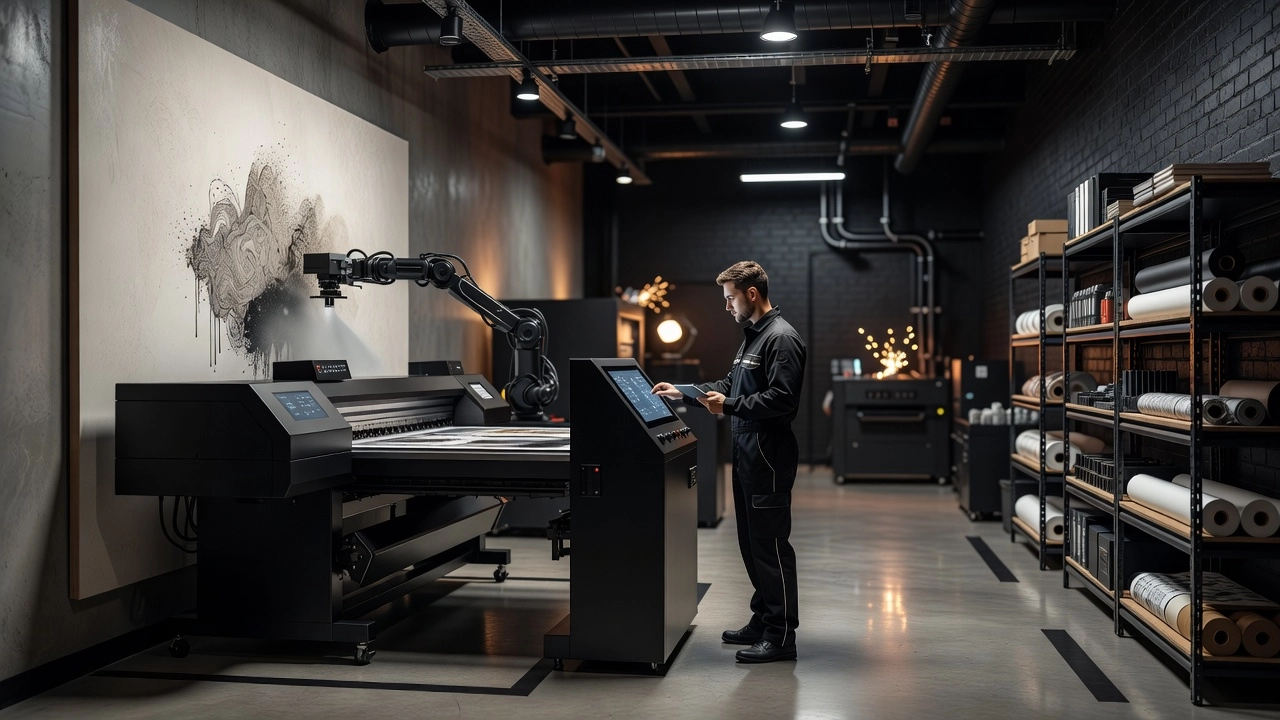
A direct-to-surface printing company operates on an entirely different principle from anything most people associate with the word "printing." Rather than producing a printed sheet, panel, or roll that gets applied to a wall afterwards, the printer itself travels across the surface, depositing UV-cured CMYK ink directly onto whatever substrate sits beneath it. No vinyl. No wallpaper. No adhesive layer between the artwork and the wall. The image becomes the wall.
Machine Canvas operates at 2400DPI resolution. At mural scale, that figure is almost difficult to comprehend until you see the results. Individual feathers on a bird rendered at ceiling height. Individual mortar lines in a trompe l'oeil brick archway. Photographic gradients that dissolve so smoothly across a ten-metre wall that the eye reads them as light rather than ink. Standing a metre away from a 2400DPI mural and searching for a pixel is a genuinely humbling experience.
The chemistry behind this matters as much as the resolution. UV-cured inks harden the instant they contact ultraviolet light, which means zero dry time on-site, zero solvent off-gassing into the room, and a finish that bonds mechanically to the substrate rather than sitting on top of it as a film. Once cured, the print is structurally part of the surface. A lacquer-sealed topcoat is then applied, creating a protective layer that backs a 5-year guarantee on interior prints and a 3-year guarantee on exterior work; figures the wallpaper and vinyl wrap markets simply cannot match.
Close your eyes for a moment. Picture a Bengal tiger stepping through the reception wall of your office building, every whisker casting a micro-shadow, fur texture rendered with the fidelity of a wildlife photograph. Now picture a floor graphic that makes visitors stop and look down before they take the next step. The process works on plaster, concrete, brick, timber, glass, and sealed floor surfaces, meaning practically any surface in any building becomes a potential canvas without structural modification. That is what separates a direct-to-surface printing company from every other print solution in the market.
Conventional Print vs. Direct-to-Surface: A Side-by-Side Comparison
The difference between these two approaches is not a matter of degree. It is a matter of category.
Substrate is where the gap opens widest. Conventional wide-format printing outputs onto paper, vinyl, or fabric, which must then be transported, stored, and physically applied to a surface using adhesives, seams, and trimming. Every additional step introduces a point of failure. Direct-to-surface printing removes every intermediate material entirely; the wall, floor, or facade is the substrate, and the ink bonds to it directly through UV photopolymerisation. No film, no sticker, no laminate, no pasting error.
Resolution at scale is where visualisation becomes unavoidable. Close your eyes and picture a floor-to-ceiling jungle mural across a twelve-foot hotel lobby wall, every leaf vein sharp, every shadow gradient clean, rendered with zero visible pixelation from any viewing distance. Conventional wide-format printing peaks at 720 to 1440 DPI effective resolution at mural scale, which often produces visible banding across large, continuous surfaces. Machine Canvas operates at 2400 DPI using UV-cured CMYK technology, holding that resolution across full room-height installations without compromise. The results are not decorations. They are environments. As explored in UV printing versus screen printing comparisons for 2026, UV printing leads decisively for large rigid surface applications and 3D effects precisely because of this technical ceiling.
Installation removes another layer of friction. Wallpaper and vinyl demand skilled hanging, adhesive management, seam alignment, and edge trimming across multiple visits. Direct-to-surface printing is a single-visit process. No adhesive residue remains on the wall. No seams interrupt the image. No edges lift six months later when humidity rises.
Durability is where the long-term argument is settled. Vinyl wraps carry no structural guarantee and are vulnerable to humidity, scuffing, and edge failure. Machine Canvas UV-cured prints are lacquer-sealed and carry a five-year guarantee on interior work and a three-year guarantee on exterior surfaces, backed by abrasion-resistant UV-cured inks that bond into the surface rather than sitting on top of it.
Application range extends the advantage further. Conventional wide-format is constrained to flat, accessible panels. Direct-to-surface printing executes on curved walls, textured concrete, outdoor facades, and high-traffic commercial floors.
Total cost over three to five years consistently favours direct-to-surface printing once installation labour, maintenance visits, and replacement cycles for peeling vinyl are calculated against a single guaranteed installation.
A Market That Is Moving Fast
The numbers behind this industry tell a story that cannot be dismissed as hype. The global direct-to-surface wall printing market was valued at USD 1.97 billion in 2024 and is projected to reach USD 3.86 billion by 2033, growing at a compound annual growth rate of 7.73%. That near-doubling over a single decade represents structural expansion, not a passing trend. The market has already demonstrated resilience, recovering from COVID-era supply chain disruption and reduced commercial spending, with demand now back above pre-pandemic levels and continuing to climb.
Zooming out to the broader digital printed wall mural category, the figures scale considerably further. That market sat at USD 5.8 billion in 2023 and is projected to reach USD 12.4 billion by 2032 at a CAGR of 8.6%, driven primarily by the accelerating demand for personalised spaces in hospitality, retail, and residential environments. Consumers and commercial specifiers alike have moved decisively away from generic decor. They want imagery that means something, surfaces that command attention, and environments that nobody else has. The Digital Wall Murals Market report from Verified Market Research reinforces this trajectory with updated projections reflecting sustained growth through 2033.
Within that broader category, the wall printer services segment, the layer of the industry closest to what operational printing businesses actually deliver, was valued at USD 276 million in 2025 and is forecast to reach USD 750 million by 2035 at a CAGR of 10.5%. That service-layer growth rate outpaces both equipment manufacturing and material supply, confirming that demand is concentrating precisely where businesses like Machine Canvas operate.
Critically, the United Kingdom is explicitly identified as a segmented geography within global wall printing service market reports. Analysts are tracking domestic UK demand as a discrete, measurable unit, which confirms that the opportunity here is structured and quantifiable rather than speculative. UV-curable ink technology, the exact process powering Machine Canvas's 2400DPI output, is now the recognised industry benchmark for direct-to-surface applications, valued for its immediate cure time, scratch resistance, and colour fidelity sustained across multi-year periods.
Who Actually Uses a Direct-to-Surface Printing Company?
The answer is: virtually every sector that controls a physical environment and understands that space is a commercial asset.
Hotels and Hospitality
Close your eyes for a moment and picture it. A boutique hotel lobby. One entire 6-metre wall transformed into a hyper-real tropical canopy, printed at a resolution so precise you can count the veins in every leaf. Guests stop walking. They pull out their phones. They photograph it, post it, tag the hotel, and repeat that action hundreds of times a week without a single penny of paid media spend. No static wallpaper has ever generated that return. A single direct-to-surface print investment becomes a perpetual organic marketing engine, and in the hospitality sector, where experiential design drives booking decisions, that is not a luxury consideration. It is a competitive one.
Gyms and Leisure Centres
A white-box gym is a missed opportunity. Now visualise a full-room mountain ridge mural wrapping three walls of a functional training space, the kind of image that makes members feel they are pushing through something real rather than staring at painted plasterboard. Interior environment directly influences how people feel about a space, how they describe it to others, and whether they renew their membership. The Wider Perspective 2025 industry survey confirms that interior rebranding is among the most actively commissioned wide-format print services, with the décor application segment growing at 12.3% CAGR, faster than any other category in large-format printing.
Offices, Corporate Spaces, Schools, and Nurseries
Reception walls printed with brand graphics or cityscapes at 2400DPI deliver a cultural signal to every visitor, recruit, and client that flat-colour paint simply cannot match. For schools and nurseries, the transformation goes further still. Imagine a 3D safari mural where animals appear to burst physically through the wall, or a perspective corridor illusion that makes a narrow hallway feel like an infinite path through a forest. These are not decorative choices; they are environmental design decisions that change how children move through, engage with, and remember a space.
Restaurants, Retail, Car Parks, and Live Events
A restaurant wall printed with a photographic vineyard scene changes the perceived quality of every dish served in front of it, and it carries a 5-year interior guarantee that no wallpaper alternative can match. In car parks and commercial floors, UV-cured graphics meeting AC4 and AC5 abrasion resistance standards are being adopted rapidly for wayfinding, branding, and safety demarcation. According to large format printing market analysis via Mordor Intelligence, retail is one of the highest-volume end-user sectors for environmental graphics, with approximately 64% of retail chains using large-format printing in-store. At the events end of the spectrum, live direct-to-surface printing at product launches and trade shows is an emerging application creating real-time branded environments that attendees cannot replicate elsewhere. Across every one of these sectors, the underlying logic is identical: the environment is the message, and a direct-to-surface printing company is the most precise tool available for controlling it.
The Service Advantage: Why You Commission Rather Than DIY
The market offers hardware-only routes for businesses that want to operate their own wall printing equipment. Commercial-grade UV floor printers start at $$3,000 and climb well past $$15,000 before a single wall is touched. That figure covers the unit alone. Add maintenance contracts, printhead replacement cycles, ink supply logistics, operator training, and the cost of downtime when something fails on a live commercial site, and the infrastructure overhead becomes substantial. For a business commissioning a feature wall or a multi-site fit-out, absorbing that overhead has no rational basis. The outcome matters; the machinery does not.
Commissioning Machine Canvas removes every one of those variables from the equation. The full project lifecycle is managed end to end: site survey, surface preparation assessment, design creation or artwork adaptation, print execution, and lacquer sealing. A client's only required input is approving the free design mock-up before any financial commitment is made. That single approval step is the entire client workload.
That mock-up offer is worth dwelling on. Before any deposit is paid, Machine Canvas produces a visual simulation showing precisely how the finished print will appear on the actual wall dimensions of your specific space. No wallpaper supplier, no signage contractor, and no UV printer equipment vendor offers pre-purchase confidence at that level. You see the result before you commit.
Pricing starts from approximately £250 for residential feature walls, with commercial projects scoped individually based on surface area and complexity. That entry point sits below most commercial interior design interventions delivering comparable visual transformation. Machine Canvas operates across England, Scotland, and Wales, meaning multi-site commercial programmes access a single specialist provider rather than coordinating inconsistent regional contractors across multiple locations.
The 5-year interior guarantee and 3-year exterior guarantee are process outcomes, not marketing language. UV-cured ink bonds directly with the substrate and becomes part of the surface itself; the lacquer seal locks that bond permanently. There is no intermediate layer, no seam, nothing capable of peeling. That durability commitment has no structural equivalent anywhere in the conventional printing company market.
Visualise Your Space Transformed: What to Do Next
The single most effective next step is one that costs you nothing. Request the free design mock-up from Machine Canvas and receive a photorealistic visualisation of your actual wall or floor, printed with your chosen design at true scale, before any commitment is made. This is not a generic template preview. It is your space, your surface, your design, rendered with the precision that 2400DPI UV-cured technology makes possible.
Reach out via WhatsApp or click-to-call for a fast project scoping conversation. Most initial enquiries move from first contact to delivered mock-up in days rather than weeks, because the process is built around speed and clarity, not drawn-out sales pipelines.
Whether your project sits in hospitality, retail, office, education, events, or residential, Machine Canvas holds active portfolio examples across every sector, each with its own distinct visual language and spatial logic.
The global wall printing market is growing at 7.73% annually because blank spaces are becoming extraordinary ones. Printing companies are everywhere. A printing company that turns your walls into something people genuinely cannot stop looking at is something else entirely, and it starts with one free mock-up.