
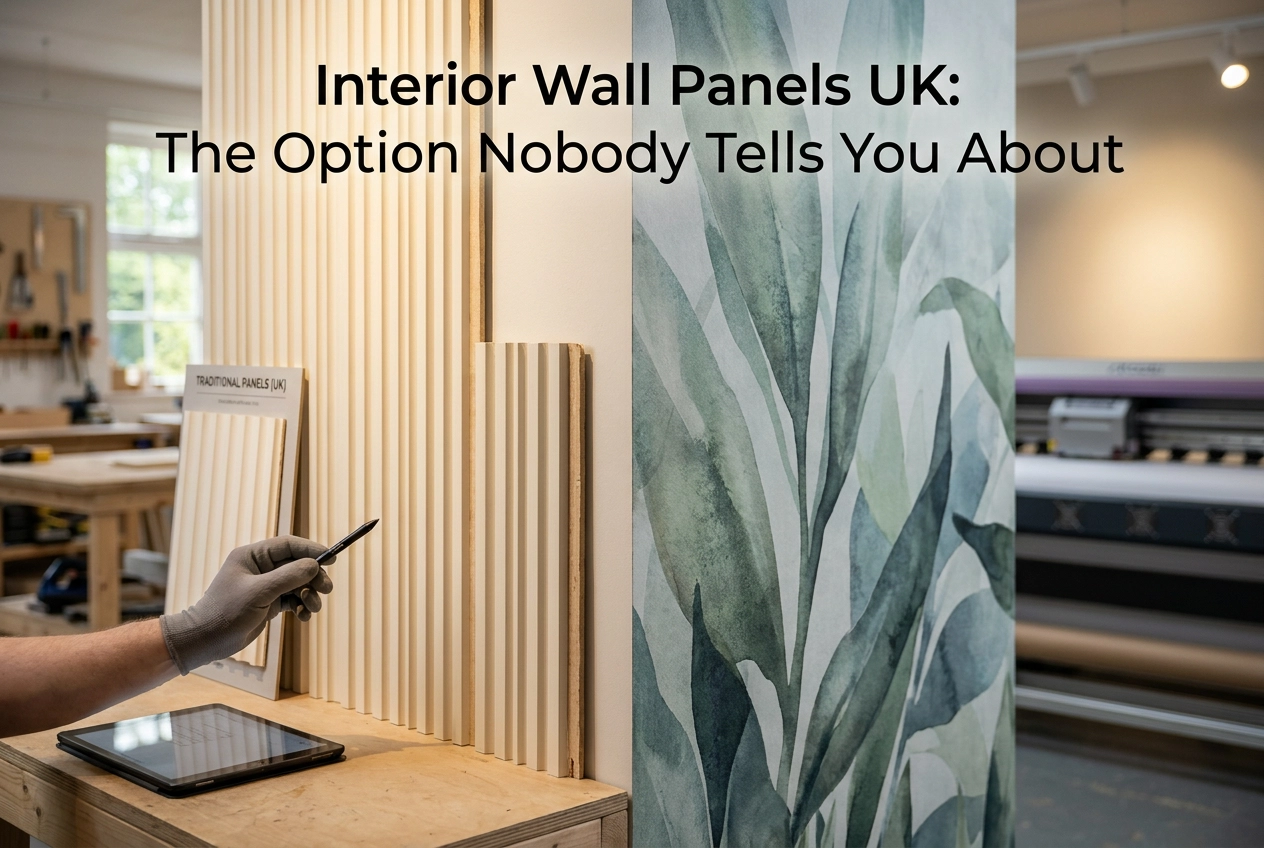
Most people searching for interior wall panels UK end up looking at the same tired shortlist: MDF, cladding, or whatever the big DIY chains happen to be pushing that month. They pick one, fit it, and spend the next few years wondering why it warps, chips, or simply fails to live up to the glossy marketing images.
Here is the truth: the UK market has expanded significantly, and there is one category of wall panelling that consistently outperforms the crowd yet rarely gets the attention it deserves. Whether you are renovating a bathroom, refreshing a living space, or tackling a full commercial fit-out, the material you choose matters far more than the design you put on top of it.
In this comparison, we are cutting through the noise. You will learn how the leading panel types stack up against each other across durability, installation, cost, and aesthetics. More importantly, you will walk away knowing exactly which option the industry insiders tend to reach for first, and why it so rarely appears on mainstream recommendation lists.
What Are Interior Wall Panels? The Conventional Market in 2026
The UK interior wall panel market arrives at 2026 with more formats, finishes, and trend-led options than any previous decade. Walk into any UK home improvement retailer or browse the leading online panel suppliers and you will encounter six dominant physical formats, each with a distinct visual character and a natural home within specific room types.
Wood slat panels feature narrow timber strips fixed to a backing board, delivering a warm, linear texture that works beautifully in living rooms and bedrooms. Fluted MDF panels present rounded or angular ridges across the panel face, available in wood-effect or paintable white finishes, making them a versatile choice for hallways and dining rooms. Shiplap uses horizontally overlapping planks with a recessed shadow line, carrying strong coastal and Scandinavian associations. Beadboard offers narrow vertical planks separated by a rounded bead detail, a traditional format beloved in hallways and period-style cloakrooms. Tongue-and-groove panels interlock via a continuous edge profile, widely used in bathrooms and kitchens for their tight, moisture-resistant joints. PVC panels bring waterproof practicality with printed marble, stone, and wood-effect surfaces, meeting demand in wet rooms and commercial washroom environments.
At the premium end of the market, 2026 interior design trends confirm a clear shift toward fluted, ribbed, tambour, and acoustic slat formats. These three-dimensional, tactile products represent the current ceiling of conventional panelling ambition, as explored in detail within the complete guide to wood wall panelling in 2026.
Residential buyers are primarily seeking decorative impact and ease of installation, and off-the-shelf formats serve them adequately. Commercial buyers are a different matter entirely. Hotels, branded retail spaces, restaurants, and offices require higher impact resistance, fire-rated substrates, and finishes that align with a precise brand identity. Mass-market panel products are not engineered to answer those demands.
Globally, the wall panel market is projected to grow at a CAGR of 11.8% from 2026 to 2033, driven by rising consumer interest in interior design and home renovation. It is worth noting that this figure represents global data; no UK-specific market size or growth rate is currently available. What it does confirm is that appetite for wall transformation is accelerating worldwide, which raises a legitimate and pressing question: in a market growing this fast, is the conventional panel actually the best the industry can offer?
The Hidden Costs of Going Conventional
The glossy product photography never shows the plasterer filling uneven patches before a single panel goes up. It never shows the adhesive cure time, the second site visit when two panels do not sit flush, or the pile of offcuts bagged for the skip. Physical wall panel installation is a construction-grade activity, consistently categorised alongside cladding and building works by UK construction intelligence trackers. A typical fitting sequence involves wall preparation, priming or damp-proofing, mechanical fixings or specialist adhesive, and finishing around every architrave, socket, and ceiling line. For most homeowners, that means coordinating a plasterer, a fitter, and likely a decorator to finish the edges. The realistic timeline from order to completed wall stretches across days, not hours.
The customisation ceiling is arguably the more damaging hidden cost. Buyers browsing the global interior decorative wall panel market, valued at $$68.4 billion in 2025, are choosing from fixed SKUs: standard widths, standard finishes, standard surface types. There is no mechanism to upload a brand logo, a bespoke landscape photograph, or a piece of commissioned artwork. The manufacturer's catalogue is the boundary of the possible. For a hotel manager envisioning a seamless feature wall that stops guests mid-stride, or a homeowner who wants something nobody else owns, that boundary is the product's fundamental failure.
The sustainability picture is equally uncomfortable. Wood panels dominate at 31.2% material share, but every panel format, including PVC, MDF, and veneer, carries a waste footprint across manufacturing, multi-leg freight, on-site offcuts, and eventual landfill disposal that is never surfaced at point of sale.
Then there is the seam problem. Every physical panel system produces visible joins, edges, and interruptions across the wall surface. Large-scale bespoke imagery, the kind that genuinely transforms a space, becomes practically impossible when every 600mm a panel edge cuts across the visual field. As the wall panel market research covering 2026 to 2031 confirms, category leaders compete on portfolio breadth and distribution speed, not personalisation. Fast shipping optimises for volume. It does not solve for vision.
The Alternative: Direct-to-Surface Wall Printing
Direct-to-surface printing is not a variation on the wall panel theme. It is a categorically different approach to wall transformation, one that eliminates the physical object entirely. The technology bonds UV-cured CMYK artwork directly onto your existing wall surface at 2400DPI resolution, with no substrate, no intermediary material, and no added layer of anything. The wall you already have becomes the canvas. What gets printed onto it is limited only by what you can imagine.
Now stop and visualise this properly. Picture a full safari scene erupting from your hotel lobby wall, with elephant trunks and acacia branches appearing to physically break through the plaster toward your guests. Picture a narrow office corridor transformed by a perspective illusion that makes the space feel twice its length. Picture a gym wall consumed by a mountain range so photorealistic that members pause mid-set to take it in. These are not renderings. These are documented outcomes that direct-to-surface printing technology delivers by treating the surface as part of the design, not merely something to decorate.
The range of achievable effects is broader than any physical panel format can match. Photorealistic landscape murals, 3D relief trompe-l'oeil compositions, burst-through artwork where subjects appear to physically project from the wall, full-room colour transformations, and bespoke branded commercial graphics are all within scope. Unlike physical panels, there are no seams interrupting a continuous image, no grout lines breaking a horizon, and no panel edges fragmenting a perspective effect.
The process also replaces an entire installation stack. As explored in this comparison of direct-to-wall printing approaches, adhesive-free direct printing is designed for occupied buildings with minimal downtime. No fixings, no surface preparation beyond the existing wall condition, and completion in a single visit by a trained print technician.
Machine Canvas, based in Lytham St Annes, Lancashire, is the UK provider delivering this technology nationwide across homes and commercial spaces. Pricing starts from around £250, and the company offers a free design mock-up before any financial commitment is required, making it straightforward to see exactly what your wall could become before spending a penny.
Interior Wall Panels vs Direct-to-Surface Printing: A Practical Comparison
Six dimensions. One clear verdict. Close your eyes for a moment and picture a wall in your home or business that stops people mid-stride, not because of a trim piece of MDF or a row of PVC planks, but because the surface itself has become a piece of breathtaking, photorealistic art at 2,400DPI resolution. Now open them, and look at the numbers.
Cost per square metre is where the conventional panel market reveals its first uncomfortable truth. PVC panels sit at the entry-level material price point, and fluted MDF sits somewhere above that, but neither figure represents your actual spend. Add surface preparation, skilled carpenter day-rates running at typical UK trade rates, adhesive or fixing hardware, priming, painting or finishing coats, and the remediation visit when two panels refuse to sit flush, and the true cost per square metre climbs considerably beyond the shelf price. Direct-to-surface printing from Machine Canvas is completed as a single mobilisation, with no fixings, no preparation materials, and no follow-up trades required. Pricing starts from around £250, and a free design mock-up is provided before any financial commitment is made.
Installation disruption compounds that cost gap in time as well as money. A physical panel project means coordinating skilled trade visits, clearing the space, tolerating on-site cutting dust, waiting for adhesive cure windows, and managing a clean-up period before the room is usable again. Direct printing is completed in hours using a mobile large-format UV print system that traverses the wall and cures ink as it moves; no structural alteration, no fixings, and no construction debris. For commercial operators, that distinction is the difference between a half-day closure and a multi-day shutdown.
Customisation capability is where the comparison becomes genuinely one-sided. Wood slat, fluted MDF, and PVC panels offer a catalogue of stock formats and pre-determined finishes; the aesthetic ceiling is set the moment the product is manufactured. Direct-to-surface printing carries no such limit. Any photograph, brand asset, architectural rendering, or bespoke artwork can be reproduced at full-wall scale with photorealistic clarity and continuous, seam-free coverage across any surface geometry.
Durability and aftercare favour direct printing in a similarly decisive way. Machine Canvas backs every interior print with a 5-year guarantee, underpinned by a lacquer-sealed UV-cured finish that is cleanable, humidity-resistant, and molecularly bonded to the wall. Typical PVC and MDF panels are subject to warping, edge lifting, moisture ingress at joints, and surface wear that ultimately demands panel replacement rather than any simple fix.
Sustainability credentials tell a consistent story. Direct printing produces no offcuts, no packaging waste, no metal fixings destined for landfill, and no replacement cycle waste. The manufactured panel supply chain, from raw timber felling or PVC extrusion through binding resins, surface coatings, packaging, and logistics, carries a substantially heavier material footprint by comparison.
Visual impact is the final and perhaps most compelling dimension. Fluted profiles and acoustic slat panels are genuinely elegant formats, but their aesthetic is fixed at manufacture. Direct-to-surface printing has no ceiling whatsoever; the output reads as part of the architecture rather than an applied layer, delivering 3D burst-through effects, perspective illusions, and ultra-high-definition imagery that no physical material can replicate. You do not hang something on the wall. You transform the wall itself into something extraordinary.
Where Printed Walls Leave Conventional Panelling Behind
Some sectors do not just benefit from direct-to-surface printing. They are defined by it.
Hotels and Hospitality Suites
A photorealistic mural printed edge-to-edge across a hotel reception wall does something that no panel catalogue can replicate: it creates an emotional response within seconds of arrival. Guests stop. They photograph it. They post it. MDF slat panels and marble-effect PVC finishes exist in the same catalogues available to every competitor hotel on the same street. A printed wall exists nowhere else on earth. For hospitality fit-outs where the brief specifies a branded lifestyle image, a location-specific skyline, or a commissioned artwork, direct printing is the only technically viable route to that outcome.
Gyms and Leisure Centres
Large-format motivational murals and immersive landscape panoramas printed across full training-floor walls generate the environmental psychology that drives member retention and daily engagement. Slat panels, however well finished, cannot carry that atmosphere. The operational case is equally compelling: Machine Canvas completes installation in a single visit, typically overnight, with no substrate build-up, no adhesive cure days, and no waste material left on site. A gym trading seven days a week loses nothing.
Offices, Retail, Schools, and Public Spaces
Office and retail fit-outs routinely specify walls carrying brand values, product photography, or wayfinding graphics supplied as artwork files. No panel SKU accommodates a client's logo treatment or campaign visual. In schools and nurseries, themed murals and educational graphics transform corridors into environments that actively engage the children using them daily. Machine Canvas backs every interior print with a five-year durability guarantee, providing the compliance confidence that facilities managers in public sector procurement require.
Portfolio Evidence That Closes the Argument
The Machine Canvas portfolio makes the capability gap concrete and undeniable. Their 3D safari murals and floral burst-through compositions use forced perspective and 2,400 DPI photorealistic depth to make walls appear to physically open into another world, an effect that is structurally impossible within any panel system. Perspective corridor illusions extend the apparent scale of tight institutional spaces through trompe-l'oeil technique printed directly onto existing plaster. Live-printed landscape murals are produced on-site, responding in real time to architectural features and lighting conditions that no factory-produced panel could anticipate. These are not finishing touches applied over a conventional interior. They are a fundamentally different category of transformation, and the wall panelling guide from Walls and Floors makes clear that conventional panels, however well specified, are material products with material limits. Close your eyes and picture that safari mural opposite your reception desk. Now picture the MDF slat alternative. The comparison ends there.
Is Direct-to-Surface Printing Right for Your Project?
Room by Room: Where Printed Walls Deliver
Start in the living room. Picture a full-width mural printed at 2400DPI, edge to edge behind your sofa, not a canvas hanging on a nail but the wall itself transformed into a scene so detailed you can count the grain in the timber or the veins in the marble. That single surface becomes the design brief for the entire room. Move to the bedroom and the principle intensifies: a floor-to-ceiling botanical print or an abstract architectural composition that makes every other design decision flow naturally from it.
Hallways deserve particular attention. Perspective illusions printed directly onto the end wall of a narrow corridor create the optical effect of a space extending far beyond its physical boundary, a technique that is transformative in the terraced and semi-detached housing stock that defines so much of the UK residential market. Children's rooms become fully immersive environments: deep-space galaxies, underwater kingdoms, ancient forests rendered in photorealistic detail that grows with the child rather than dating alongside a themed wallpaper border.
Addressing the Commitment Question
The most common hesitation is permanence. It should not be. Unlike physical panels requiring unscrewing, potential plaster damage, skip hire, and a replastering bill, a direct-to-surface print can simply be painted over when you want a change. The commitment level is comparable to choosing a paint colour, not installing joinery.
Commercial Projects Where ROI Is Clearest
Hospitality venues, retail fit-outs, and culture-driven workplaces represent the strongest commercial case. A statement wall in a bar or hotel lobby generates organic social media reach that pays for itself repeatedly. Retail environments use print to make brand identity physical and memorable. Offices deploying values-driven murals invest in environments that actively support staff retention.
The starting point for all of it is a free design mock-up from Machine Canvas, a photorealistic visualisation placed on your actual wall before any commitment is made. It removes every element of guesswork from a decision that might otherwise feel daunting. The service covers England, Scotland, and Wales in full, meaning location is never a barrier, whether the project is a Manchester hotel lobby or a rural Scottish farmhouse kitchen.
Your Wall Is Waiting. Here Is What to Do Next.
Conventional interior wall panels are a perfectly adequate product for people who want an adequate wall. For anyone who wants a wall that commands attention, starts conversations, and genuinely transforms a space, direct-to-surface printing occupies a different category entirely. The comparison is not close.
Here is what sets Machine Canvas apart, in plain terms:
2,400 DPI UV-cured print quality — photographic precision, not texture approximation or pattern repetition
5-year interior guarantee — backed by a lacquer-sealed finish that conventional panels rarely match
Single-visit installation — no return trips, no disruption, no waiting on adhesive cure times
No fixings or panel edges — the seamless result that physical panels, with their visible join lines, cannot replicate
Free design mock-up before commitment — see the finished result on your actual wall before spending a penny
UK-wide service — homes and businesses across England, Scotland, and Wales
Request your free mock-up today via WhatsApp or click-to-call. There is no obligation, no upfront cost, just your design, rendered on your wall, ready for you to approve before anything is printed.
That image you pictured at the start of this article, the wall that stopped you mid-thought, bold, immersive, impossible to ignore. It is not aspiration. It is specification. It is printable, guaranteed, and one conversation away.
Conclusion
The UK interior wall panel market is far broader than most people realise, and choosing the wrong material can cost you time, money, and considerable frustration. Here are the key takeaways: substrate quality determines long-term performance far more than surface appearance; the most heavily marketed options are rarely the best performers; and the panels industry insiders consistently choose prioritise durability and ease of installation above all else.
You now have the knowledge to make a smarter decision, one that goes beyond what the big DIY chains want you to buy.
Do not settle for a panel that looks good in a showroom but disappoints within a year. Browse our full range of high-performance interior wall panels, compare the options side by side, and choose with confidence. The right wall panel is out there. Now you know exactly where to look.