
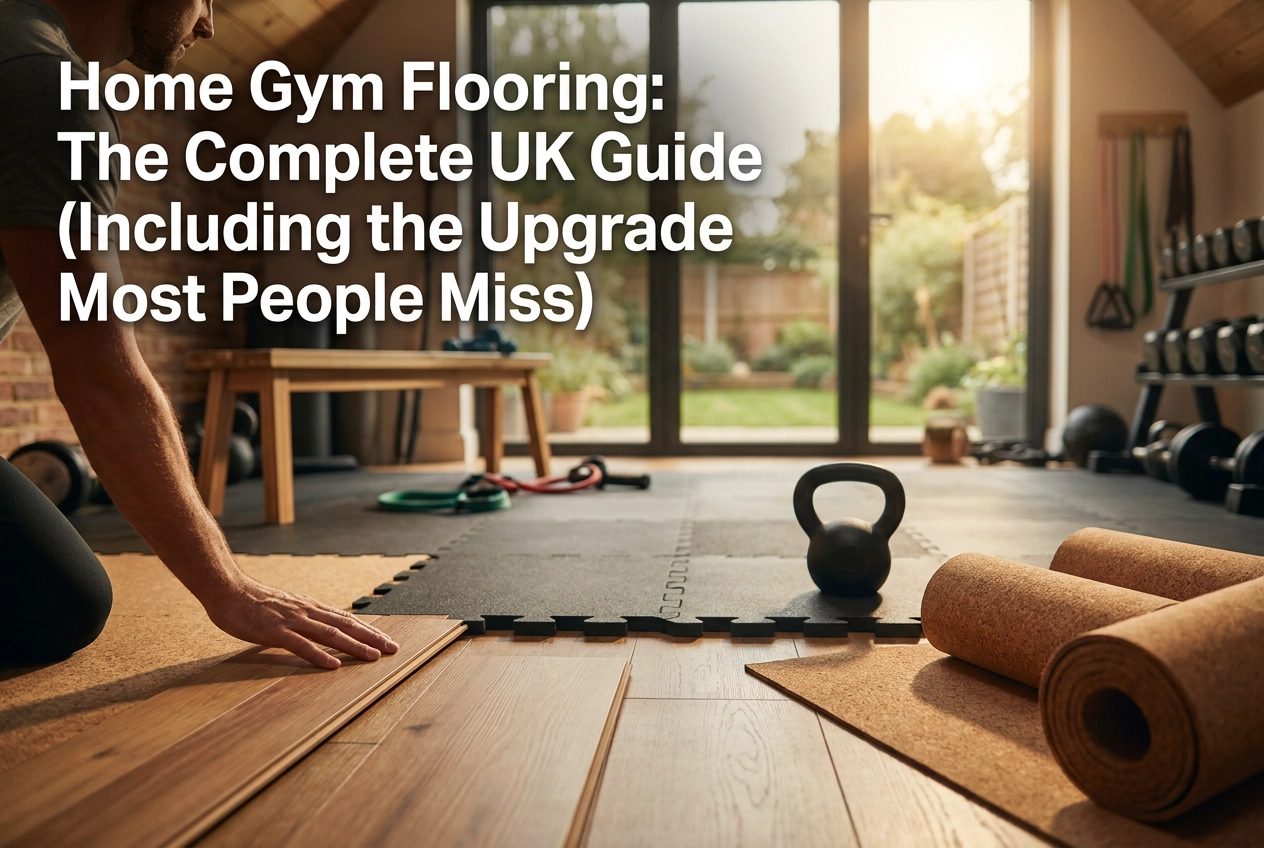
You've got the weights, the bench, maybe even a decent barbell setup. But if you're training on bare concrete or dodgy carpet, you're leaving performance on the table and probably risking your joints in the process. The foundation of any serious training space starts with what's under your feet, and yet home gym flooring is one of those things most people either rush through or completely overlook.
Here's the thing: the right flooring doesn't just protect your floor from dropped weights. It protects your knees during squats, reduces fatigue during long sessions, dampens noise for everyone else in the house, and honestly makes your setup look a lot more legitimate.
In this guide, we're covering everything you need to know to make the right choice for your space and your training style. From rubber matting and foam tiles to interlocking platforms and the one upgrade most gym owners don't think about until it's too late, we've got it all laid out. Whether you're setting up a garage gym or converting a spare room, this is the only flooring guide you'll need.
Why Your Home Gym Floor Matters More Than You Think
Let's be honest with you. Most people building a home gym spend hours agonising over the perfect barbell, debating squat rack brands, and hunting down the right bench. Then they lay down a couple of rubber mats, call it done, and wonder why the space never quite feels the way they imagined it would.
The floor is the largest visible surface in your entire gym. Every lift, every rep, every warm-up and cool-down begins and ends on it. Yet it remains the single most neglected investment in home gym design, and that gap between what people spend on equipment versus what they invest in the floor beneath it is significant.
Here is what the market data tells us: the global exercise and gym flooring market is forecast to grow at a CAGR of 9.9% between 2026 and 2033, driven specifically by rising health consciousness, the continued growth of home gym culture, and surging demand for multifunctional, visually inspiring spaces. That is not incremental growth. That is a structural shift in how people think about fitness at home.
The global sports flooring market, valued at $$12.4 billion in 2025, is projected to reach $$20.8 billion by 2034, with indoor flooring holding the dominant segment share. Consumers are already voting with their wallets for floors that perform and inspire simultaneously.
This brings us to a two-layer thesis that runs through everything in this guide. The functional layer handles impact absorption, safety, and surface performance. The design layer handles identity, motivation, and the feeling of walking into a space that actually makes you want to train. These two layers are not competing priorities. They are complementary, and the best home gyms in 2026 deliver both without compromise.
The 6 Best Home Gym Flooring Options in the UK
Let's cut straight to it. There are five solid, functional flooring options for a home gym in the UK, and one that sits in a completely different category. We'll work through all six honestly, with real recommendations, so you can make the right call for your space, your budget, and your training style.
1. Rubber Flooring Tiles
If you're serious about your training, rubber tiles are the gold standard. Full stop. They handle everything a home gym throws at them: dropped barbells, power rack feet, kettlebell swings, and the general chaos of heavy training sessions. For weight training areas, 20mm thickness is the minimum you should consider, and the Sprung PRO 20mm tile is widely cited as the highest-rated option in the UK market. Expect to pay roughly £20 to £35 per square metre from UK specialist suppliers, depending on density and thickness.
The functional case is strong across every metric. Rubber tiles absorb impact sound considerably better than hard surfaces, which matters enormously if your gym is above a living room or adjacent to a neighbour's wall. They're moisture-resistant, easy to clean, and because they interlock, you can lift individual tiles for cleaning underneath or replace a single damaged piece without redoing the whole floor. The main drawbacks are weight and initial odour. Recycled rubber tiles in particular can smell fairly strongly when new; ventilate well for a few weeks and it fades. They're also heavier to carry and install than any other option on this list, so factor that in if you're working alone in a first-floor spare room.
For subfloor compatibility, rubber tiles work well over concrete garage floors and can be laid over existing carpet in a pinch, though a flat, hard base always gives better results under heavy equipment. If you're running a power rack loaded to 200kg-plus, rubber tiles on concrete is the combination you want.
2. Foam (EVA) Interlocking Tiles
Foam tiles are the entry-level option, and they're genuinely useful in the right context. EVA interlocking tiles at 20mm thickness work well for bodyweight training, yoga, stretching, Pilates, and light cardio. They're lightweight, easy to cut with a craft knife to fit awkward shapes, and available from most UK DIY retailers for as little as £8 to £15 per square metre.
Here's where you need to be honest with yourself, though. Foam tiles are not suitable under a power rack, barbell, or any heavy free weight equipment. They compress unevenly under point loads, which can destabilise a rack, throw off your footing during a lift, and cause permanent indentation over time. If your training involves any serious iron, foam tiles are a support option at best; lay them over rubber in stretching zones or cool-down areas rather than as your primary surface.
From a noise perspective, foam offers reasonable cushioning for impact sound on upper floors, making it a reasonable choice for flat dwellers doing yoga or bodyweight circuits. It's worth noting that edges can lift over time with heavy foot traffic, so opt for tiles with interlocking borders rather than simple butt joints. For anyone building a mixed-use space on a tight budget, foam tiles in low-load zones paired with rubber tiles in lifting zones is a practical and cost-effective combination.
3. Vinyl and Luxury Vinyl Plank (LVP)
Luxury vinyl plank has earned its place in the home gym conversation because of one simple fact: it looks great. Wood-effect LVP turns a garage or spare room into a space that feels intentional rather than improvised. It's water-resistant, easy to mop down after a session, compatible with underfloor heating, and generally quieter underfoot than rubber during light exercise.
The important caveat is that LVP cannot handle point loading from gym equipment without supplementary matting. The click-lock joints that make LVP easy to install are also its vulnerability; barbell drops, rack feet, and heavy machinery can crack the planks or force the joints apart. The practical solution is to use LVP as your primary surface for cardio machines, yoga, and general movement, then place rubber mats or tiles beneath any heavy equipment. Quality LVP for gym use in the UK runs from around £15 to £40 per square metre, depending on wear layer thickness; aim for a wear layer of at least 0.5mm for durability.
For UK homes with suspended timber subfloors (common in terraced houses and Victorian conversions), LVP is a sympathetic choice because it doesn't require adhesive and flexes slightly with natural timber movement. It also photographs beautifully, which leads us somewhere interesting later in this list.
4. Gym Carpet Tiles
Carpet in a gym sounds like a terrible idea until you've stood barefoot in a cold garage in January. Specialist gym carpet tiles are a different product entirely from household carpet; they're low-pile, dense, and built for high foot traffic and equipment. They offer genuine grip underfoot, absorb airborne sound well, and provide a level of thermal comfort that rubber and vinyl simply don't match in unheated outbuildings.
UK pricing for gym-specific carpet tiles sits around £10 to £20 per square metre, making them an affordable option for larger spaces. The honest downsides are significant for heavy training environments, though: carpet absorbs sweat and moisture, which creates hygiene concerns if you're training intensively. They're difficult to deep-clean properly, and barbell drops will damage them. If your gym is primarily for cycling, rowing, cable machines, and bodyweight training rather than free weights, gym carpet tiles are a genuinely underrated choice. For a dedicated lifting room, they're not the right call on their own.
5. Cork Flooring
Cork is the most niche option on this list, but it earns its place for a specific type of home gym user. If your training is centred around yoga, Pilates, mobility work, or light cardio, cork offers natural cushioning, thermal insulation (a real advantage in UK garages and basement conversions), and antimicrobial properties that resist bacteria and mould growth. It's also one of the more sustainable flooring choices available, which aligns with a growing trend among UK consumers prioritising eco-credentials in renovation decisions.
For exercise use, 6 to 12mm thickness is appropriate, and the surface must be properly sealed to resist moisture. The critical limitation is permanent indentation under point loads; even a moderately heavy dumbbell rack will compress cork irreversibly, and it cannot be recommended anywhere near a power rack or barbell. UK pricing typically starts around £20 to £35 per square metre for sealed exercise-grade cork, and it can be harder to source than rubber or vinyl at mainstream UK flooring retailers. Think of cork as the specialist choice for a dedicated mindfulness or mobility zone rather than a general gym floor.
6. UV-Printed Floor Graphics
Now. You've sorted your floor. You've picked the right surface for your training, your subfloor, and your budget. Your gym is functional. It protects the building, absorbs impact, handles your equipment.
But here's the question none of the first five options answer: why does your home gym still look like a spare room?
This is where UV-printed floor graphics enter the conversation, and they occupy an entirely different category from everything above. This is not a structural floor. It does not replace rubber tiles or LVP. It is a design layer, applied over your existing functional surface, that transforms the visual identity of your gym from a room you work out in into a space that genuinely makes you want to train harder.
Picture a floor graphic of a competition arena, a raw concrete powerlifting platform with your name stencilled into the centre, a birds-eye city grid, or a motivational typographic design scaled to fill your entire floor space. Close your eyes and actually see it for a second. The zone demarcation of a serious facility. Your lifting platform defined in bold lines. A stretching and mobility zone with a completely different visual identity from the iron area. Interior design that would sit at home in a premium performance facility, inside your house.
Machine Canvas is a UK direct-to-surface printing company based in Lancashire that prints at 2400 DPI using UV-cured, lacquer-sealed technology, which means the finish is waterproof, durable, and backed by a five-year interior guarantee. Critically, UV-printed graphics adhere best to smooth, flat surfaces; LVP, sealed rubber rolls, and concrete are all ideal bases. Textured rubber tiles may require a rigid overlay panel first.
This is not a product you need. Your gym will function without it. But the global exercise and gym flooring market is growing at a CAGR of 9.9% through to 2033, driven significantly by demand for customisation and visually elevated spaces, and the reason for that is straightforward: people who invest in a home gym want a space that inspires them, not just one that protects their subfloor. UV-printed floor graphics are the single option on this list that answers that need directly. You can explore your options and request a free design mock-up before spending a penny, which makes it genuinely low-risk to at least see what your floor could look like. As comprehensive home gym flooring guides increasingly confirm, the aesthetic layer is becoming as important as the functional one. The question is whether you're going to act on that or keep staring at bare rubber tiles.
1. Rubber Roll Flooring
Rubber roll flooring is the workhorse of the UK home gym world, and for good reason. These are dense, heavy-duty rolls typically running from 6mm up to 15mm thick, engineered to absorb the punishment of dropped weights, heavy deadlifts, and relentless high-intensity training sessions. If you are building a serious garage gym or converting a basement into a proper lifting space, this is almost certainly the first flooring type you will encounter.
The case for rubber rolls is genuinely strong. They are durable enough to outlast most of the equipment sitting on top of them, cost-effective at roughly £15 to £35 per square metre depending on thickness and supplier, and far easier to cut around awkward corners or irregular room shapes than you might expect. They also handle moisture and most gym cleaning chemicals without complaint, which matters when you are training hard and cleaning up regularly.
The downsides are real though. A full roll is heavy, and solo installation across a large garage floor is a genuine workout in itself. Aesthetically, your options are limited: black or flecked grey, take it or leave it. Visible seam lines can break up larger rooms, and without regular cleaning, rubber can hold onto odour stubbornly.
Per this detailed home gym flooring guide from Iron Company, 8mm rolls suit most mixed-use home gyms, while 10mm to 15mm thickness becomes important once you are regularly working with heavier barbells and kettlebells. For basement installations, tape-down rolls are recommended over loose-lay to manage moisture from concrete subfloors.
Bottom line: rubber rolls are built for lifters who want maximum function and minimum fuss. They do the job brilliantly. They just will not do anything for the way your gym actually looks.
2. Interlocking Rubber Tiles
If rubber rolls are the workhorse, interlocking rubber tiles are the DIY favourite. These modular panels, available in either puzzle-edge or straight-edge formats, simply click together without a single drop of adhesive. That means you can pull them up, reconfigure them, take them with you when you move, or swap out a damaged section without touching the rest of the floor. For anyone fitting out a spare bedroom or garage without contractor involvement, that flexibility is genuinely hard to beat.
Thickness options run from around 15mm up to 40mm for serious powerlifting use, so there is a tile for every training style. Thinner options work well for cardio and bodyweight training, while the denser, high-density variants handle barbell drops and heavy rack setups without complaint. For a detailed breakdown of thickness recommendations by training type, this home gym flooring guide from Iron Company is worth bookmarking.
The honest drawbacks are worth knowing upfront. Joints between tiles collect sweat, debris, and bacteria over time, requiring consistent cleaning to keep hygiene in check. Thinner tiles can shift under lateral movement like sled pushes or HIIT drills, and premium high-density options carry a noticeably higher price tag.
Typical UK cost: roughly £20 to £60 per square metre depending on tile thickness and density.
3. Foam EVA Tiles
EVA foam tiles are the colourful, squishy, deceptively cheerful option you'll recognise immediately from school sports halls and yoga studios. They're the entry-level choice, and there's absolutely nothing wrong with that, as long as you know exactly what you're buying.
The appeal is obvious. Pricing typically runs from £5 to £20 per square metre, making them the most affordable home gym flooring category by a considerable margin. They're lightweight, interlock without tools, and you can have an entire room covered in an afternoon. For yoga flows, Pilates sessions, stretching work, martial arts practice, and children's activity zones, they genuinely deliver comfort where it counts.
The limitations are equally obvious once you understand them. As experienced home gym builders consistently point out, foam compresses under heavy loads and creates an uneven, unstable surface that becomes a safety hazard under weight racks or barbells. They slide on smooth subfloors, seams lift over time, and sharp-edged plates will eventually tear through the surface.
For a dedicated stretching corner or a kids' fitness zone, EVA tiles are a smart, budget-conscious pick. As your primary gym floor for serious lifting? Step up to rubber. That said, an interesting hybrid trend is emerging, with rubber-topped EVA foam tiles gaining traction among home gym communities looking for the best of both worlds.
4. Vinyl and LVT Flooring
LVT has quietly become one of the most visually seductive flooring options on the market, and it is easy to see why homeowners with dual-purpose spaces are gravitating toward it. Available in wood-effect planks, slate-look tiles, and abstract stone finishes, a well-chosen LVT floor genuinely looks premium in a way that a black rubber roll simply cannot match. According to Checkatrade's 2026 LVT cost guide, LVT is now one of the fastest-growing flooring products in the UK, and that appetite for elevated aesthetics is only growing.
The practical advantages are real too. LVT handles moisture brilliantly, installs easily via click-lock systems, and feels noticeably warmer underfoot than rubber, which matters if your gym doubles as a yoga or stretching space. Mid-to-premium LVT typically costs between £20 and £55 per square metre for supply, making it accessible without feeling cheap.
The limitations are important to acknowledge honestly. As this rubber vs vinyl comparison for fitness centres confirms, vinyl simply cannot absorb the shock of heavy dropped weights the way rubber can. Equipment feet will scratch and gouge the surface over time without protection underneath.
LVT works best in cardio-focused setups, treadmill and bike rooms, or any multifunctional space where visual warmth matters as much as function. Pair it with a rubber underlayer beneath heavy equipment zones and it performs significantly better.
5. Hardwood and Engineered Timber
Now we are firmly in luxury territory. Engineered timber is the flooring choice for the homeowner who refuses to let their gym look like a gym. If you have ever walked into a beautifully designed yoga studio or a high-spec Pilates space and thought "I want my home to feel like this," hardwood and engineered timber is where that feeling lives.
Engineered boards are constructed from a real wood veneer bonded to a cross-ply plywood or HDF core, giving you the genuine warmth and grain of natural wood with far superior dimensional stability. That matters in UK homes, where rooms double as gyms one hour and living spaces the next, and where humidity shifts with the seasons. Solid hardwood moves and warps under those conditions; engineered timber holds its shape. According to flooring specialists at GoFloorIt, the right gym flooring should suit the way you actually exercise, and for multi-use, aesthetics-led spaces, engineered timber delivers on both counts.
Pros: It is the most visually luxurious base flooring you can lay. It adds genuine resale value to your property. It feels warm and inviting underfoot in ways that rubber simply cannot match. And critically, it pairs beautifully with printed wall graphics or printed floor graphics for a high-end studio finish that stops visitors in their tracks.
Cons: Budget roughly £40 to £100 per square metre for boards alone, plus professional installation on top. It offers zero impact absorption for heavy free weight drops, so rubber mats over any lifting zone are non-negotiable. Moisture and sweat will damage unsealed surfaces over time.
Best suited for: Studio-style training rooms, open-plan living spaces with a dedicated workout zone, and any home gym where interior design carries equal weight to functional performance.
6. UV-Printed Floor Graphics: The Design Layer Most Home Gyms Are Missing
Every other option on this list does a job. This one changes how a room feels.
UV-printed floor graphics sit in a completely different category to everything we have covered so far. Rather than replacing your existing floor, they are applied directly onto it, transforming plain rubber, concrete, or resin into something that looks like it belongs in a professional training facility or a high-end editorial shoot. This is the design layer the home gym market has been missing, and almost nobody is talking about it yet.
Close your eyes for a second. Picture a carbon fibre grid radiating outward from the centre of your garage floor, printed at 2,400 DPI with such precision that your brain reads it as physical texture rather than a flat image. Or a topographic contour map laid across an entire training room floor in muted, ultra-high-definition tones that make the space feel like a military command centre. Now picture yourself walking into that room at 6am every single morning. The latest sports flooring trends for athletic facilities confirm that aesthetics are now treated as a co-equal priority alongside performance in professional environments. Your home gym deserves exactly the same standard.
Machine Canvas delivers this using UV-cured, CMYK, 2,400 DPI direct-to-surface printing technology, lacquer-sealed for full waterproofing and wear resistance. The finish carries a 5-year interior guarantee, meeting the durability benchmarks being cited as primary investment drivers in a gym flooring market forecast to grow at a CAGR of 9.9% through 2033. The model is elegantly simple: your rubber mat handles the deadlifts, the impact, and the grip. The printed graphic handles everything else, the identity, the atmosphere, the visual impact that transforms a converted spare room into a space you genuinely want to train in every day.
Pricing starts from £250. Before you spend a single penny, Machine Canvas provides a free photorealistic design mock-up of your exact floor. Visualise that for a moment. A photo-accurate preview of your finished gym floor, in your space, before any commitment whatsoever. That is the kind of confidence that the broader shift toward customised gym flooring is built on, and it is exactly what separates a smart investment from a guessing game.
The Two-Layer Approach: Why Functional and Beautiful Are Not Mutually Exclusive
Think of your home gym floor as having two distinct jobs, and the mistake most people make is expecting one product to do both perfectly.
Layer 1 is your performance base. Rubber, foam EVA, LVT, engineered timber; whichever option you have already chosen from this list, it is doing critical structural work. It is absorbing impact, protecting your subfloor, reducing noise transfer, and keeping you safe during heavy lifts and dynamic movement. That layer is non-negotiable, and nothing about the second layer changes it.
Layer 2 is your design surface. This is the layer that handles identity, atmosphere, and motivation. It is the thing that makes you actually want to close the laptop, leave the sofa, and walk into that room to train. And according to the data, this is no longer a nice-to-have. The rising demand for multifunctional spaces and integrated fitness designs is cited explicitly as a key emerging trend shaping the gym flooring market for 2026 and beyond. Buyers are no longer choosing between performance and design; the market has moved, and they expect both.
The practical question is how you add a design layer without adding unwanted height, complexity, or installation headaches. Machine Canvas's UV-cured printing process works directly over concrete screed, resin, and smooth existing floor surfaces. The print integrates with the structural surface rather than sitting on top of it as a secondary overlay. If you are working with a bare concrete or resin floor, the design layer effectively becomes the floor finish itself, adding negligible height and zero architectural compromise.
The durability objection tends to come up here, and it is worth addressing head-on. Machine Canvas backs every interior print with a 5-year guarantee, making the printed design layer comparable to, or better than, most mid-range rubber mat alternatives on pure wear-life terms. This is not a decorative surface that will scuff and fade after six months of deadlifts and kettlebell swings. It is a warranted performance finish, lacquer-sealed and built for the same environment commercial gyms operate in daily. Research into evolving gym flooring trends consistently confirms that aesthetics and durability are now evaluated together, not in competition.
Now stop reading for a second and actually picture this. You have your rubber tile floor. Familiar, functional, slightly uninspiring. Now overlay it in your mind with a full-surface sports court graphic; lane markings, a central logo, performance zone colours, all of it printed in ultra-high-definition 2400DPI across every square metre of your floor. The rubber is still underneath. The shock absorption, the grip, the noise reduction; all completely intact. But the room is now somewhere else entirely. That shift from functional utility space to genuine performance environment is what Layer 2 delivers, and once you have pictured it, the plain rubber tiles are genuinely hard to go back to.
What to Look for in Home Gym Flooring: A Practical Checklist
Before you buy a single tile or roll, run every option through this checklist. Most guides online skip half of these, and that is exactly where the expensive mistakes happen.
1. Impact resistance and load-bearing capacity
Match the spec to the training, not the other way around. A cardio-only setup needs comfortable cushioning and surface grip; a powerlifting platform needs to absorb serious load without compression failure or subfloor damage. Rubber flooring can absorb up to 60% of impact force, and sports flooring with proper shock absorption reduces peak impact force by between 19% and 45% compared to bare concrete. Undershooting this specification is the single most common and most costly home gym flooring mistake. Be honest about what your training actually involves before you commit.
2. Slip resistance and safety certification
Ask suppliers directly for coefficient of friction ratings, and check those ratings against your specific movement patterns. Barefoot training, sock-footed mobility work, and loaded barbell movement all create different demands. Indoor sports flooring holds a 67.3% share of the global sports flooring market specifically because indoor safety standards are non-negotiable, and your home gym deserves the same rigour.
3. Moisture and sweat resistance
Home gym spaces build up humidity over time, particularly in garages and basements. Every layer in your floor system should be waterproof or moisture-resistant, including any decorative surface treatment applied on top. Machine Canvas's UV-cured, lacquer-sealed finish meets this requirement by design, so the print performs alongside the functional layer beneath it rather than working against it.
4. Ease of maintenance and cleaning
Rubber and foam surfaces harbour bacteria and need regular disinfecting. Sealed printed surfaces, by contrast, clean easily with standard floor cleaners and show no print degradation. Maintenance is not a glamorous specification, but it shapes the long-term livability of the space significantly.
5. Aesthetic alignment and psychological impact
This is where almost every home gym flooring guide stops short, and it is the most important dimension for long-term training consistency. The visual environment you train in directly affects motivation, focus, and the psychological pull the room has on you. A space that looks deliberate and designed draws you in; a space that looks like an afterthought does the opposite. Evaluate the floor as a design decision, not just a functional one.
6. Total cost of ownership
Foam tiles typically last three to five years under heavy use. Rubber rolls run eight to ten years. Machine Canvas interior prints carry a five-year guarantee. Calculate cost per year across your full floor system rather than comparing headline prices, and factor in the value each layer adds to the space, not just how long it physically lasts.
Home Gym Flooring Ideas: What the Best Spaces Actually Look Like
Stop picturing the default. Stop mentally placing black rubber tiles in a grid pattern, stop seeing the bare concrete, stop imagining the beige carpet you ripped out six months ago still haunting the edges. That is not what the best home gym spaces look like. Not even close. The best spaces look like someone made a deliberate visual decision about every single surface before a single piece of equipment arrived. Picture that version instead.
The Garage Gym Transformation
Visualise a garage floor printed with a matte dark geometric grid at 2,400 DPI. Not a sticker. Not a vinyl wrap. A print so precise and tonally deep that the geometry reads as architecture rather than decoration. Rubber mats sit over the lifting platform area, doing exactly the structural job they are meant to do. The rest of the floor is the print, uninterrupted, leading the eye across the full space. The result does not look like a garage. It looks like a private performance facility that someone has spent serious money designing from scratch. That visual difference is not incidental; it changes how you train in the room.
The Spare Bedroom Studio
Now picture the spare bedroom. Glue-down commercial LVT is the correct base layer here, properly specified for load-bearing performance. But once that functional foundation is down, the visual work begins. A tonal floor graphic ties the perimeter together and leads the eye directly toward the feature wall. On that wall, a burst-through mural printed by Machine Canvas shows a mountain range or an industrial cityscape projecting forward with such dimensional depth that the room immediately feels three times its actual size. The floor pattern and wall mural are designed as a single visual language. Nothing about this room says spare bedroom any more.
The Open-Plan Training Room
Engineered timber as a base layer, then a competition court-style graphic printed directly over a defined section of the floor. That printed zone does not merely look different from the rest of the room; it functions as interior architecture, creating a spatial boundary with the same clarity as a physical partition. No wall required. No furniture arrangement required. The print does the work.
Why Resolution Is a Literal Specification, Not a Selling Point
At 2,400 DPI, Machine Canvas floor prints reproduce grain, texture, depth, and tonal variation that standard floor sticker products simply cannot approach. Picture the difference between a photograph printed on a home inkjet and the same image printed to professional gallery standard. That gap in quality, in perceived depth, in tactile credibility, is exactly the gap between a generic floor graphic and a Machine Canvas print.
Floor and Wall as a Unified Interior
Machine Canvas prints directly onto walls as well as floors, which means the entire visual identity of a home gym can be designed as one coherent system. No equipment purchase replicates that.
How Much Does Home Gym Flooring Cost in the UK?
Here is a clean breakdown of what you can expect to pay across the main home gym flooring options in the UK right now.
Rubber roll flooring sits at roughly £15 to £35 per square metre for materials. A 20 square metre garage gym floor will cost you somewhere between £300 and £700 before delivery or any installation labour. Delivery is worth budgeting for separately because commercial-grade rubber rolls are genuinely heavy, and carrier surcharges can add meaningfully to the total project cost depending on your supplier and location.
Interlocking rubber tiles carry the widest price range of any functional option: roughly £20 to £60 per square metre, putting a 20 square metre setup anywhere from £400 to £1,200 in materials alone. That spread is not arbitrary. It reflects real differences in density, thickness, and whether you are buying virgin or recycled rubber content. Do not buy purely on the lowest price per tile; the performance gap between budget and mid-range interlocking tiles under heavy free-weight use is significant.
EVA foam tiles are the most affordable entry point at £5 to £20 per square metre. The catch is longevity. Under regular barbell work or heavy machine use, foam compresses and degrades faster than rubber, which means replacement costs should sit in your mental budget from day one rather than arriving as an unwelcome surprise twelve months in.
LVT and vinyl run roughly £20 to £55 per square metre for mid-to-premium products. These are increasingly popular in dual-purpose spaces, but they typically require a smooth, level subfloor before installation. For concrete garage floors with imperfections, that subfloor preparation is an additional cost that catches people out.
Now here is where the framing shifts completely.
Machine Canvas UV-printed floor graphics start from £250 for the printed design layer, with a free design mock-up available before you commit a single pound. A typical home gym represents somewhere between £2,000 and £10,000 in equipment investment. The floor is the largest visible surface in that entire space. The printed design layer that transforms it, that turns a rubber-tiled room into something you actually want to spend time in, starts at £250. The question was never whether it is affordable. The question is why anyone building a serious home gym would leave the most visible element of that investment entirely to chance.
Frequently Asked Questions About Home Gym Flooring
Can UV-printed floor graphics be applied over existing rubber gym flooring?
This is the question we get most often, and the honest answer is: it depends on your surface. Machine Canvas UV-prints directly onto concrete, resin, and smooth prepared substrates. Rubber mat bases are a different proposition because recycled crumb rubber tiles, vulcanised rolls, and smooth-face interlocking tiles all have different surface chemistries and textures. Some rubber surfaces may require a primer or base coat before printing can happen cleanly. Because there is no single answer that covers every scenario, the right move is to contact the Machine Canvas team directly and request a free surface assessment before committing to anything.
How durable is a printed floor graphic in a high-traffic gym environment?
Genuinely tough. Machine Canvas backs every interior UV-printed floor graphic with a 5-year guarantee, and that guarantee exists because the lacquer-sealed finish is engineered specifically for demanding conditions. Sweat exposure, impact vibration from dropped weights, and routine cleaning with standard gym-grade chemicals are precisely the stressors the lacquer seal is designed to handle. You are not applying something fragile over your gym floor. You are applying something that has been UV-cured and sealed to last.
Do I need to strip out my existing flooring first?
In most cases, no. The direct-to-surface process works with the existing structural surface beneath your flooring, rather than requiring a complete strip-out. If your rubber tiles are loose-laid or interlocking without adhesive, removal is typically straightforward anyway. The free mock-up process includes surface assessment guidance, so you will know exactly what is involved before any work begins.
What is the minimum project size and cost?
Machine Canvas floor graphic pricing starts from £250. The journey runs from first enquiry through a free design mock-up, which includes surface guidance, to a confirmed quote and installation. You see the design before you spend a penny.
Does this work for commercial gyms and leisure centres too?
Absolutely. Machine Canvas already serves commercial gyms and leisure centres across England, Scotland and Wales. The same 5-year guarantee and lacquer-sealed durability that works in your garage gym works just as compellingly at commercial scale.
Ready to Build a Home Gym Floor Worth Looking At?
The floor has two jobs. Most home gym owners nail the first and never think about the second.
Your functional base, whether rubber, foam, or LVT, handles the performance side. The design layer handles everything else: the atmosphere, the motivation, the feeling you get the moment you walk in and the door closes behind you. That second layer is what most spaces are missing entirely.
A home gym is a daily commitment. The space should earn that commitment back. A UV-printed floor graphic at 2,400 DPI does not just look different from anything else on this list; it changes the energy of training in that room, every single time you step into it.
If you are building or upgrading a home gym, request a free mock-up from Machine Canvas. You will receive a photorealistic preview of your floor design before spending anything beyond your time. No commitment, no pressure, just a clear visual of what your space could actually look like.
If you operate a commercial gym, leisure centre, or fitness studio, the same design logic applies at scale, with the same 5-year interior guarantee and the same free mock-up process.
Start the conversation on WhatsApp or give Machine Canvas a call directly. See the floor first, then decide.
Conclusion
Getting your home gym flooring right is one of the smartest investments you can make in your training setup. To recap the essentials: choose a material that matches your training style, prioritise thickness for joint protection and noise reduction, think about interlocking options for flexible layouts, and don't skip the upgrade that ties the whole space together.
The difference between training on proper flooring versus bare concrete is not just comfort. It is consistency, safety, and the kind of environment that actually makes you want to show up and train hard.
Now that you know what to look for, take a proper measurement of your space, think about the movements you do most, and start building your foundation the right way. Your joints, your floors, and your future self will all thank you for it.