Most gym operators treat their walls as an afterthought. That is a costly mistake, and the evidence is catching up with those who make it.
Wall graphics directly influence member motivation, workout intensity, and renewal likelihood. Yet the majority of UK leisure centres are still selecting wall murals based on upfront cost or aesthetic appeal alone, ignoring the technical criteria that determine whether a graphic survives six months or six years in a high-humidity, high-impact, chemically cleaned environment.
The wall murals UK market offers three distinct delivery methods: vinyl graphics, painted murals, and direct-to-surface UV printing. Each comes with a different performance profile, compliance position, and total cost of ownership. Understanding those differences is not optional for serious buyers; it is the foundation of a sound procurement decision.
This guide works through every criterion that matters, from fire-class compliance and cleaning resistance to surface compatibility and installation logistics. By the end, you will have a clear framework for evaluating any supplier, a practical checklist to apply immediately, and a well-evidenced answer to which method consistently outperforms the alternatives in real gym conditions.
Why Your Gym Walls Are a Performance Asset, Not a Decoration Decision
Your gym walls are working on your members right now. The question is whether they are working for you or against you.
Research into sports facility design confirms that visual elements are among the primary factors influencing customer attraction and retention in fitness environments. Blank walls, faded graphics, and peeling vinyl are not neutral backdrops; they actively communicate neglect, reduce perceived value, and undermine the motivation that keeps members renewing. The environment is inseparable from the experience.
Boutique fitness operators and multi-site leisure franchises already understand this. Wall space now sits alongside equipment specification and lighting design as a core brand decision, not a finishing touch. The operators competing on atmosphere rather than price are the ones filling memberships and commanding premium monthly fees.
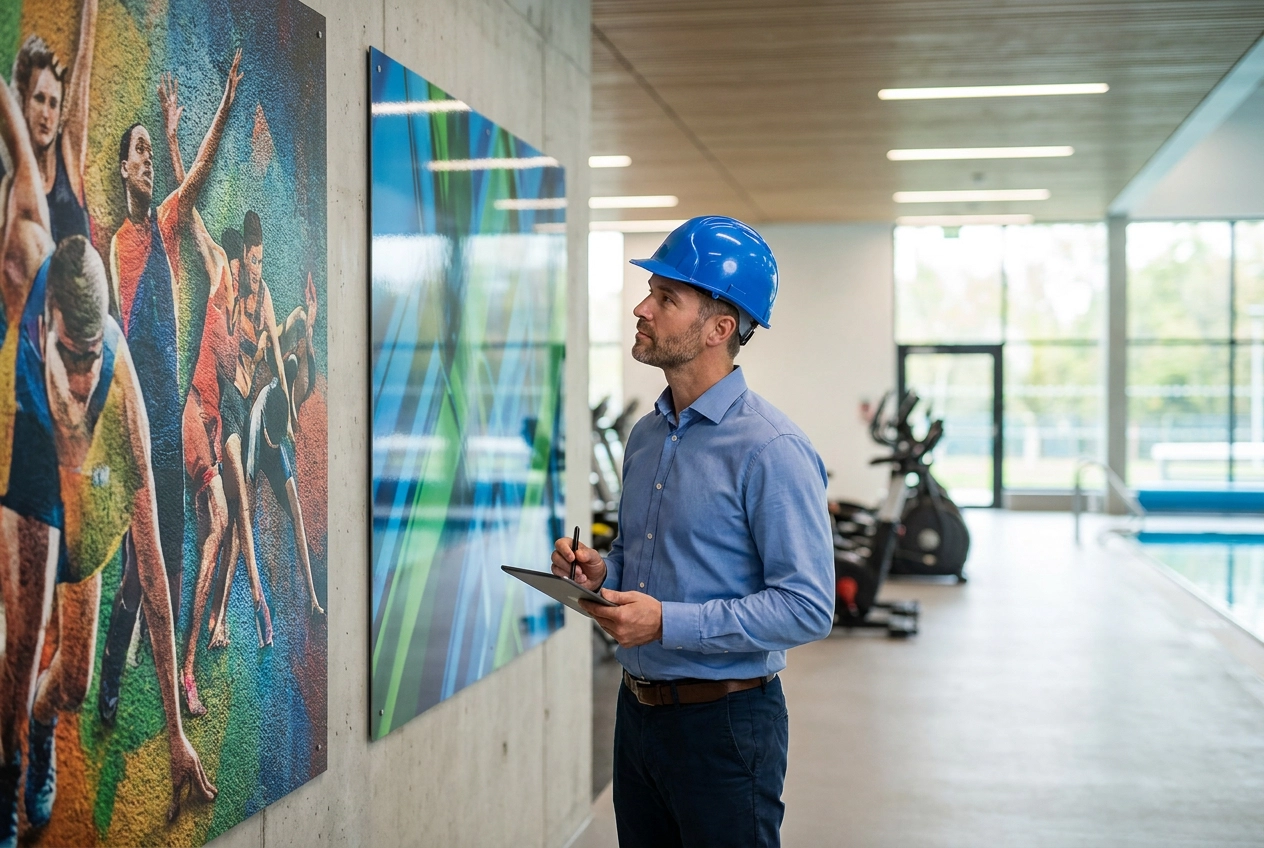
Now picture this: a full-width mountain ridgeline printed at 2400DPI across the back wall of your weight floor. Every grain of granite. Every shift in altitude light. Visible with photographic clarity from 30 feet away. A member on the treadmill does not see a wall; they see a destination. That is visual anchoring, and it transforms a functional room into an immersive environment that feels worth returning to. For operators who have seen what direct-to-surface printing achieves where conventional formats fall short, the gap between a printed wall and a blank one is not aesthetic; it is commercial.
For franchise operators running multiple sites, consistency is an operational requirement. Brand colours, edge definition, and surface integrity must hold across every location, not just the flagship. And this is precisely where the choice of wall graphic method matters most; a solution that looks exceptional on day one but degrades within 18 months fails the brief entirely, depreciating both the atmosphere and the brand it was installed to reinforce.
The Three Options on the Market: What Suppliers Will Offer You
When you request quotes from suppliers, three distinct methods will be presented to you, and understanding what separates them technically is more valuable than any price comparison.
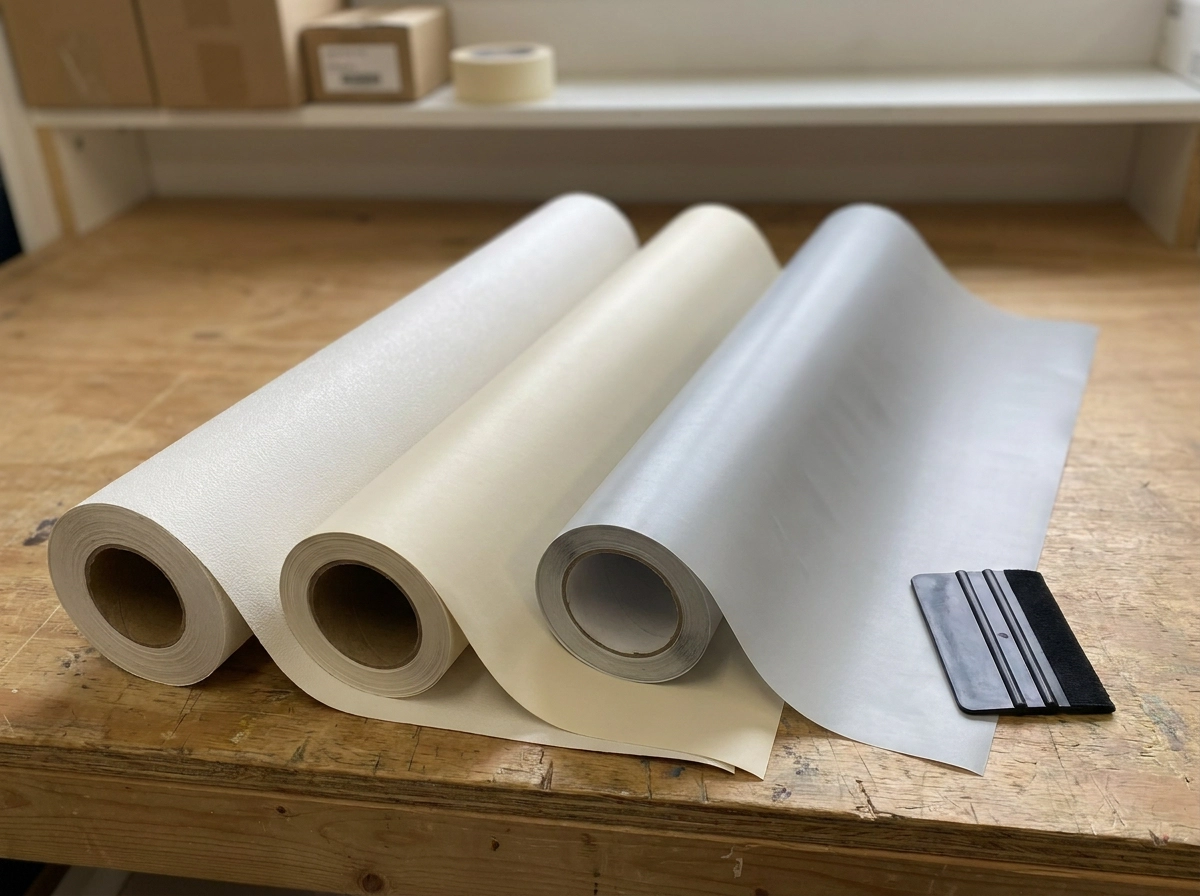
Adhesive vinyl graphics are printed onto self-adhesive film and applied to a prepared wall surface. They dominate supplier quotes not because they perform best, but because most general signage contractors already own the equipment and workflows to produce them. Low upfront cost and contractor familiarity drive their prevalence; technical suitability for gym environments does not.
Painted murals are hand-applied by a mural artist using specialist paints directly onto the wall. The visual impact can be considerable, but every aspect of the outcome, durability, cleaning resistance, colour accuracy, replication across multiple sites, is entirely dependent on the individual artist and the paint system used. No industry standard governs finish performance, and no consistent warranty framework exists across installations.
UV-cured direct-to-surface printing works differently from both. A mobile large-format UV printer deposits ink directly into the wall substrate; there is no adhesive film layer involved. The ink bonds mechanically into the surface rather than sitting on top of it. This is the least familiar method to most procurement buyers, but it is the most technically relevant to gym environments. For a detailed breakdown of how this process compares to applied films, the Direct-to-Surface Printing vs. Applied Vinyl and Wallpaper guide covers the mechanics precisely.
Each method carries a different failure profile under the humidity, sweat aerosol, impact loading, and chemical cleaning cycles that define a working leisure centre. That failure profile, not the initial price, is the correct basis for evaluation.
One further point worth noting before you assess any quote: most general signage suppliers will default to vinyl because their commercial model is built around it. That is a business incentive, not a technical recommendation.
How Gym Environments Destroy Wall Graphics (and Why Most Suppliers Ignore This)
Those three methods sit in very different positions when you put them inside an actual gym. The environment does the testing for you, and it is not gentle.
Moisture is the first mechanism of failure. Cardio zones generate sweat aerosol continuously during operating hours. That aerosol settles as a persistent moisture film on every adjacent wall surface. Over time, it works beneath the cut edges of adhesive vinyl, softening the bond and beginning the peel-and-lift sequence. It is not dramatic at first: a lifted corner near a treadmill bank, a bubble forming along a seam. Within months, it is visible across the whole installation.
Cleaning chemistry accelerates the process. UK leisure centres follow infection-prevention protocols that became standard practice post-2020, and those protocols involve quaternary ammonium compounds, alcohol-based sprays, and sodium hypochlorite solutions. These formulations are chemically aggressive to many adhesive vinyl films. Applied repeatedly at standard dilutions, they break down the adhesive bond from the surface inward, producing delamination that no amount of edge-pressing reverses.
Impact loading completes the picture. Free-weight zones and resistance equipment areas subject adjacent walls to repeated contact and vibration. Adhesive vinyl has no mechanical resilience to this; it cracks, bubbles, and separates from the substrate under loading that the wall itself absorbs without damage.
The combined result: adhesive vinyl in a working gym typically reaches visible failure within 12 to 18 months, requiring full replacement. Patching is not a viable option because the adhesive profile of new film never matches aged substrate. That replacement cycle is a recurring cost most procurement evaluations do not model at the point of initial quote.
Painted murals fail differently but just as reliably. Surface abrasion degrades the finish in high-traffic zones; commercial disinfectants at working concentrations cause colour shift and surface dulling; and hand-applied work cannot be accurately reproduced across multiple sites, making brand consistency unachievable.
Direct-to-surface UV printing removes the adhesive layer from the equation entirely. The ink is cured into the substrate rather than bonded onto it with a film. There is no edge to lift, no film to crack, and no adhesive chemistry for disinfectants to attack. For a fuller picture of how substrates and longevity interact in practice, the detail on surface suitability, longevity and what to expect in practice is worth reading before finalising any specification.
Durability Side by Side: Vinyl, Paint and Direct-to-Surface UV Printing
The failure modes described above translate directly into service life numbers that procurement teams can compare on a single page.
Adhesive vinyl in a gym context realistically lasts 12 to 18 months before visible degradation forces replacement. That ceiling applies under typical conditions; in humid cardio spaces or rooms on a twice-daily disinfection schedule, degradation arrives earlier. Low-traffic storage corridors may stretch the lifespan, but the average across a working gym floor will not.
Painted murals offer more longevity in low-abuse zones, typically 3 to 5 years, but that figure depends entirely on the individual artist's paint specification and application technique. No warranty framework governs it. Surface scuffs from equipment contact, marker graffiti, and routine disinfectant cleaning at full concentration all degrade the finish, and there is no contractual definition of failure that obligates the supplier to respond.
UV-cured direct-to-surface printing operates on a different basis entirely. The ink bonds mechanically into the wall substrate rather than sitting on top of it as an applied film. Finished with a protective lacquer seal, interior prints carry a guaranteed service life of 5 years with no edge-lift or delamination failure mode possible, because there is no adhesive layer to fail. For a fuller technical comparison of how this differs from conventional print methods, A Specialist Print Shop vs. Direct-to-Surface Printing: Five Dimensions That Matter covers the distinction in detail.
One failure mode unique to adhesive-film methods is worth naming separately. When vinyl peels, the reverse side leaves adhesive residue and visible ghosting on the wall surface, requiring remedial preparation before any replacement can be applied. Direct-to-surface printing has no film to peel, so this problem does not exist.
For multi-site operators, consistency matters as much as raw lifespan. UV direct-to-surface printing delivers repeatable results across locations because the process is equipment-controlled, not dependent on an individual artist's judgement.
When evaluating any supplier, request a written durability guarantee with defined failure conditions. Verbal assurances are not enforceable, and in a commercial leisure setting, they are not sufficient.
UK Fire Compliance for Gym Wall Graphics: The Criterion Most Buyers Miss
Durability tells half the compliance story. The other half sits in a regulatory framework most wall graphic suppliers never mention.
Approved Document B, the statutory fire safety guidance for buildings in England, applies to surface linings in non-domestic buildings including leisure centres. The Regulatory Reform (Fire Safety) Order 2005 reinforces this at the operational level. Wall graphics are surface finishes and fall within scope of both instruments, regardless of whether your supplier acknowledges this.
The Classification Framework
The operative standard is BS EN 13501-1, now the sole reaction-to-fire classification route following the March 2025 amendments to Approved Document B, which removed the old BS 476 references entirely. The scale runs from Class A1 (non-combustible) down to Class F (no performance determined). For applied wall finishes in escape routes and publicly accessed areas, Class B or better is the threshold typically required.
Where Vinyl and Paint Both Fail This Test
Many standard signage vinyls have never been tested or certified to BS EN 13501-1. Suppliers operating primarily in retail or office signage rarely encounter the question and will not raise it unless asked directly. If your procurement process does not specifically request a BS EN 13501-1 certificate for the finished surface, you will not receive one.
Painted murals carry a parallel gap. The underlying wall may have a known fire rating, but the paint system applied over it constitutes a separate layer. Its classification depends on product data sheets for the exact formulation used, and most mural artists do not work to that level of documentation.
For context on how applied surface treatments differ in compliance terms, What Are Decorative Wall Panels? The Honest Overview is a useful reference point.
Why UV Direct-to-Surface Printing Performs Differently
UV-cured direct-to-surface printing applied to a fire-rated substrate such as concrete, blockwork, or plasterboard does not introduce a combustible film layer. There is no adhesive, no polymer carrier sheet, no separate material with its own combustion profile. The fire performance of the finished surface remains closely aligned with the substrate's own classification rather than being downgraded by an applied film.
The practical instruction is straightforward. Request BS EN 13501-1 fire classification documentation, not a general safety data sheet, from every supplier you are evaluating. Cross-reference the class stated against your facility's fire risk assessment requirements. Any supplier unable to produce that document for the specific finished surface is presenting a compliance gap you will own, not them.
Cleaning Resistance and Infection Control: The Operational Test Wall Graphics Must Pass
Fire compliance sets the regulatory floor. Cleaning resistance is where graphics fail in daily operation.
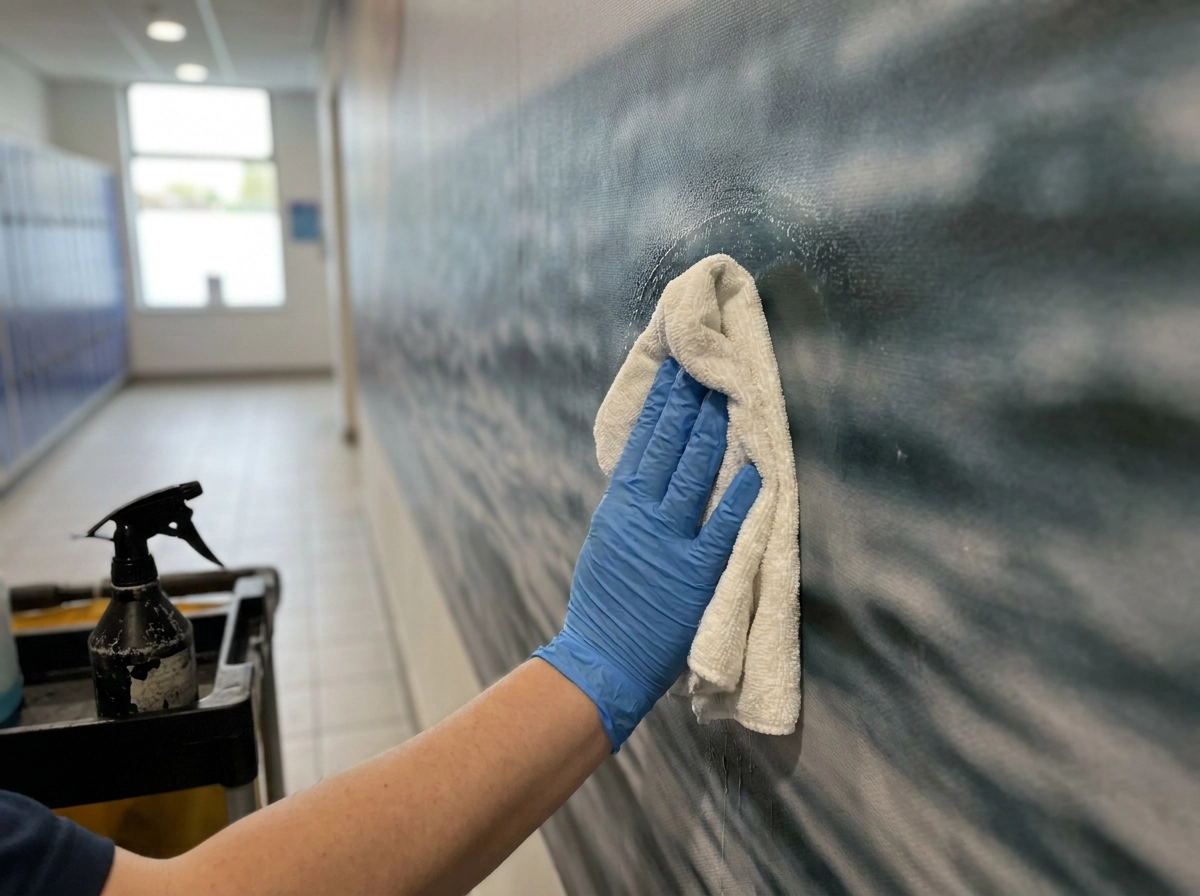
UK leisure centres governed by HSE guidance HSG179 carry out daily or twice-daily surface disinfection using quaternary ammonium compounds, alcohol-based sprays, or sodium hypochlorite solutions. All three are aggressive to adhesive film surfaces. The adhesive bond softens, edges lift, and the film delaminates from the substrate, often within weeks of regular chemical exposure.
This creates a binary operational trap. Reduce cleaning frequency to protect the graphic, and you compromise the hygiene standards your facility is legally obligated to maintain. Keep to protocol, and you accept accelerated degradation of a surface you paid to install. Neither outcome is acceptable.
UV-cured direct-to-surface printing sidesteps the problem entirely. The cured ink layer is chemically inert at normal disinfectant dilution rates; it does not absorb liquid and does not react with the formulations used in standard leisure centre protocols. Understanding what direct-to-surface printing actually is, and why that distinction matters explains the mechanical bonding process in detail, but the operational implication is straightforward: the surface cleans like the wall itself, not like a film sitting on top of it.
A lacquer seal adds a further layer of chemical resistance. Machine Canvas applies a protective lacquer as standard, which means wet-cloth and spray cleaning produces no colour shift, no surface dulling, and no edge lifting. When evaluating any supplier, confirm explicitly whether lacquer finishing is included in their process, not offered as an optional extra.
Wet-side environments demand particular attention. Pool surrounds, steam room corridors, and shower block walls carry persistent moisture loading that accelerates vinyl failure. Direct-to-surface UV printing on correctly sealed substrates handles these conditions consistently.
When shortlisting suppliers, request a written cleaning compatibility statement naming the disinfectant formulations their finished surface has been tested against. A serious commercial supplier holds this documentation as standard. The absence of it is a credible reason to eliminate the bidder.
The True Cost of Gym Wall Graphics: A Total Cost of Ownership Model
Cleaning resistance is one cost dimension. The deeper one is time and money across the full life of the wall.
Most wall printing UK price comparisons quote only the day-one invoice. That number is misleading. The correct unit of analysis is cost per year of service life, modelled across a realistic 5 to 10 year operational horizon.
Adhesive vinyl carries a lower upfront cost but degrades within 12 to 18 months under gym conditions. Across a 10-year wall, that replacement cycle means 6 to 8 complete reinstalls. Each reinstall carries material cost, contractor labour, waste disposal, and, critically, facility downtime while the zone is stripped, re-prepared, and re-applied. Buyers who model only the first installation are, in effect, planning to pay for the wall six times over.
UV-cured direct-to-surface printing typically requires a higher initial investment. But with a 5-year interior guarantee and no replacement cost within that period, the per-year cost is substantially lower. On most realistic cost models, the lifecycle advantage shifts to UV printing by year 3, often earlier for facilities with high cleaning frequency.
Downtime is the hidden cost that procurement teams consistently underestimate. Closing a gym zone for vinyl removal and re-application is not a facilities inconvenience; it is a membership disruption with a measurable revenue value. For operators running a single site, this is a manageable irritation. For multi-location operators, aggregated downtime across a portfolio of sites cycling through vinyl replacement simultaneously becomes a significant operational drag that a UV-cured solution removes entirely.
For a detailed breakdown of how these costs stack up in practice, What Does It Actually Cost, and Is It Worth It? works through the numbers in full.
Machine Canvas offers printed wall murals from around £250, backed by a 5-year interior guarantee on lacquer-sealed UV-cured finishes. A free design mock-up before any financial commitment allows procurement teams to validate the visual outcome before signing off on budget.
Surface Compatibility, Installation Logistics and Minimum Disruption
Cost modelling establishes why UV direct-to-surface printing wins on lifecycle economics. The practical question that follows is whether your facility can actually accommodate it.
Substrate compatibility is straightforward for most commercial gym builds. Painted plasterboard, rendered blockwork, concrete, and sealed interior finishes are all compatible. Where surfaces are heavily textured, porous, or unprepared, a pre-print assessment determines whether a primer stage is needed before printing begins. Understand this before requesting a quote, not after.
Surface preparation is the single variable that determines whether any print lasts. Suppliers who skip or compress this stage generate the majority of premature failure claims in the industry, regardless of which printing method they use. When evaluating shortlisted suppliers, ask specifically how they assess and prepare the substrate before the printer arrives. Vague answers are a credible elimination criterion. To understand what rigorous preparation looks like in practice, What a Direct-to-Surface Printing Company Actually Does is a useful reference.
Installation speed is a genuine operational advantage. A full back-wall mural in a commercial fitness suite can typically be printed and lacquer-sealed within a single working day. That is measured in hours, not the multi-day closures that vinyl stripping and re-application require. For a facility where every closed zone represents lost member access, this difference has real operational value.
Direct-to-surface printing is also tolerant of normal commercial environments with appropriate dust control. Adhesive vinyl installation demands near clean-room conditions to prevent contamination under the film during application. UV printing carries no such constraint.
One legal point requires attention for leased facilities. Direct-to-surface printing in most cases constitutes a permanent alteration to the premises. Tenants with reinstatement obligations should clarify their landlord's position before commission, not at lease end. This is a property law question, not a printing one.
Finally, multi-zone projects combining feature walls, corridor murals, reception graphics, and floor printing benefit significantly from a single supplier coordinating all surfaces. Multiple contractors with different methods and separate accountability creates gaps that compound over time.
What Next-Level Gym Wall Murals Actually Look Like at 2400DPI
Stop picturing a logo on a beige wall. Picture this instead: a full floor-to-ceiling mountain range stretching across the entire back wall of your weight floor, printed at 2400DPI, every grain of granite and every atmospheric shift in altitude rendered with the clarity of a professional photograph viewed from ten metres. Members lifting in front of it do not see a graphic. They see a landscape.
That is what UV-cured direct-to-surface printing at this resolution actually delivers, and it reframes every other option you have been quoted.
3D burst-through effects take the visual ambition further. A sprinter tearing through the wall at the end of a sprint track. A wave breaking through the tile line of a pool corridor. A cityscape receding into the horizon from a treadmill-facing feature wall. These are not design gimmicks; they are engineered perspective illusions that physically alter how a member experiences a space during the 45 minutes they spend in it.
In narrow gym corridors, perspective murals can visually double the perceived depth, transforming oppressive service passages into branded thoroughfares that extend the member experience well beyond the gym floor itself. The wall becomes part of the journey through the facility, not a boundary at the edge of it.
CMYK UV-cured printing at 2400DPI captures photographic-grade colour fidelity. Custom wall murals built around brand colours, sponsor imagery, or athlete photography hold total accuracy over time, avoiding the colour shift that degrades vinyl under high-UV interior lighting. What you approve in the design file is what members see in year four.
That design approval process matters. Free design mock-ups rendered to your actual wall dimensions allow leisure centre managers to see the finished result before any commitment. The gap between a concept file and a wall-mounted reality is exactly where interior transformation decisions are won or lost.
Operators competing on member experience rather than price need walls that make the environment feel worth returning to. At the per-square-metre scale of impact, next-level prints represent one of the highest-return investments available to a leisure facility.
How to Evaluate Any Gym Wall Graphic Supplier: A Practical Checklist
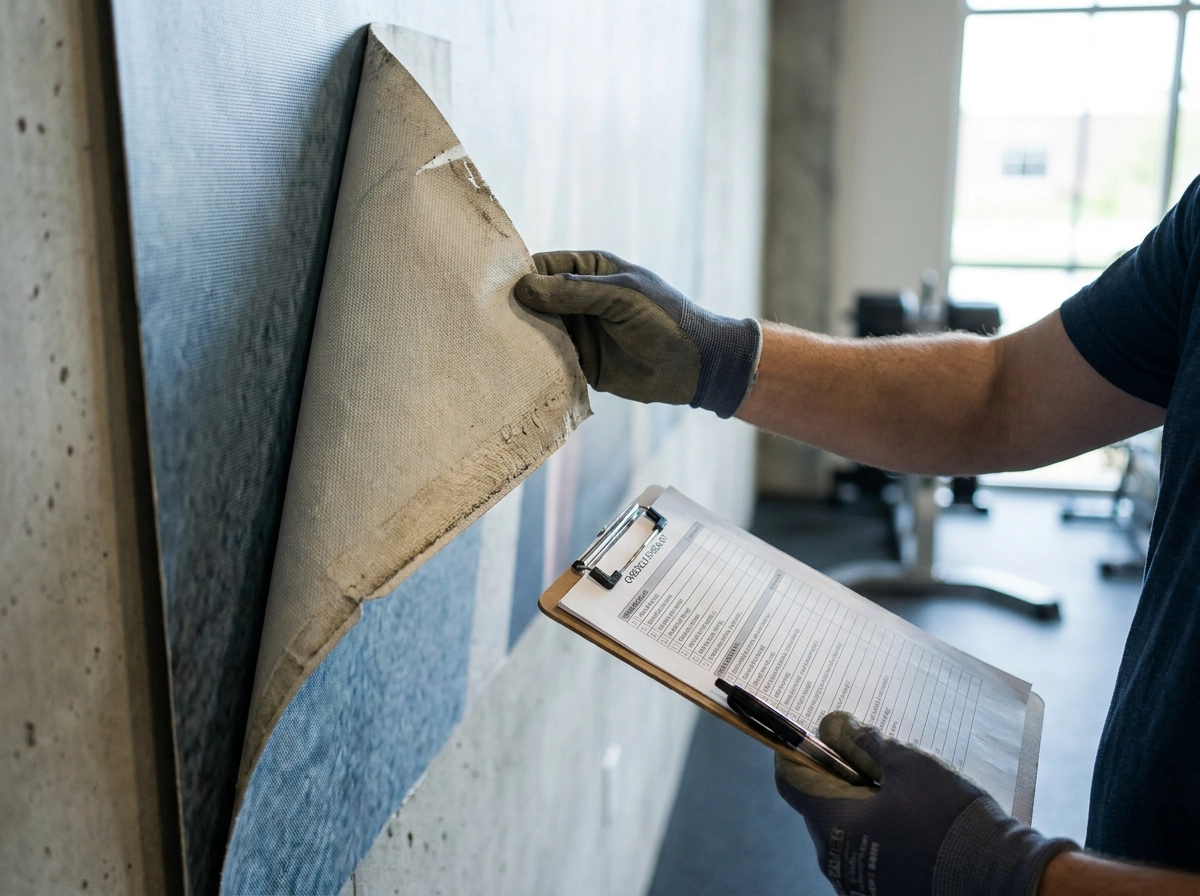
Once you know what world-class looks like on your walls, the next question is brutally practical: how do you verify which supplier can actually deliver it, and which will leave you with peeling vinyl and a compliance headache six months later? Use this checklist on every conversation.
Written durability guarantee. Five years for interior direct-to-surface printing is the benchmark. Anything shorter, or confirmed only verbally, is a risk signal. Request the guarantee in writing with defined failure conditions before signing off budget.
BS EN 13501-1 fire classification documentation. Ask for classification data on the finished printed surface, not the substrate alone. An applied vinyl film or paint layer creates a separate surface with its own fire performance profile. For any public-access leisure facility, this documentation is non-negotiable; a supplier unable to produce it should be eliminated from the shortlist.
Cleaning compatibility statement. UK leisure centres use quaternary ammonium compounds, alcohol-based sprays, and sodium hypochlorite solutions as standard. Ask the supplier for a written statement confirming their finished surface has been tested against these specific formulation types. A credible commercial wall murals supplier holds this documentation; a generalist print shop typically does not.
Pre-installation surface assessment. Suppliers who quote without physically assessing your substrate are either guessing on adhesion or using a method that does not require surface integrity. That usually means vinyl. A supplier proposing direct-to-surface printing should conduct or require a substrate inspection before confirming the specification.
Portfolio evidence in comparable environments. Residential or retail portfolio work does not validate performance under gym conditions. Request specific examples of printed wall murals delivered in commercial fitness or leisure settings, with evidence of longevity under cleaning and humidity load.
Visualisation before commitment. The ability to see your actual wall space rendered with the proposed design before any financial commitment separates serious operators from generalist printers. Machine Canvas provides a free design mock-up as standard, before any cost is incurred, so you evaluate the outcome on your terms.
The Buying Decision in Summary: Why the Evidence Points One Way
Apply the checklist from the previous section to any supplier conversation and the verdict becomes consistent. Here is what the evidence shows.
Vinyl graphics appear cost-effective at quote stage. In a functioning gym environment, they are not. Sweat, disinfectants, and impact loading degrade adhesive film within 12 to 18 months, triggering replacement cycles that accumulate far beyond the original installation cost over any realistic operational horizon.
Painted murals offer genuine visual ambition but fail every standardisation test a multi-site or compliance-conscious operator requires. No repeatable fire classification, no documented cleaning compatibility, no written guarantee framework. Attractive as a one-off; unworkable at scale.
UV-cured direct-to-surface printing is the only method that clears every criterion simultaneously. It passes the durability test with a lacquer-sealed 5-year interior guarantee. It passes the fire compliance test by adding no combustible film layer over the substrate. It passes the cleaning resistance test with confirmed compatibility against commercial disinfectant formulations. It passes the total cost of ownership test when modelled across a realistic 5 to 10 year horizon.
The five criteria this guide has established, written durability guarantee, BS EN 13501-1 fire classification, cleaning compatibility documentation, pre-installation surface assessment, and portfolio evidence from comparable environments, give your procurement team a repeatable framework. Use it with every supplier. The responses will differentiate quickly.
Machine Canvas delivers UV-cured direct-to-surface printing across England, Scotland, and Wales from its base in Lancashire. Interior work is backed by a 5-year guarantee. Every project begins with a free design mock-up showing your actual space, with no financial commitment required until you are ready to proceed.
That visualisation is the logical next step. Request it.