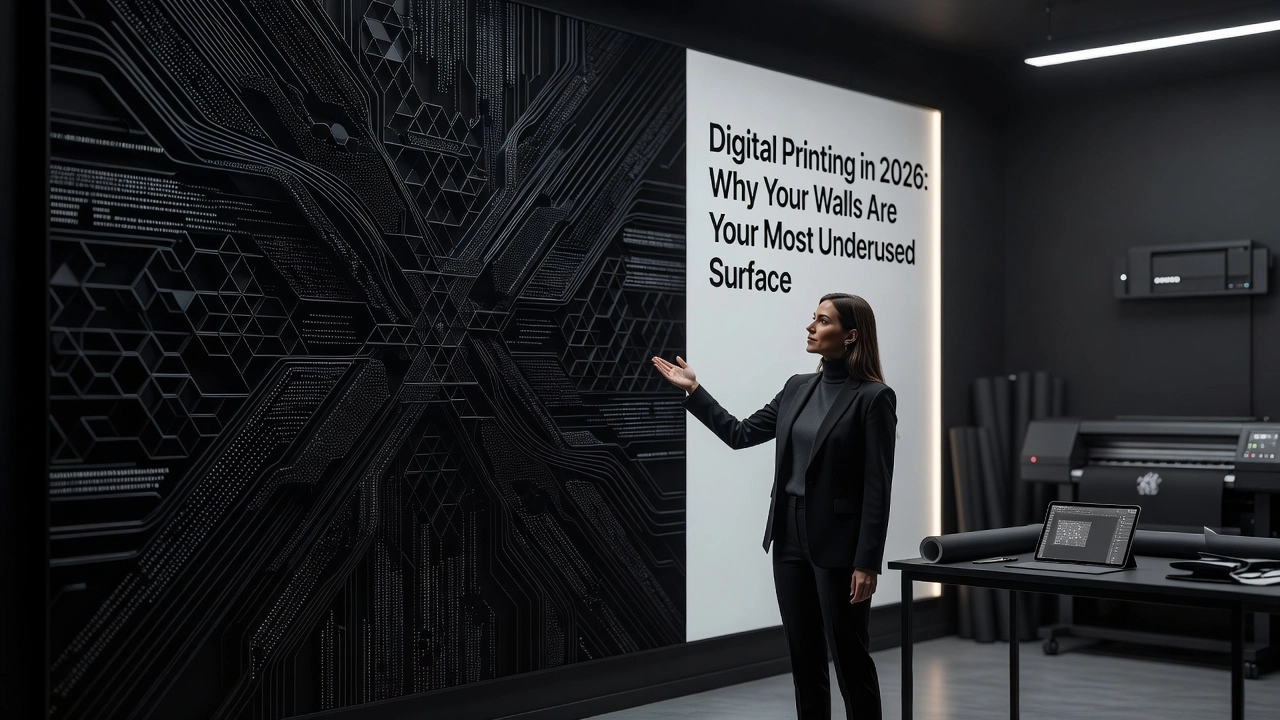
Every room tells a story, but most walls stay silent. While furniture, lighting, and textiles receive careful attention in interior design, the largest surfaces in any space are routinely painted a neutral shade and forgotten. In 2026, that habit is starting to look like a missed opportunity.
Digital printing has matured into a transformative force in both commercial and residential design, offering a level of customization and visual precision that simply was not accessible a decade ago. From large-format photographic murals to intricately patterned wallcoverings produced on demand, the technology has closed the gap between imagination and execution. And yet, adoption among everyday consumers and small businesses remains surprisingly low.
This analysis breaks down why walls represent the most underused canvas in modern interiors, how digital printing technology has evolved to make large-scale customization practical and affordable, and what the current landscape looks like for anyone ready to rethink their space. Whether you are designing a home office, a retail environment, or a hospitality venue, understanding what is now possible could fundamentally change how you approach your next project.
What Digital Printing Actually Is in 2026
Print technology has been on a quiet but relentless march forward for decades. Offset lithography dominated commercial reproduction through most of the twentieth century, delivering consistent results at high volume but demanding lengthy setup times, significant material waste, and rigid minimum run quantities. Screen printing followed as the preferred method for surface decoration, particularly for textiles and signage, but it shared the same fundamental limitation: every design change required a new screen, making short runs economically unviable. The shift that changed everything was the maturation of high-resolution inkjet as a production-grade output method. Today, inkjet technology commands 59.9% of the digital décor technology market in 2026 and holds 63.1% revenue share of the broader digital printing market, a position built on its ability to reproduce extraordinarily fine detail, respond to design changes in minutes, and scale economically from a single bespoke piece to a full commercial installation.
The Ink Chemistry That Changed Everything
Underpinning inkjet's rise in interior and architectural applications is a specific ink chemistry: UV-cured formulations. The global digital print for décor market is valued at USD 1.1 to 1.2 billion in 2026, and UV-curable systems are cited consistently as the primary driver of both quality improvement and durability across that segment. The UV flatbed printer sub-segment alone was valued at USD 1.8 billion in 2025, forecast to reach USD 3.6 billion by 2034 at a 7.9% compound annual growth rate. These figures reflect a market responding to something genuinely better, not merely incrementally improved.
Understanding why requires a brief look at the chemistry in customer-facing terms. When a UV-cured print head deposits ink onto a surface, an array of ultraviolet lamps follows the print pass immediately. The ultraviolet light triggers a photochemical reaction inside the ink, cross-linking its molecular components almost instantaneously into a solid, bonded layer. There is no drying time in the conventional sense; the ink does not evaporate or off-gas, which means no solvent fumes during or after application. Once cured, the result is a finish that resists scratching, tolerates moisture, and withstands the demands of both interior and exterior environments without fading or flaking.
The Distinction That Actually Matters
Now consider what most people mean when they say "digital printing." In the vast majority of cases, they are describing a process in which artwork is printed onto an intermediary material, typically paper, vinyl, or fabric, which is then applied to a surface using adhesive. The output is, in effect, a printed layer sitting on top of a substrate, sitting on top of the wall or floor. Every join is a potential seam. Every edge is a potential lift point. Every bubble trapped during application is a permanent flaw.
The technological frontier is categorically different. Direct-to-surface UV digital printing eliminates the intermediary entirely. The printer works directly on the physical surface, whether brick, plaster, concrete, or timber, bonding ink permanently without any substrate layer between the artwork and the wall.
Direct-to-surface UV digital printing is a process in which UV-curable ink is applied directly onto a physical surface with no intermediary material. Ultraviolet light instantly bonds the ink in place, producing a permanent, fume-free, scratch-resistant finish with no substrate, no seams, and no risk of peeling or lifting over time.
This is the distinction that separates a surface transformed from a surface decorated, and it is the foundation on which everything else in this analysis rests.
The Interior Décor Explosion Driving Market Growth
According to Fact.MR's 2026 digital print for décor analysis, interior décor and furniture now commands 44.1% of total end-use market share within the global digital print for décor sector. That is not a marginal lead. It is a structural dominance, confirming that walls, floors, and surface panels have become the primary arena where digital print technology competes, innovates, and scales. High-resolution inkjet printing reinforces that dominance further, holding 59.9% of technology share across the sector in the same period. The message from the data is unambiguous: surfaces are where the growth lives, and the growth is accelerating.
Mass Customisation Is No Longer a Premium Option
The operational model of interior print has fundamentally changed. Short runs, rapid design iteration, and on-demand production are no longer the preserve of high-end bespoke studios; they are standard commercial practice in 2026. Fact.MR explicitly identifies the shift toward mass customisation and rapid design iteration as the core structural force reshaping digital décor manufacturing globally. Variable data printing, once a niche capability, now sits at the centre of how interior spaces are designed, specified, and delivered. For businesses and homeowners alike, this means the barrier between imagining a transformed space and actually producing it has collapsed to almost nothing.
The Renovation Boom Is Printing Its Own Demand
The numbers driving this market are not abstract. The digital print for décor market is forecast to grow from USD 1.20 billion in 2026 to USD 3.21 billion by 2036, at a compound annual growth rate of 10.4%, adding approximately USD 2.01 billion in absolute value over the decade. Expanding residential and commercial renovation activity is a named demand accelerator within that forecast, not a background assumption. Every hotel refurbishment programme, every office redesign cycle, every gym refit, every school corridor overhaul feeds directly into that trajectory. The renovation economy and the digital print economy are now running in parallel, and both are moving fast.
Picture the Space You Walk Into Every Day
Stop for a moment and actually picture it. Your hotel lobby at check-in, the first thing every guest sees before they form their opinion of your brand. Your gym changing room, the wall opposite the mirror where members spend two minutes every session staring at nothing. Your office reception, the space where clients sit waiting and decide, before anyone speaks, whether you are a serious operation. Now ask yourself what a single feature wall, transformed at 2,400 DPI resolution with photographic precision and UV-cured permanence, would do to that first impression. The answer is not subtle. It is the difference between a space that is forgotten and a space that is remembered.
Generic Walls Are a Commercial Liability
The era of magnolia neutrality has not faded quietly. It has been displaced by data. Personalised interiors are now a primary purchase driver across both residential and commercial segments, with market forecasts explicitly linking "increasing demand for personalized interiors" to accelerating spend. Generic surfaces no longer read as tasteful restraint; they read as a missed opportunity. Businesses that continue to treat their walls as passive background are, in a measurable sense, leaving brand equity on the table. The market has moved, the technology exists to meet it, and the spaces that embrace that shift are the ones that command attention from the moment a door opens.
Direct-to-Surface Printing vs. Applied Vinyl and Wallpaper
Applied vinyl and wallpaper occupy a legitimate position in the wall graphics market. Both methods have a decades-long track record, are understood by most interior trades, and remain entirely appropriate for short-term brand campaigns, rental properties, or low-footfall spaces where a two-year lifespan is acceptable by design. That context matters, because a fair comparison starts by acknowledging what these methods genuinely do well before examining where they fail.
The failure points, however, are structural and they become impossible to overlook in high-ambition commercial or residential environments.
Where Applied Media Breaks Down
Seams are the most visible problem. Vinyl sheet material has a physical width limit; any graphic wider than approximately 54 inches requires panel joins, and aligning those joins across a textured or imperfect wall surface adds between 20 and 40 percent to installation labour costs. Even when aligned perfectly at day one, those seams become visible within months as adhesive contracts, humidity fluctuates, or cleaning staff catch an edge with a mop head. In hospitality settings, high-traffic corridors, gyms, or schools, that degradation timeline shortens considerably.
Adhesive failure accelerates in precisely the environments where visual impact matters most. Commercial vinyl in active-use spaces typically begins lifting and curling within 18 to 36 months. That means most commercial installations face a complete replacement cycle before the third year of operation. Over a ten-year ownership horizon, a £50,000 vinyl installation can accumulate total lifecycle costs exceeding £120,000 once material, labour, surface remediation, and re-installation are accounted for across two or three replacement rounds. Adhesive residue removal, drywall repair, and skim-coat preparation are routine costs at each cycle that rarely appear in the original quote.
Textured, porous, or exterior surfaces make the equation worse. On brick, sealed concrete, or exterior render, standard vinyl simply cannot adhere without costly substrate modification, which inflates the effective first cost significantly before a single panel is printed.
The Direct-to-Surface Alternative
UV direct-to-surface printing removes the applied substrate entirely. The printing system traverses the wall directly, depositing UV-curable inks that bond at a molecular level to whatever surface sits beneath, whether that is smooth plasterboard, textured masonry, or concrete block. The ink cures instantly on contact. There is no adhesive layer to degrade, no film to lift, no panel seams to align, and no secondary substrate sitting between the artwork and the wall.
The result is a finish that is, for practical purposes, part of the wall itself. A lacquer-sealed topcoat protects the print against abrasion, cleaning chemicals, and UV exposure, producing a surface that performs in occupied buildings across their full operational life rather than a fraction of it. As research into direct-to-wall printing versus vinyl wall coverings confirms, UV-cured direct printing eliminates the adhesive degradation, removal damage, and substrate incompatibility that define the lifecycle cost of applied media.
Machine Canvas backs this technology confidence with a 5-year guarantee on interior prints and a 3-year guarantee on exterior work. These are warranties grounded in bonded ink chemistry, not adhesive reliability, and no vinyl applicator can credibly offer equivalent terms on the same scope of work. That warranty gap is not a marketing position; it is a direct reflection of how differently the two technologies perform over time.
The ROI Case for Commercial Buyers
For commercial decision-makers, the financial argument is straightforward. A single guaranteed direct-to-surface installation from Machine Canvas starts from £250, scales to architectural dimensions without a proportional jump in complexity, and arrives with a free design mock-up before any financial commitment is required. Set that against the accumulated cost of even one vinyl replacement cycle across a five-year period and the value engineering case for direct-to-wall printing becomes the operational and financial default, not the premium option.
What 2,400 DPI Actually Looks Like on a Wall
Close your eyes for a moment and picture the finest nature photograph you have ever seen. The kind where you can almost feel the moisture in the air, where the fur on an animal carries individual strands, where a single raindrop holds an entire landscape inside its curve. Now open your eyes and put that image on your wall. Not a print hung against it. Not a panel applied to it. The wall itself, rendered in that same extraordinary fidelity. That is what 2,400 DPI direct-to-surface printing delivers, and once you understand what that resolution actually means at full scale, conventional interior decoration becomes genuinely difficult to settle for.
At 2,400 dots per inch, the printer is depositing ink at a density that most people's eyes simply cannot parse as separate dots. UV-cured CMYK technology at this resolution means that a photorealistic grass field does not suggest individual blades; it renders them. A limestone texture does not approximate the look of stone; the pores, the mineral variation, the micro-shadows within the grain are each individually present. A water droplet in a forest scene carries its own internal light, its own shadow, its own reflected geometry. According to large format printing resolution research, what matters at wall scale is not simply the raw DPI figure but how that dot density translates to perceived sharpness from a natural viewing distance. At 2,400 DPI, even close inspection, the kind where a curious visitor leans in to understand what they are looking at, yields nothing but continuous, unbroken image. The wall does not have a print on it. The wall has become the image.
The Safari Burst-Through Effect
Picture a nursery corridor. Plain painted walls, functional lighting, unremarkable in every direction. Now picture a giraffe leaning into that space from the right-hand wall, its neck extending forward into the room at an angle so convincingly rendered that children reach out to touch it before their rational minds can catch up. This is the 3D safari burst-through effect, and it does not work by hanging anything from the surface. The illusion is printed directly into the wall using perspective geometry, shadow mapping, and layered tonal depth that makes flat ink appear to occupy three-dimensional space. In a hotel bar, a lion's face emerges from what appears to be weathered brickwork, its jaw slightly forward, its gaze fixed on the room. Guests photograph it within minutes of arrival. Not because they were asked to, but because the image is simply too spatially convincing to document any other way.
Floral Relief and Botanical Depth
The floral burst-through effect operates on the same trompe-l'oeil principle but produces a completely different emotional register. Oversized botanicals, magnolias, tropical leaves, abstract garden forms, appear to physically project from the surface. Apparent shadows fall beneath petals. Stems seem to anchor into the wall at one point and lift away from it at another. The depth does not exist in the physical structure of the wall, but it exists with complete authority in the perception of everyone who enters the room. Interior designers working with these effects routinely describe the same reaction from clients: the instinct to reach out and test whether something is actually raised, followed by genuine surprise that the surface is flat. That perceptual dissonance is the effect working precisely as intended.
Perspective Illusions in Difficult Architecture
Narrow corridors, low-ceilinged side rooms, awkward service areas with no natural light; these are the spaces conventional interior decoration cannot solve without expensive structural intervention. A flat wall printed with a perspective tunnel illusion becomes a passage into depth. A wall printed as a floor-to-ceiling window onto a forest path introduces apparent volume that no mirror, no paint colour, and no applied panel can replicate with the same conviction. The digital printing resolution principles that govern large-scale output confirm that viewing distance is the critical variable in perceptual sharpness, and for corridor illusions specifically, the typical standing distance of two to four metres is exactly where these effects reach their full visual authority. For hotels managing awkward floor plans, schools with repetitive institutional corridors, or offices with architecturally constrained spaces, this is a genuinely practical solution to a structural problem.
Floor Graphics That Command Space
UV-printed floor graphics are not decals. They are not adhesive films placed over a surface and vulnerable to peeling edges or curling corners. They are printed directly into the floor substrate, UV-cured and lacquer-sealed against foot traffic, trolley wheels, and in commercial and car park settings, vehicle weight. A reflective puddle illusion printed into a gym reception floor stops visitors mid-step. A cracked earth surface across a retail floor creates a branded landscape underfoot that customers navigate as part of the brand experience. A corporate mosaic in a hotel lobby places the property's identity into the architecture itself rather than onto a sign above the door. These are spatial design decisions, not decorative add-ons, and the technology that makes them permanent and load-bearing is the same UV-cured system producing every mural on every wall above them.
Commercial Sectors Being Transformed by Digital Printing
The commercial case for direct-to-surface digital printing is not simply aesthetic. It is strategic, competitive, and increasingly measurable. As the commercial printing market accelerates toward a projected $$719.69 billion in 2026 and digital output continues taking share across every application category, the businesses investing in large-format, high-resolution environments are not decorating their spaces. They are engineering them.
Hotels and Hospitality
Picture the lobby of a hotel where the first wall a guest encounters is not painted magnolia or hung with framed prints, but printed floor-to-ceiling with a photorealistic landscape at 2,400 DPI. The depth is absolute. The colour is permanent. The surface is the same wall it always was, only now it holds an image so resolved and so immersive that guests stop walking and start looking. Corridor murals extend that world across every metre of a 20-metre walk, transforming a functional transit space into a curated journey that reinforces the hotel's identity before a guest has seen their room. Bar and restaurant interiors carry the same logic further: every surface is part of the design intent, printed directly onto existing walls and sealed for a guaranteed five-year lifespan. This is not installation art. It is brand architecture, delivered permanently and without compromise.
Gyms and Leisure Centres
The motivational environment of a serious fitness space is not accidental. Every element, from equipment layout to lighting, is calibrated to make members feel capable of more. Direct-to-surface digital printing extends that engineering to the walls and floors. Imagine motivational murals scaled to full warehouse height, athletes rendered at twice life-size with the kind of resolution that makes individual muscle fibres visible. Visualise changing rooms where 3D athletic illusions make a three-by-four-metre wall read as a stadium tunnel, depth-printed so convincingly that the corridor appears to continue for fifty metres. Sprint track graphics printed directly underfoot in functional fitness studios define lanes, set pace, and signal serious intent. These are spaces built to perform, and the surfaces perform alongside the members.
Offices and Co-Working Spaces
Brand identity at genuine architectural scale is not the same thing as a logo above a reception desk. It is a full-floor visual language that communicates what an organisation believes, what it builds, and who it is recruiting, before a single word is spoken. Strategic shifts transforming the business of print consistently confirm that the most commercially agile operators have moved from volume production toward application-specific, high-value output; and office interiors represent exactly the kind of bespoke, single-site project that direct-to-surface printing is structured to serve. Every client, candidate, and employee who walks into a reception area printed with purpose understands within seconds that this organisation takes its identity seriously.
Schools, Nurseries, and Educational Settings
The learning environment shapes cognition before a lesson begins. Alphabet jungles wrapping a nursery room introduce literacy through visual immersion rather than flat instruction. Number forests turn counting into exploration. Science murals in secondary classrooms bring the periodic table or the solar system to a scale where engagement is automatic rather than effortful. These are curriculum-integrated surfaces that teach as well as decorate, printed directly onto the walls that already exist, requiring no fixings and leaving no gap between the image and the architecture.
Retail, Automotive Showrooms, and Car Parks
Experiential retail is not a trend; it is a survival strategy. The space itself must become a reason to visit. Showroom walls printed with precision imagery that mirrors the engineering ambition of the vehicles on the floor turn a transaction environment into a brand statement. Commercial printing's structural evolution confirms that physical print for consumer engagement is growing, not contracting. Car park floor graphics extend the canvas to the ground plane: wayfinding systems, safety demarcation, and brand activation printed directly onto concrete at a scale that only direct-to-surface technology can deliver with the durability commercial use demands.
The Sustainability Case for UV Direct-to-Surface Printing
The environmental credentials of UV direct-to-surface printing are not incidental. For an increasing number of commercial buyers in 2026, they are a procurement requirement, and they deserve precise examination rather than vague claims about being "eco-friendly."
VOC-Free Inks and Indoor Air Quality
UV-cured inks contain no volatile organic compounds and produce no solvent off-gassing either during or after application. This distinction matters enormously in settings where indoor air quality is a contractual, regulatory, or safeguarding concern. Hospitality venues, schools, nurseries, healthcare facilities, and public sector buildings all operate under frameworks where the chemical environment of interior spaces is subject to scrutiny. Solvent-based large-format printing releases VOCs into the atmosphere during application and, in some formulations, continues off-gassing after installation. UV direct-to-surface printing eliminates that risk entirely. Astek's commitment to sustainable UV digital printing notes that UV inks are VOC-free and contain no heavy metals or corrosive substances, with formulations carrying UL Solutions' GREENGUARD Gold certification. That is a third-party verified, internationally recognised indoor air quality standard, not a self-declared marketing position.
Zero Substrate Waste Across the Full Lifecycle
Conventional applied-media decoration carries a hidden environmental burden that is rarely calculated in full. Vinyl wallcovering requires raw material extraction, substrate manufacturing, ink application, roll transportation, on-site adhesive installation, and eventual disposal of the backing, adhesive layer, and any off-cuts generated during fitting. Every one of those stages consumes energy, generates emissions, and produces waste. UV direct-to-surface printing removes the entire material stack by using the surface already present as the finished product. There is no substrate to manufacture, ship, or discard. The lifecycle environmental cost is fundamentally different in structure, not merely smaller in degree.
Longevity as a Sustainability Metric
A Machine Canvas interior print guaranteed for five years is, by any lifecycle assessment logic, less resource-intensive than a vinyl wallcovering replaced on a two-to-three-year cycle. In high-traffic commercial environments, that replacement cycle is not theoretical; hotel corridors, school hallways, and retail interiors routinely see applied wallcoverings damaged or aesthetically dated well within three years. Each replacement repeats the full environmental cost of manufacture, installation, and disposal. Fewer replacement cycles per decade means fewer raw materials consumed and less waste generated per square metre of decorated surface.
A Documentable ESG Case
Eco-friendly production has been identified as a headline trend across the print sector in 2026, reflecting both tightening regulation and shifting buyer expectations. The water-based UV ink market alone was valued at USD 6.62 billion in 2026 and is projected to reach USD 10.51 billion by 2032, a trajectory driven in part by environmental compliance requirements. For commercial buyers with ESG reporting obligations or sustainability procurement criteria, UV direct-to-surface printing offers a combination of claims that can be evidenced and documented: zero-substrate waste representing eliminable material categories, VOC-free inks with third-party certification, and a quantified guaranteed lifespan that reduces replacement frequency. That combination provides a documentable environmental case to sit alongside the aesthetic and commercial arguments, precisely the kind of structured evidence that procurement teams operating under sustainability frameworks need to act on.
From Concept to Completed Wall: How the Process Works
The journey from first enquiry to finished wall follows a clear, low-risk sequence that removes every traditional barrier associated with large-scale interior transformation. It begins with a brief: a conversation about the space, the surface, the design direction, and the intended effect. Surface condition, dimensions, substrate type, and ambient environment are all assessed before a single pixel is placed. From that information, the design team creates a scaled digital composition mapped precisely to the wall in question. Then comes the step that changes everything for first-time buyers: a free mock-up, rendered in context, showing exactly how the finished print will look in the actual space. No deposit is requested at this stage. No contract is signed. No money changes hands. The buyer sees their wall transformed before committing to anything, making this one of the most transparent entry points in any commercial interior service available today.
The Printing Day Itself
On the day of installation, the process is surgical in its efficiency. The surface is prepared, the UV-cured CMYK inkjet system is positioned, and printing begins directly onto the wall. Machine Canvas operates at 2,400 DPI resolution, which means the level of detail deposited onto the surface is not a approximation of the design; it is the design, rendered at a fidelity that reveals individual textures, tonal gradations, and fine linework that would be invisible at lower resolutions. UV curing happens in real time as the print head passes across the surface, bonding ink to the substrate instantly on exposure to the UV lamp. There is no wet-paint drying period. There is no ventilation requirement. There is no chemical off-gassing that displaces staff or customers. The print zone is the only area affected, and once the lacquer seal is applied for long-term surface protection, the wall is ready for immediate use. For a hotel corridor, a gym reception, or a school common room, this means a single working day delivers a permanent, guaranteed result with zero operational disruption.
Nationwide Coverage Without Logistical Complexity
Operating from a base in Lytham St Annes, Lancashire, Machine Canvas serves projects across England, Scotland, and Wales, with mobilisation reach extending from Manchester to Edinburgh and beyond. For commercial buyers evaluating suppliers, logistics and mobilisation cost are genuine procurement variables, and the nationwide footprint resolves that concern directly. Pricing starts from £250 for a feature print, which, combined with the free mock-up process, means the financial exposure at the point of first commitment is precisely defined and entirely predictable.
Now picture the specific wall in your building. The one that currently does nothing. Rendered in the design you have always wanted, permanent, sealed, and guaranteed for five years on interior surfaces. A free mock-up is the only step between that image in your mind and that image on your wall.
The Walls You Have Are Not the Walls You Have to Keep
The digital print for décor industry is growing at 10.4% CAGR through 2036, scaling from USD 1.20 billion today toward USD 3.21 billion within the decade. Interior walls and floors sit at the physical centre of that growth, commanding 44.1% of total market share. UV direct-to-surface printing is the most advanced expression of that technology available right now, and the gap between what most people associate with "printed walls" and what 2,400 DPI UV direct-to-surface printing actually delivers is not incremental. It is categorical. Vinyl peels. Wallpaper bubbles. UV-cured ink bonds permanently to the surface itself, with no intermediate layer standing between your wall and the image it carries.
Visualise it. Your specific wall. Your chosen design. Rendered in ultra-high-definition detail before a single penny changes hands. That is precisely what a free design mock-up from Machine Canvas makes possible, with no commitment and no upfront cost, available to homes and businesses across England, Scotland and Wales.
The only thing this requires is the decision to see what is possible. Request your free mock-up today and make the choice with complete visual confidence.
Conclusion
Your walls are not blank backgrounds. They are the largest, most visible surfaces in any space, and in 2026, leaving them untouched means leaving your most powerful design tool completely idle.
The key takeaways are clear: digital printing has made large-scale customization genuinely accessible, the cost barrier has dropped significantly, and the gap between a vision and a finished wall has never been smaller. Most importantly, consumers and small businesses that act on this now will stay well ahead of a trend that is only gaining momentum.
The next step is simple. Choose one wall, one room, or one space that feels flat and forgettable. Then explore what a custom printed mural or wallcovering could do to transform it completely.
Your space already has a story. It is time to let your walls tell it.