
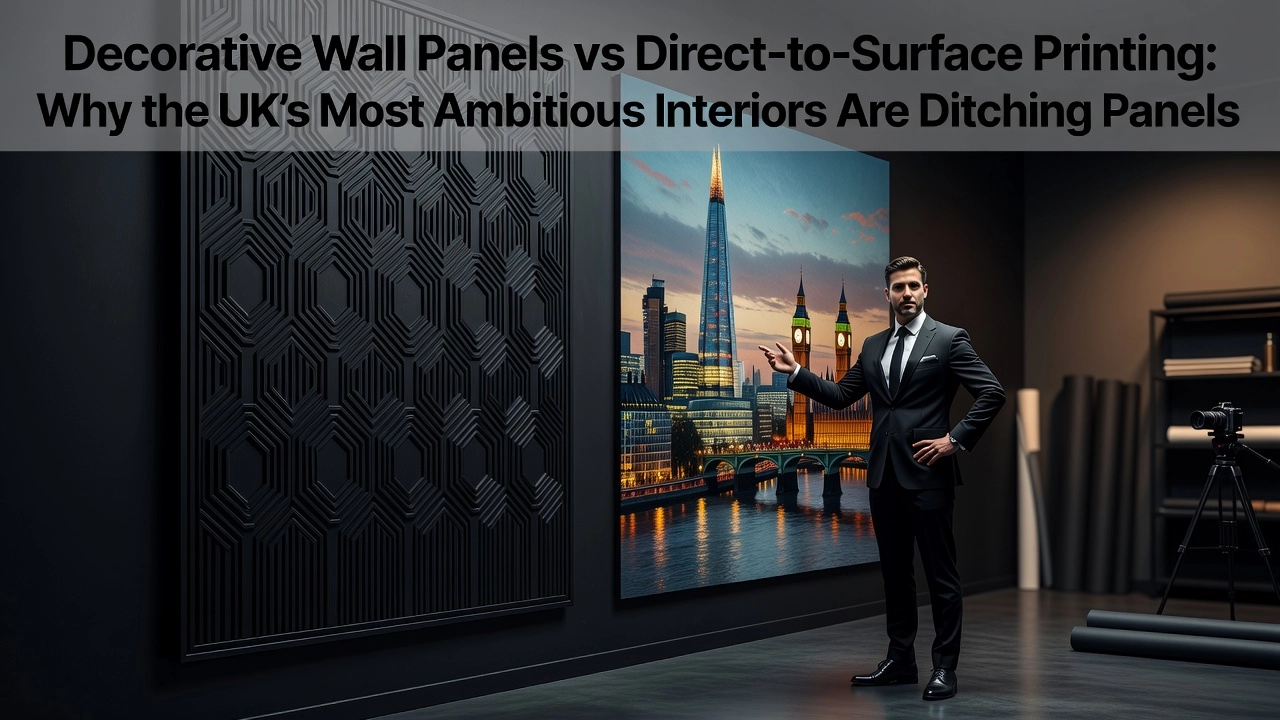
Walk into any high-end hotel lobby, upscale restaurant, or luxury residential development in the UK right now, and you will notice something has shifted. The walls are doing more than ever before, yet something about the way they look has fundamentally changed. Gone are the telltale seams, the slight texture breaks, and the visual interruptions that once quietly betrayed the presence of decorative wall panels. In their place, seamless, immersive artwork stretches across entire surfaces without a single edge in sight.
Decorative wall panels have dominated the UK interiors market for decades, and for good reason. They are practical, relatively affordable, and endlessly versatile. But a growing number of designers, architects, and property developers are quietly moving away from them in favour of direct-to-surface printing, a technique that is redefining what walls can actually achieve.
In this post, we will break down exactly how these two approaches compare across cost, installation, longevity, design freedom, and overall impact. By the end, you will have a clear picture of which solution genuinely serves ambitious interior projects best.
What Are Decorative Wall Panels? The Honest Overview
Decorative wall panels are architectural surface elements installed over existing walls to deliver aesthetic appeal, protection, or functional performance. They represent a genuinely broad category, and understanding the main physical types is the honest starting point before any conversation about which solution actually earns its place on your wall.
PVC and composite panels are the workhorses of the category. Waterproof, lightweight, and fire-resistant, WPC (wood-plastic composite) and SPC (stone plastic composite) variants blend recycled materials with practical performance credentials, making them a popular choice for bathrooms, kitchens, and commercial wet areas. Laminate and wood-effect cladding replicates the appearance of timber and stone at lower cost, typically using melamine-faced boards or UV marble sheets that capture the grandeur of natural materials without the weight or maintenance demands.
3D textured panels introduce depth and shadow play to flat surfaces. Relief depth is the defining variable here: panels under 0.2 inches deliver subtle surface texture, while 0.5 to 1-inch relief profiles cast dramatically deeper shadows under directional lighting, creating rooms that genuinely shift in mood as daylight moves. Natural material panels, including bamboo, cork, grass and reed, and natural fibre cladding, bring biophilic warmth to interiors. Bamboo charcoal panels even combine sustainable fibres with activated charcoal for air-purifying properties, reflecting the growing convergence of aesthetics and environmental performance. Rounding out the category, acoustic and functional panels built from foam or timber cores wrapped in vinyl or fabric serve schools, hotels, auditoriums, and open-plan offices, absorbing sound transfer while contributing a designed surface rather than a purely utilitarian one.
The market data behind this category removes any doubt about its commercial seriousness. The global wall panels market is valued at USD 1.23 billion in 2026 and is projected to reach USD 2.84 billion by 2035, growing at a CAGR of 8.7%. That trajectory does not describe a design trend; it describes a fundamental, sustained shift in how built environments are conceived and finished.
Sustainability has moved from a peripheral talking point to an active purchasing criterion, particularly in commercial settings with ESG commitments. Bamboo, natural fibre, and recycled laminate materials now anchor dedicated product ranges, while specifiers increasingly prioritise low-VOC and formaldehyde-free options across healthcare, education, and hospitality procurement, as catalogued in current decorative wall panels guides.
In the UK specifically, dedicated market research windows extending to 2032 confirm that demand for decorative wall solutions is on a sustained upward trajectory across residential, commercial, healthcare, and education sectors. British specifiers and homeowners are not browsing casually; they are actively investing in wall transformation at scale.
Physical panels are a legitimate, well-evidenced category answering a real desire to change how a wall looks and feels. But they are one answer to that question, and as this comparison will show, not necessarily the most powerful one available.
The Limitations Nobody Mentions When Selling You Wall Panels
The panel brochure rarely tells you the full story. What follows is the part of the conversation that tends to happen after the purchase order has been signed.
Installation Is Never as Simple as It Looks
Physical panel installation involves adhesives, mechanical fixings, precise measurement, surface preparation, and accurate cutting. For anything beyond a straightforward domestic feature wall, a skilled trade is typically required, and that labour cost sits entirely outside the per-square-metre material price you see advertised. Factor in the complete procurement timeline: specifying the right product, placing an order, waiting for delivery, scheduling a fitter, and allowing for surface prep and curing time. That process routinely stretches across several weeks. Any honest total-cost calculation must include every one of those variables, not just the panel price itself.
The Seam Problem Nobody Wants to Discuss
Close your eyes for a moment. Picture a floor-to-ceiling panoramic forest scene flowing across an entire hotel lobby wall without a single interruption. Now picture that same design installed with physical panels. See those lines? Every physical panel has edges, and every edge creates a visual break. No matter how precisely a skilled installer fits the joins, those seams interrupt the image. For the kind of immersive, large-format visual environments that hospitality brands, retail operators, and corporate spaces increasingly demand, that limitation is structural and unavoidable. It is also almost never mentioned in product marketing materials. Tracking 2026 wall panel trends confirms the direction of travel toward bolder, more immersive surfaces, which only makes the seam problem more visible, not less.
Fixed Aesthetics Are a Hidden Long-Term Cost
Once panels are bonded to a surface, they are committed. Changing the look means stripping, disposing, and restarting the entire procurement and installation process from scratch. For a hotel that refreshes its aesthetic every four years, a gym that rebrands, or a restaurant that evolves its concept, that locked-in aesthetic represents a significant future liability that simply does not appear on the original specification sheet. The cost of change is rarely included in initial sales conversations, yet for commercial environments, it is one of the most financially material decisions a specifier can make.
Moisture and Edges Are a Genuine Operational Risk
In bathrooms, commercial kitchens, gym changing rooms, and hospitality wet areas, panel edges represent a documented vulnerability. Lifted edges trap moisture. Trapped moisture creates conditions for surface deterioration that compromises both visual quality and hygiene standards. This is not a marginal risk; it is a known characteristic of bonded panel systems in high-humidity environments, and it matters considerably in any setting where hygiene compliance is regulated or inspected.
The Environmental Footprint Is Larger Than It Appears
Off-cuts from cutting panels to size, protective packaging on delivery, waste from old surface removal, and eventual panel disposal at end-of-life all contribute to a physical installation's total environmental footprint. Decorative architectural panel systems are evolving, with some manufacturers using recycled content in raw materials, but recycled input does not resolve installation waste or disposal volume. For commercial specifiers with ESG reporting obligations or sustainability targets, this underexamined liability is worth quantifying before committing.
The Comparison That Changes the Conversation
Criterion
Physical Wall Panels
Direct-to-Surface Printing (Machine Canvas)
Installation time
Days to weeks including delivery and fitting
Faster on-site application; no panel lead time
Customisation flexibility
Limited to available patterns; custom orders add cost
Fully bespoke; any image or design printed directly
Seam lines
Unavoidable at every panel join
Seamless; no physical joins interrupting the image
Scale capability
Constrained by panel dimensions; large walls need many joins
Floor-to-ceiling, wall-to-wall continuous imagery
Entry cost
Material plus delivery plus labour plus surface prep
From £250; no panel procurement or disposal cost
Longevity/guarantee
Variable; edge lift and moisture ingress are known risks
5-year interior guarantee; lacquer-sealed, no edges to lift
Sustainability profile
Off-cuts, packaging, and end-of-life disposal add to footprint
Minimal waste; no physical product manufactured or shipped
Visual resolution
Fixed surface texture; imagery limited by panel material
2400 DPI UV-cured print; photographic quality on any surface
On every criterion that matters to a serious specifier, direct-to-surface printing resolves a problem that physical panels simply cannot. That is not a marketing claim; it is the logical consequence of a fundamentally different approach to the wall surface itself.
The Alternative That Is Rewriting Interior Design Across the UK
There is a process available right now, being used across hotels, gyms, offices, restaurants, and homes throughout England, Scotland, and Wales, that renders every physical panel constraint entirely irrelevant. It does not involve ordering a product, managing a supply chain, cutting panels to fit, or accepting the visual compromise of a seam running across your feature wall. It is UV-cured direct-to-surface printing, and it is not a refinement of existing technology. It is a different category altogether.
The process itself is straightforward to understand. CMYK UV-cured ink is printed at 2400 dots per inch directly onto your existing wall or floor surface. The surface does not need to be replaced, lined, or panelled first. There is no physical product to manufacture, package, ship, or store. No waste. No waiting for delivery. No measuring and cutting on-site. The artwork goes directly onto the surface you already have, and it does so at a resolution that exceeds the threshold of human visual perception at normal viewing distance.
Picture the Wall Itself Becoming the Artwork
Stop and visualise this properly. You are standing in a hotel lobby. The feature wall in front of you is floor-to-ceiling rainforest. Not a printed panel. Not wallpaper. Not a mural painted by hand. The wall itself has become the artwork. Every leaf is rendered at a resolution so sharp it appears to carry physical depth. The light catches the surface and the canopy reaches forward into the room. Guests stop. They photograph it. They do not look for a frame, a join, or an edge because there is none. That is not a creative exaggeration. That is a Machine Canvas installation, and it is available from £250.
Visual Capabilities No Physical Panel Can Match
The visual range available through UV direct-to-surface printing has no equivalent in the physical panel market. Photo-realistic murals reproduce at a fidelity that physical panel printing simply cannot achieve at this scale. 3D burst-through effects create the illusion that design elements are physically projecting from the surface into the room, an effect that has to be seen in person to be fully processed. Perspective corridor illusions use carefully engineered depth cues to make a short corridor read as a significantly longer one, a transformation that changes how a space feels to occupy rather than simply how it looks. Full-room wraps dissolve the boundary between wall and world entirely, pulling the viewer into a landscape, an abstract, or a branded environment that surrounds them completely. Decorative panel innovation continues to advance, but no physical product in the current market replicates any of these effects at this resolution or at this scale.
The Technology Advantage, Stated Plainly
UV-cured ink does not sit on top of the surface in the way conventional paint or printed media does. It bonds at a molecular level during the curing process, creating a finish that is structurally integrated with the substrate. A lacquer-sealed top coat adds durability, stain resistance, and cleanability, making the finish appropriate for high-traffic commercial environments and family homes alike. Machine Canvas backs every interior installation with a five-year written guarantee and every exterior application with a three-year written guarantee. That is not a marketing claim appended to a brochure. It is a contractual commitment.
Zero Seams. Zero Edges. Zero Compromise.
Because the image is applied directly to the surface rather than assembled from components, the visual field is continuous. No joins. No panel edges creating shadow lines across the image. No grout lines bisecting a mural. The image runs from corner to corner and floor to ceiling without interruption. Physical panels, regardless of how they are engineered or finished, are assembled from discrete components. Seams exist by definition. The 2026 interior design trends shaping UK homes point toward immersive, continuous visual experiences. Only direct-to-surface printing delivers that without compromise.
Scale is the final differentiator. Machine Canvas prints onto interior walls, exterior facades, floors, ceilings, feature walls, and entire rooms. A single decorative feature or an entire building. Scale here is not a limitation to engineer around. It is simply the canvas.
Where Direct-to-Surface Printing Outperforms Panels Every Single Time
The global wall panels market is projected to reach USD 2.84 billion by 2035, growing at a compound annual growth rate of 8.7 percent. That figure tells you demand for designed wall surfaces is accelerating sharply. What it does not tell you is that a growing share of the most visually ambitious, commercially serious interior projects are moving decisively away from physical panels entirely. The reason is simple: direct-to-surface printing at 2400DPI does things that no panel range, at any price point, is physically capable of doing.
Hotels and Hospitality
Close your eyes for a moment and picture the lobby of a hotel that stopped you in your tracks. Chances are, the wall did something unexpected. Direct-to-surface printing makes that moment repeatable, intentional, and permanent. A lobby mural can be botanically precise, architecturally scaled, and photorealistic to a degree that rewards inspection from two inches or twenty feet. Corridor perspective illusions, a speciality of Machine Canvas's portfolio, transform a utilitarian service corridor into something guests photograph and share. The branded feature wall in a reception area does not just look like the brand; it is the brand, embedded into the physical fabric of the building. Printed once, guaranteed for five years, requiring zero ongoing maintenance, it operates at a cost-per-year that physical panel installations cannot approach once fitting, replacement, and repair cycles are factored in.
Gyms and Leisure Centres
Now picture the treadmill row of a serious gym. Behind it, a sprinting athlete rendered at full wall height, the depth of field pulling the figure physically forward from the surface, every muscle fibre resolved at a resolution that makes the image feel almost three-dimensional. That is a 3D burst-through effect, printed directly onto the wall at 2400DPI, and it is something a physical panel cannot produce because physical panels have no depth of field. They are flat objects in a flat range. Wall printing versus wallpaper comparisons consistently identify the seamless, fixture-free finish as a decisive advantage in high-impact commercial environments, and in a gym, where impact surfaces and hard-wearing walls are the norm, the absence of protruding physical fixtures is not a minor benefit; it is a meaningful safety and maintenance consideration.
Offices and Commercial Spaces
A reception wall is the first substantive thing a client sees when they walk through the door. A panel in a stock finish says very little. A full-resolution printed wall expressing the organisation's visual identity at scale, correctly coloured, correctly proportioned, and impossibly detailed, says that this is a company that invests in quality without compromise. Digital printing is actively rewriting interior design for precisely this reason: it removes the constraint of manufactured ranges and replaces it with the constraint of imagination alone. Collaborative zones with distinct visual identities, breakout spaces with printed environments that shift the mood of the room, branded corridors that make the building feel like a coherent creative statement rather than a tenanted space; these are outcomes direct printing delivers at full resolution, every time.
Schools and Nurseries
Children respond to detail. An alphabet mural that is rich with illustrated characters, precisely rendered animals, layered outdoor scenes, and imaginative world-building imagery does more for engagement and environmental quality than any panel range manufactured in standardised formats. Machine Canvas's UV-cured finish is durable, cleanable, and safe for educational environments, making it as practical as it is visually transformative. Technical comparisons between direct printing and conventional wall coverings confirm that UV-cured inks bond to the surface rather than sitting on top of it, which means no peeling corners, no adhesive failure, and no moisture trapping behind the substrate.
Restaurants and Cafés
Visualise a botanically precise tropical scene covering an entire restaurant wall from floor to ceiling, every leaf and shadow resolved at a resolution that genuinely rewards close inspection by a diner seated directly beside it. That is atmosphere created by print, not by physical fixtures. A Tuscan vineyard, a dense urban skyline, an abstract tonal mural that defines the entire brand aesthetic of a hospitality space; these are executed in a single session, with no physical elements to obstruct sightlines, collect grease, or require seasonal replacement.
Residential Feature Walls
Every home has one wall that could define the entire room. Direct-to-surface printing makes that wall genuinely bespoke: a family landscape, a geometric optical illusion that makes the room feel twice its actual depth, or a burst-through floral arrangement that fills every corner of the space with colour and three-dimensional energy. No off-the-shelf panel range has ever offered this. Machine Canvas's free design mock-up means you can see exactly what that wall will look like before a single drop of ink touches the surface, with pricing starting from £250 and a five-year interior guarantee behind every project.
The True Cost Comparison: Panels vs Printed Surfaces
Strip away the brochure language and the comparison becomes straightforward. Physical decorative wall panels carry a product price, a delivery charge, adhesives, trims, fixings, and trade labour, and every one of those line items lands on your invoice before a single design decision has been made. PVC and MDF panels start from £9 to £15 per panel at the product level, with professional fitting adding £15 to £25 per square metre on top. Scale that across a feature wall of 12 square metres and you are looking at a material and labour stack that comfortably exceeds several hundred pounds before consumables and delivery are factored in. Direct-to-surface printing from Machine Canvas starts from £250 as a single consolidated figure, with no separate procurement chain attached to it.
Design Confidence Before a Single Payment
The free design mock-up model is where the financial comparison becomes something more significant than a cost-per-square-metre calculation. Before any commitment, before any payment, before a van leaves Lytham St Annes, you see exactly what your finished wall looks like at full scale, in your space, with your chosen design. Physical panel specification cannot offer this. Panels are ordered, delivered, and installed before the reality of the finished result is visible on your wall. Colour variation between a manufacturer's render and the physical batch is a known procurement risk, and the return logistics for a full panel order are costly. The mock-up model eliminates that risk entirely and replaces it with a level of pre-purchase confidence that changes how the decision feels.
Longevity Against Known Failure Modes
Machine Canvas backs interior printed surfaces with a 5-year guarantee and exterior work with a 3-year guarantee, with a lacquer-sealed finish maintaining that protection without any maintenance schedule required on your part. Physical panels carry failure modes that accumulate invisibly over time: lifted edges at seam joints, moisture ingress behind the panel face, progressive delamination, and colour fade in high-UV environments. None of these are addressable without partial or full reinstallation. Commercial environments that renew traditional surface treatments every 3 to 5 years often find that the 10-year total cost of ownership across multiple cycles substantially exceeds the original installation figure. A single printed surface, guaranteed and sealed, does not behave this way.
Zero Waste, Zero Repeat Procurement
For commercial specifiers carrying ESG reporting obligations, the sustainability position of direct-to-surface printing is structurally different from any panel product. There are no off-cuts, no packaging materials, no physical substrate requiring disposal at end of life, and no repeat procurement cycle triggered by wear or fashion change. The wall is the product, and the product is permanent. This matters in sectors where procurement teams are accountable for material waste metrics and supply chain transparency.
A Refresh Without Structural Disruption
Because no physical substrate is bonded to the structure, a future redesign requires no stripping, no skip hire, no trades, and no surface remediation. As this 2026 guide to direct-to-wall UV graphics confirms, high-traffic commercial environments are actively re-evaluating legacy surface approaches for exactly this reason: visual identity needs to evolve, and the ability to do so without structural disruption is a business advantage, not a cosmetic one. A return visit and a new design brief are all that stand between your current wall and the next version of your space.
The Process: Simpler Than Ordering Wall Panels Online
Ordering decorative wall panels online, even from a well-organised supplier, means entering a procurement chain. You confirm product type, specify dimensions, review physical samples, wait for production, coordinate delivery, schedule installation, and manage the trade. The custom decorative wall panels OEM/ODM process involves requirement consultation, mold development, pre-production preparation, mass production, quality control, logistics, and on-site fixing before a single wall is transformed. The Machine Canvas process involves five steps, and the client is responsible for exactly one of them.
Step One: The Conversation That Replaces a Specification Sheet
Contact Machine Canvas via WhatsApp or click-to-call, describe the space, share dimensions or a photograph, and a full visualisation of the finished wall is produced before any commitment is made. No samples to wait for. No specification forms to complete. The result is visible in your actual space, at scale, with accurate colour rendering, before the process advances by a single step.
Step Two: Approval Without Guesswork
The mock-up shows precisely what will be printed, in your space, at the correct proportions. Where traditional panel procurement requires iterative sample approval before mass production even begins, approval here is the final confirmation before the team arrives on site. Colour accuracy is built into the process at 2400DPI resolution. What you approve is what appears on the wall.
Steps Three, Four and Five: Arrival, Print, Guarantee
Machine Canvas visits the site and prints directly onto the existing surface. No adhesive substrate preparation. No panel cutting or fixing schedules. No trade coordination required from your side. Immediately after printing, a lacquer seal is applied, bonding the UV-cured ink to the wall and activating the guarantee period. The wall is ready to occupy, trade through, or open to guests the same day.
Step five is the result. A surface that looks like nothing else in the building, finished to a standard backed by a written five-year guarantee. Close your eyes and picture it: a corridor that stops visitors mid-step, a feature wall that redefines the entire room, a floor-to-ceiling image printed at a resolution that demands to be looked at closely. That wall exists from the moment the lacquer cures, and it will still look precisely that way in five years. That is the guarantee, in writing.
Close Your Eyes and Visualise What Your Wall Could Actually Be
Picture a giraffe. Its hooves are planted at skirting board level. Its neck rises the full height of the wall. Its head, rendered at a scale that fills your peripheral vision, appears to push forward from the surface, the nose breaching the wall plane into the room itself. Now place that image in a children's hospital ward, where a patient in a bed looks up at something extraordinary rather than a painted ceiling. Place it in a school corridor, where students walk past a savannah every single day. Place it in a hotel breakfast room, where guests reach for their coffee and find themselves on the edge of a game reserve. Place it in a living room. Hold every one of those images, because none of them are concept renders or mood board fantasies. Every single one of them is a delivered Machine Canvas project, printed directly onto the surface using UV-cured technology at 2400DPI.
What 2400DPI Actually Feels Like
Specifications on paper communicate nothing. Standing in front of a 2400DPI direct-to-surface print communicates everything. At that resolution, the texture of bark is not suggested by pattern repetition; it is present, groove by groove, in a way that makes your fingertips expect resistance. The veining of a single leaf is rendered individually, not approximated by a repeating tile. The depth of shadow in a mountain range creates genuine spatial recession, the kind that registers not as decoration but as depth, as if the wall has simply ceased to be a wall. This is not an image brought to site on a substrate and mounted. The wall itself becomes the image. The surface and the artwork are the same object. That distinction is not technical; it is entirely experiential, and it is the reason people stand in these rooms and stop talking.
The Ceiling of the Catalogue
The most premium decorative wall panel range available presents a fixed selection of pre-designed textures, printed to a fixed maximum resolution, onto a physical substrate, cut to standard sizes, and joined at seams that reassert themselves as product every time the light catches an edge. The ambition is real. The constraint is structural. Forty-four unique designs, however beautifully executed, is someone else's imagination applied to your space. The seam is where the illusion ends and the panel begins.
Now do something deliberate. Stand in the room you intend to transform. Look at the wall. Ask yourself, honestly, whether a catalogue of pre-cut panels represents the actual limit of what that surface could become, or whether the surface itself is the canvas, waiting for an image that exists nowhere else in the world, scaled precisely to your dimensions, printed directly into the wall, with no seams, no substrate, no ceiling on ambition.
Your Next Feature Wall Deserves Better Than a Panel
Decorative wall panels serve a genuine market need, and this comparison has treated them fairly. For straightforward surface coverage, consistent texture, and DIY-friendly installation, they remain a legitimate choice. But legitimacy and transformation are not the same thing. For any space where the wall is meant to do something, to anchor a room, define a brand, or create the moment that guests photograph and share, direct-to-surface UV printing operates on an entirely different level. Superior visual resolution at 2,400 DPI, true seamlessness across any wall dimension, complete freedom of scale and subject matter, and a simpler process from first conversation to finished result: these are not marginal improvements. They are structural advantages.
The starting point carries no risk. A free design mock-up from Machine Canvas shows exactly what your wall could become, rendered in full resolution, before any commitment is required. It is not a mood board or a rough sketch; it is the finished result on your actual wall, visible before a single decision is made.
The most memorable hotels, gyms, offices, and homes across the UK right now share one defining quality: a wall that stops people mid-step, demands a second look, and earns its place in a phone camera roll. Request the free mock-up today and explore the portfolio at Machine Canvas.
Conclusion
The evidence is clear: direct-to-surface printing is outpacing decorative wall panels across the metrics that matter most to ambitious UK interiors. It delivers seamless, immersive visuals that panels simply cannot replicate. It eliminates installation complexity, reduces long-term maintenance concerns, and unlocks a level of creative freedom that transforms walls into genuine design statements.
If you are planning a high-end hospitality project, a luxury residential development, or a commercial space where first impressions count, the question is no longer whether to consider direct-to-surface printing. It is whether you can afford not to.
Ready to see what your walls could become? Speak with a specialist today and explore what direct-to-surface printing can do for your next project. The most inspiring interiors in the UK are already making the shift. Yours could be next.