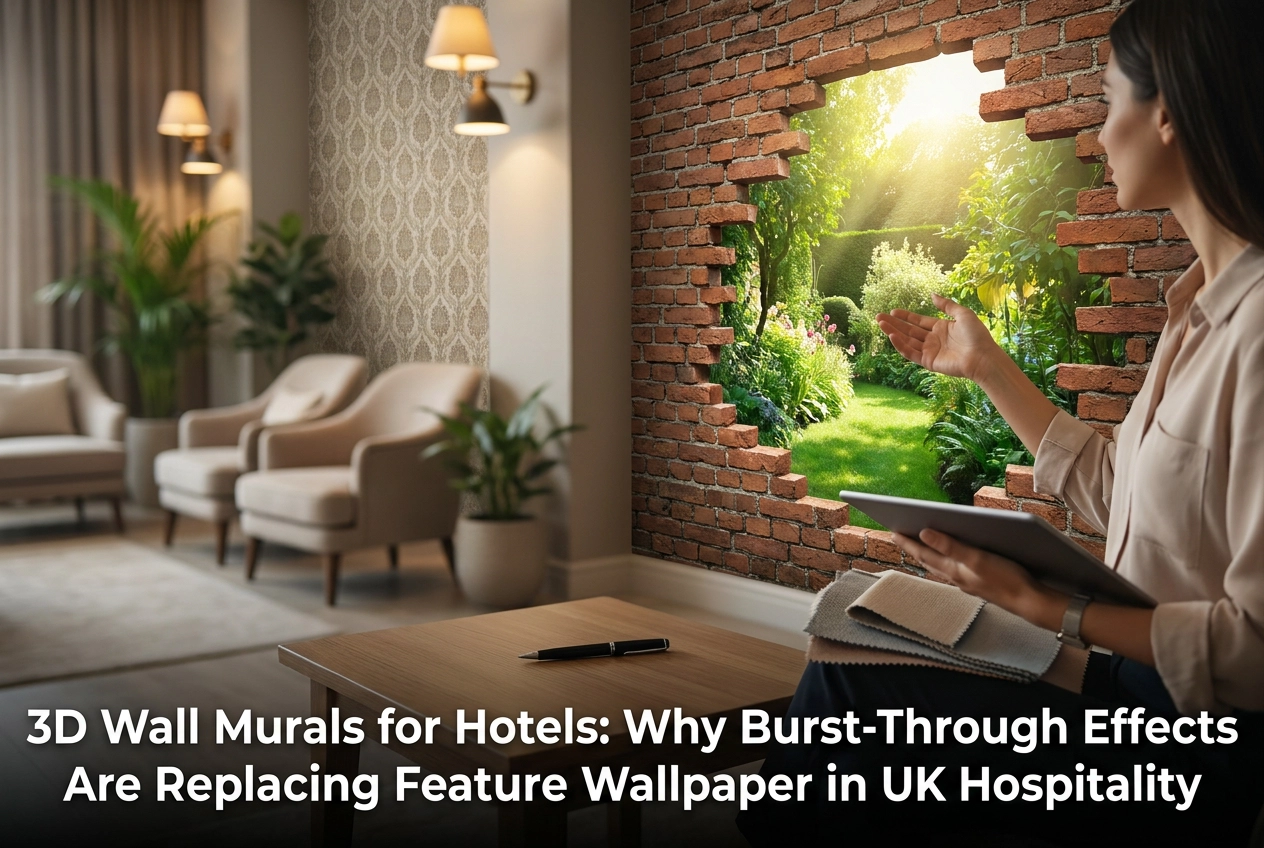
A guest turns the corner into your hotel lobby and stops walking. Not because of a sign, not because of a member of staff, but because something on the wall demands their attention. Within seconds, the phone is out. Within hours, your property is on their feed.
This is not a happy accident. It is the result of a deliberate design decision, one that a growing number of UK hotels are exploring by moving away from feature wallpaper and toward 3D burst-through printed murals.
The wall murals UK hospitality designers are now commissioning are nothing like the patterned wallcoverings of previous renovation cycles. They create spatial illusions, emotional reactions, and shareable moments that wallpaper simply cannot produce, regardless of the print quality or pattern complexity.
In this post, we break down exactly why burst-through 3D murals are outperforming feature wallpaper across guest experience metrics, brand memorability, and long-term durability. We examine the technology behind the effect, the commercial case for switching, and what UK hotels gain when they commit to visual installations built to perform at hospitality scale.
The Moment a Guest Stops Walking and Reaches for Their Phone
Picture it. Your hotel lobby, and one wall that does not sit quietly behind your guests but erupts toward them: a 3D burst-through mural printed at ultra-high definition, towering botanical forms reaching forward from the surface, geometric architecture projecting outward with impossible depth, or a dramatic landscape rendered with such tonal precision that the eye cannot immediately resolve where the wall ends and the image begins.
In that moment, the guest stops mid-stride. They orient their body toward it. They raise their phone. That instinctive act, repeated by every guest who encounters the wall, transforms your interior design into circulating content, reaching audiences you have never paid to address.
This is the measurable gap between a feature wall guests walk past and one they walk toward. It is the gap that separates properties guests forget from properties guests describe to friends, photograph for followers, and return to because the space felt genuinely remarkable.
Post-pandemic, that gap has become a commercial pressure point. UK hotels are increasingly directing design investment toward guest experience, and the design directive is clear: passive decoration no longer earns its place on the wall. Immersive, photographable, brand-distinct visual moments are increasingly understood as drivers of return visits, word-of-mouth, and the kind of reviews that fill rooms.
Feature Wallpaper Has a Problem It Cannot Design Its Way Out Of
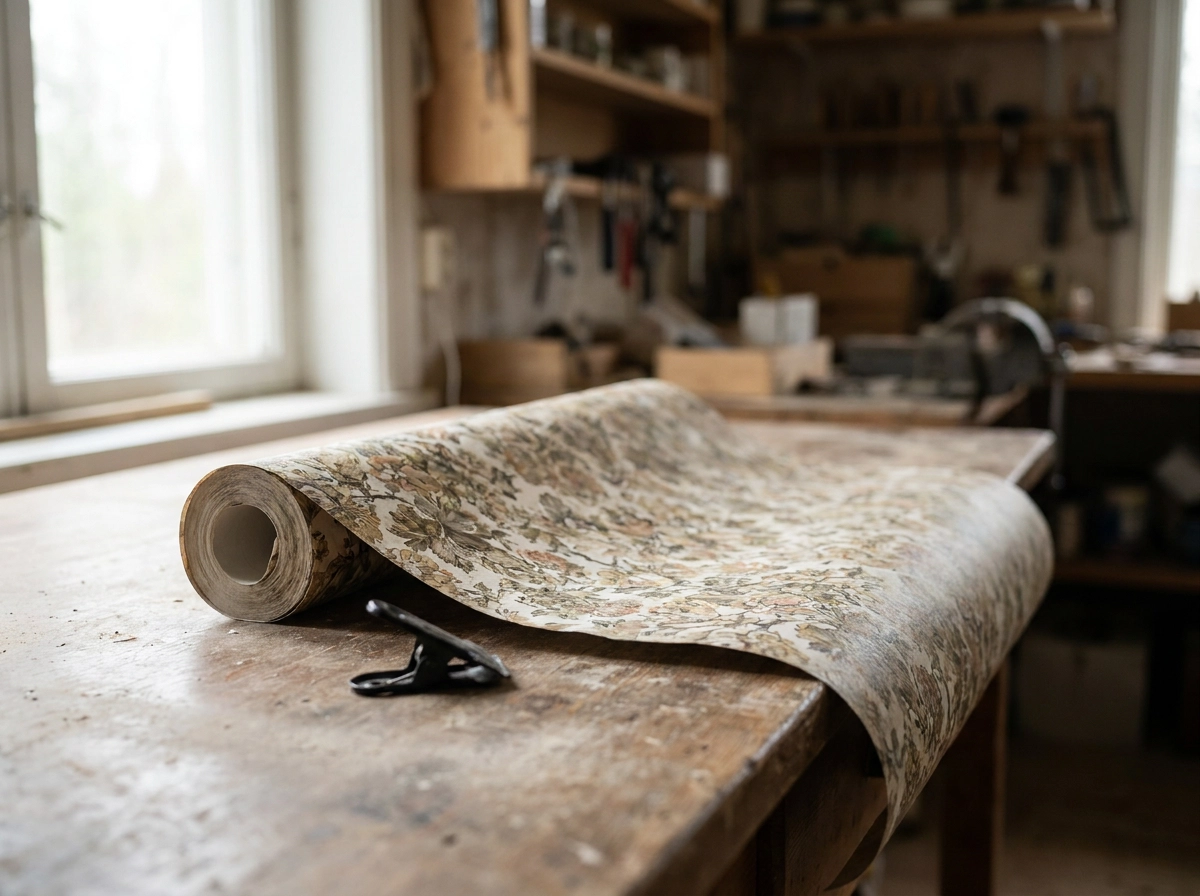
Feature wallpaper served a purpose. For decades it was the hospitality industry's dependable shortcut to a considered interior: affordable, pattern-rich, and capable of transforming a blank lobby wall into something that at least communicated curatorial intent. That era is over, and the problem is structural, not stylistic.
Wallpaper is inherently passive. It sits flush against the surface, offers no depth, invites no interaction, and gives a smartphone camera precisely nothing to work with. In a photograph, a flat patterned wall collapses into the background. It does not anchor the frame or stop the scroll. Guests walk past it.
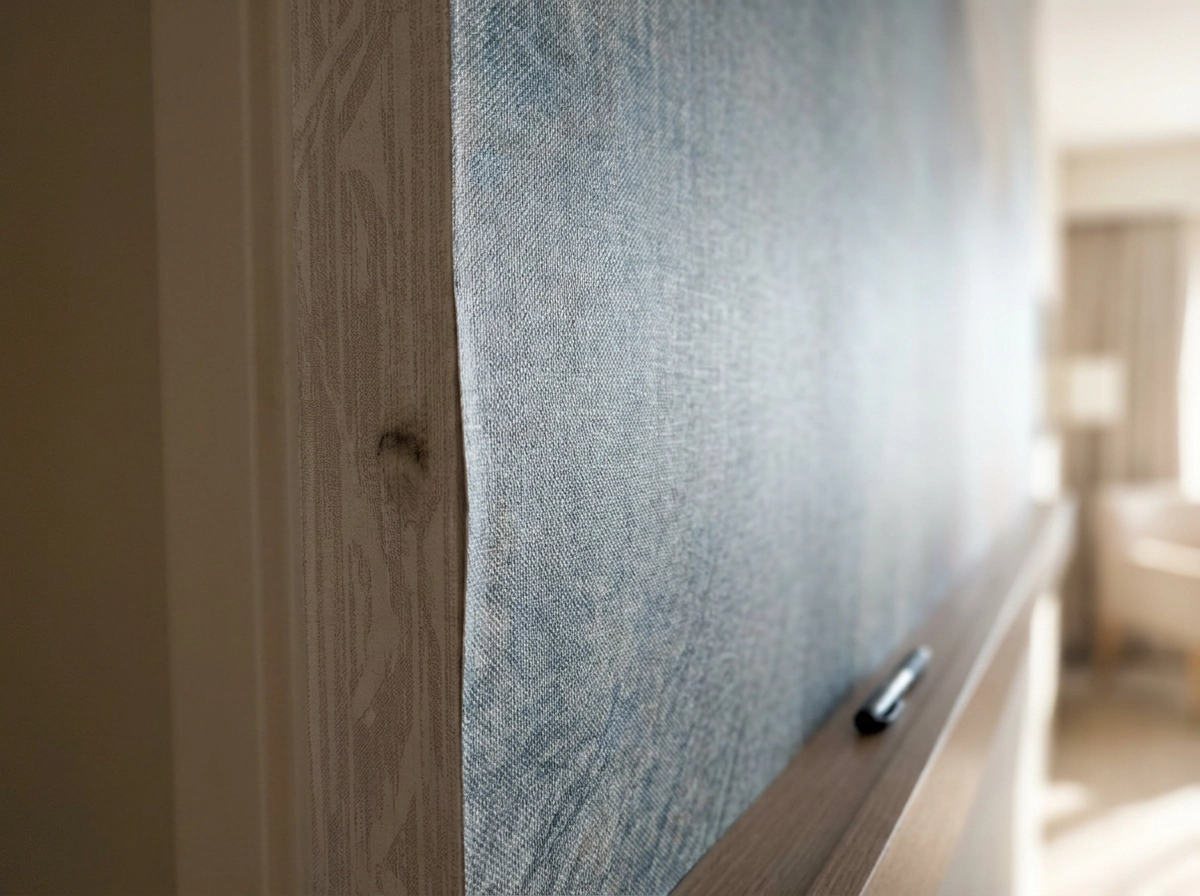
The physical durability record in commercial hotel environments compounds the issue. In practice, seams lift at corners and high-contact edges. Cleaning regimes, running continuously in a working hotel, gradually loosen adhesive bonds. Humidity in en-suites and kitchen corridors accelerates delamination. When a section is damaged, a pattern-match repair using original stock is rarely achievable, and the result is visible. These are not edge-case failures; they are the predictable consequences of applying a residential-grade finish to a high-traffic commercial surface. The case for why direct-to-surface printing outperforms applied finishes in commercial settings comes down to exactly this attrition.
Design obsolescence arrives on a similar timeline. A wallpaper scheme can feel dated within a few years of installation, triggering strip-and-replace cycles that carry significant materials and labour costs and require taking operational spaces out of service.
That recognition gap is where brand memorability is lost, the subject of the next section.
What a Burst-Through 3D Wall Mural Actually Does to a Space
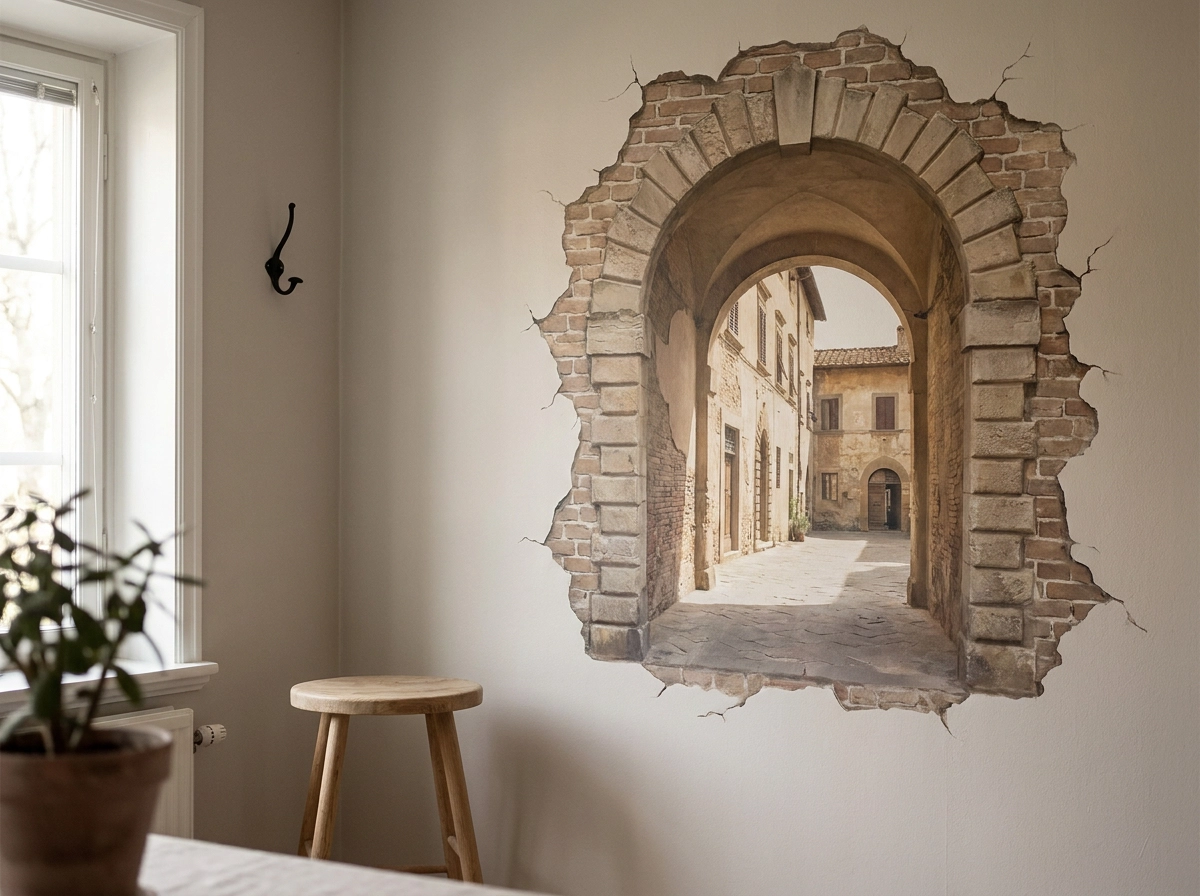
Where wallpaper retreats to the background, a burst-through mural advances. The difference is not aesthetic preference; it is structural.
A burst-through effect is a printed design engineered with precision: perspective calculation, shadow layering, and forced foreshortening combine so that elements appear to physically break the plane of the wall. Picture botanical branches reaching forward at impossible scale. Wildlife emerging from the surface as though the wall is a membrane rather than a boundary. Architectural forms projecting outward with the weight of something real.
Now picture it rendered in ultra-high definition, at a resolution where every tonal gradient reads as physical depth rather than printed colour. Your eye genuinely cannot immediately resolve where the wall ends and the image begins, that moment of visual suspension is instinctively photographable.
The impact operates simultaneously across three registers. Spatially, the room or corridor feels dramatically larger and more dynamic, the eye pulled through a surface that no longer has a fixed depth. Emotionally, the image carries narrative: a lobby mural of dense tropical foliage communicates something fundamentally different from one of geometric architecture, and guests absorb that mood before they reach reception. Socially, the wall becomes a landmark; guests reference it, photograph it, and post it, making it a recurring presence in the reviews and feeds that influence future bookings.
Experiential continuity extends that logic across the full property. A custom 3D burst-through mural programme can carry a consistent visual narrative from lobby through corridors and into guest rooms, so guests feel the brand at every transition rather than only at check-in.
Critically, luxury wall murals achieve this without the operational burden of physical art installations: no insurance schedules, no specialist lighting rigs, no security requirements, no rotation logistics.
Wallpaper vs. 3D Printed Murals: What Hotel Buyers Actually Need to Know
The experiential case is clear. Now here is where procurement logic catches up with design ambition.
Feature Wallpaper
3D Printed Mural
Visual impact
Flat pattern; background element in every photograph
Dimensional foreground moment; anchors every image taken in the space
Durability
Seam lifting, humidity delamination, edge damage from trolleys and luggage
UV-cured ink bonds directly to substrate; lacquer-sealed finish withstands cleaning, moisture, and daily contact
Maintenance
Damage requires patching or full strip; batch-matching after the original run sells out is rarely precise
No seams, no adhesive layer; surface cleaning does not compromise the image
Longevity
Wear, damage, or trend ageing drives periodic strip-and-replace cycles
Five-year interior guarantee reduces replacement frequency and operational disruption
Brand distinctiveness
Catalogue product; any property can specify the same pattern
Commissioned exclusively for the property; unrepeatable and narratively specific
Social media value
Photographically inert; generates no organic content moment
A photographable landmark that circulates on every platform each time a guest posts
Installation
Requires stripping, adhesive preparation, seam management, and drying time
Prints directly to the surface; no substrate layers, shorter access window
For hotel buyers weighing operational risk against creative ambition, the comparison above is not close. Direct-to-surface printing removes compounding liabilities entirely. There is a deeper examination of exactly where direct-to-surface printing outperforms panels every single time if the specification case needs building further.
The technology behind that performance is what the next section addresses.
The Technology That Makes Hospitality-Grade Depth and Durability Possible
Those comparative advantages are only possible because of what is happening at the print level itself.
The dimensional illusion in a burst-through 3D wall mural is not a design trick; it is a function of resolution and colour precision. At 2400 DPI with full CMYK rendering, the tonal gradients, shadow transitions, and depth cues that make an image read as physically three-dimensional are reproduced with a fidelity the eye processes as spatial rather than printed. The result is not a picture of depth; it is perceived depth.
UV-cured ink technology makes that image permanent in a way applied wallpaper fundamentally cannot be. Machine Canvas's UV-cured ink is applied directly to the wall surface, no adhesive layer, no substrate above or below it. For commercial wall murals in high-traffic hotel environments, that structural integration is the difference between a finish that holds and one that gradually surrenders to its conditions.
The lacquer-sealed topcoat does two things at once: it shields the image from cleaning chemicals, moisture, scuffs, and UV degradation, and it allows the sheen level to be specified, so the finish works with the ambient lighting of the space rather than against it.
For hospitality buyers, this translates directly into a five-year interior print guarantee, aligning product lifespan with standard commercial refurbishment cycles. The same technology scales without compromise, from a boutique hotel feature wall to a multi-floor corridor programme, and extends to exterior-facing surfaces under a three-year exterior guarantee.
How Machine Canvas Delivers Commercial Wall Murals for UK Hotels
That technology is only as useful as the team deploying it. Machine Canvas is a UK direct-to-surface printing company serving hotels and commercial properties nationwide across England, Scotland, and Wales, with a hospitality portfolio spanning 3D safari and botanical burst-through effects, perspective corridor illusions, and full-room immersive landscape murals.
The commissioning process is built to remove friction for commercial buyers. It opens with a free design mock-up, created before any financial commitment, so hotel fit-out managers and brand directors can see precisely how a finished mural transforms their actual space. That single step eliminates the guesswork that typically stalls specification decisions.
From there, the service covers the complete journey: design brief, surface preparation, print, and lacquer finishing. Pricing for commercial wall murals starts from around £250, scaling to full-property programmes across lobbies, corridors, restaurants, and guest rooms. The end-to-end workflow, from concept to completed wall, is designed to fit around operational schedules rather than disrupt them.
The portfolio demonstrates what that range looks like in practice: burst-through botanicals commanding lobby walls, geometric architectural forms reshaping corridor perception, wildlife emergence effects turning a standard guest room feature wall into something guests genuinely cannot walk past without stopping.
Critically, none of it relies on adhesive, substrate, or seam. The print bonds directly to the surface. The result is a luxury wall mural with the permanence and resilience of the wall itself, not a finish applied on top of it.
What UK Hotels Gain When They Commission a Custom 3D Burst-Through Mural
The commercial case distils into five returns that wallpaper structurally cannot match.
Every guest with a smartphone becomes an unpaid content creator. A 3D burst-through mural is intrinsically photographable; the dimensional depth that makes botanical forms appear to project from the wall compels guests to stop, frame the shot, and post it. That content circulates on Instagram, TikTok, and Google reviews among precisely the audience the property is trying to reach, generating compounding visual marketing from every stay.
The mural is exclusive to the property. A custom wall mural built around a hotel's location, history, or aesthetic identity cannot be replicated by a competitor. It positions the property as a considered destination rather than a commodity room-night, and research confirms that visual distinctiveness directly shapes brand love and loyalty outcomes.
Operational resilience is built into the medium. The compounding maintenance overhead that applied finishes accumulate over a commercial refurbishment cycle simply does not apply to UV-cured prints, which hold visual quality without seams lifting, adhesive failing, or pattern batches running out.
Immersive environments drive measurable brand affinity. Hospitality research identifies the immersive experience economy as the dominant driver of return visitation; guests who find a space visually remarkable associate positive emotions with the property, mention it in reviews, and return.
For hotels holding a luxury positioning, the statement is commercial, not merely aesthetic. Commissioning luxury wall murals signals that this property invests in extraordinary experiences, at a level no off-the-shelf finish can credibly communicate.
The Feature Wall Has Always Been the Hotel's Boldest Statement. Make It One Worth Remembering.
The decision is already made by your walls before a guest says a word. The properties delivering immersive, photographable, brand-distinct spaces are the ones appearing in reviews, on social feeds, and on shortlists for return visits.
A 3D burst-through wall mural is not a cosmetic upgrade. It is a guest experience decision, a marketing asset, and a brand statement, all resolved in a single surface. If you want to understand the broader principle of how printed environments shape perception, where printed quote walls make the biggest impact illustrates how even typographic surfaces shift the emotional register of a space entirely.
For UK hotel operators and interior designers ready to replace a wallpapered feature wall with something that genuinely earns its place on every guest's camera roll, Machine Canvas offers a free design mock-up before any financial commitment; no obligation, just the opportunity to see precisely what your wall could become.
Contact the team via the Machine Canvas contact page, WhatsApp, or click-to-call to discuss your space and start the mock-up process today.
Conclusion
Feature wallpaper had its moment. That moment has passed. UK hotels that invest in custom 3D burst-through murals are making four things happen simultaneously: they stop guests in their tracks, generate organic social content, communicate brand identity at the highest possible level, and create spaces worth returning to. The technology exists, the durability is proven, and the process begins with zero financial commitment.