
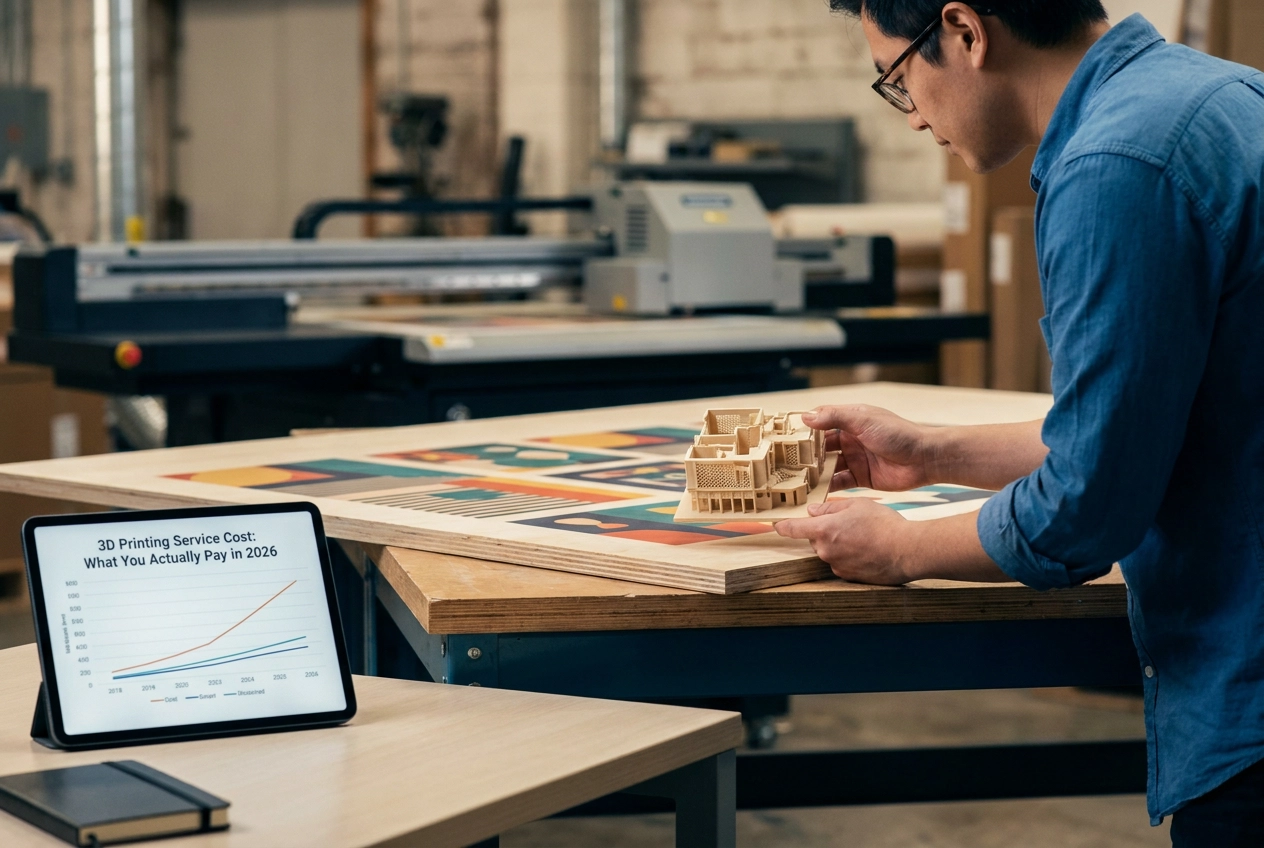
You've done the research, compared a few quotes, and still have no idea why two services charge completely different prices for the same file. You're not alone. Understanding 3D printing service cost is one of the most frustrating parts of using these platforms, largely because pricing varies based on factors most providers never bother to explain upfront.
In 2026, the landscape looks different than it did just a few years ago. Material costs have shifted, new technologies have entered the market, and competition between online bureaus has pushed some prices down while specialty services have climbed. Knowing where your money actually goes, and what separates a fair quote from an inflated one, can save you hundreds of dollars on your next project.
This guide breaks down what you can realistically expect to pay across different service types, materials, and turnaround times. We compare the major platforms side by side, highlight hidden fees that rarely appear in the initial estimate, and give you a clear framework for evaluating whether a quote makes sense for your specific needs. Let's get into the numbers.
The 3D Printing Market in 2026: Why Costs Have Shifted Dramatically
The global additive manufacturing market sits at an estimated $$28–34 billion in 2026, and the numbers alone tell a story of structural transformation, not incremental change. That total encompasses hardware, materials, software, and services, growing at roughly 20–23% compound annually since 2020. Print services on demand, the segment most relevant to anyone evaluating whether to buy, outsource, or commission professionally, accounts for $$7–8 billion of that total. This is no longer a niche technology market; it is a mature, competitive, and rapidly repricing industry that directly affects what you pay today.
Hardware commoditisation is the single most disruptive force reshaping 3D printing service cost calculations. A desktop machine that carried a $$2,000 price tag in 2020 now sells for $$250–$$400 in 2026, delivering faster speeds, better reliability, and superior output quality in the process. Approximately 3.5–4.5 million 3D printers shipped globally in 2025, with around 85% being desktop FDM units priced under $$1,000. The question for most buyers has fundamentally shifted: ownership is accessible, but whether it actually makes economic sense for a specific project is a far more complex calculation.
The so-called Bambu Lab effect, catalysed from 2022 onward, accelerated this dynamic permanently. Consumer FDM machines now operate at 300–500mm/s, a benchmark that reset market expectations for turnaround speed and output quality across every service category. You can explore broader 3D printing market size and trend forecasts to understand how these forces continue compounding through 2035.
Whether you are evaluating ownership, bureau outsourcing, or commissioning a specialist professional service, understanding these market conditions is not optional context; it is the foundation of every cost decision you will make in 2026.
Consumer FDM Printing Costs: Hardware, Filament and First-Year Reality
Consumer and prosumer FDM machines now span $$150 to $$3,500 in 2026, and the entry tier has never been more capable. According to the 2026 complete guide to 3D printing costs, machines in the $$150 to $$300 range now ship with auto-bed-levelling, CoreXY motion systems, and print speeds of 300 to 500mm/s, capabilities that demanded $$2,000 budgets just five years ago. For UK buyers, that entry window translates to roughly £120 to £240 at current exchange rates, though VAT and import duties can push real retail prices higher than a simple currency conversion implies.
The headline per-print cost figure of $$0.10 to $$3.00 for hobby-scale FDM parts looks compelling until you examine what it actually measures. That range covers filament consumed and little else. It excludes failed prints, support structure waste, bed adhesion consumables like glue sticks and replacement PEI sheets, electricity (typically $$0.01 to $$0.03 per print hour), and the operator time spent monitoring jobs, recalibrating after failures, and post-processing finished parts. For anyone printing beyond occasional curiosity, those excluded costs compound quickly.
The first-year true ownership figure is where the reality becomes clearest. Per the same source, a hobbyist FDM setup costs a minimum of approximately $$325 (around £260) once accessories, spare parts, and an initial filament supply are included. That is the absolute floor for a functional setup, not a productive or comfortable one. Nozzle replacements, additional build plates, hand tools, and a meaningful filament stock all push real-world year-one spend meaningfully higher, and monthly running costs of $$20 to $$50 continue accumulating regardless of how often the machine is used.
The learning curve represents a cost that no spec sheet will ever show. Print failures during the first one to three months of ownership can consume several hours per week in recalibration, slicer tuning, and troubleshooting. That time investment is commercially significant for anyone expecting consistent, high-quality results rather than occasional hobby outputs.
The most important contextual point is this: FDM exists to fabricate discrete physical objects you can hold in your hand. Prototypes, mechanical components, figurines, custom brackets. The entire cost model, from filament pricing to failure rates, is structured around that use case. If your goal is transforming the surfaces you live or work within, walls, floors, corridors, lobbies, FDM's cost framework is simply the wrong lens entirely. Those are different applications, different disciplines, and different value propositions. You can also explore how to calculate true 3D printer cost to understand the full ownership picture before making any hardware commitment.
Resin and SLA Printing Costs: Higher Detail, Higher Overhead
Resin printing's headline costs look deceptively approachable. The widely cited per-print range of $$0.20 to $$5.00 sounds competitive until you examine what that figure actually excludes, and the list of omissions is long enough to rewrite the budget entirely.
What the Per-Print Number Leaves Out
Every resin print cycle demands consumables that standard cost comparisons quietly ignore. FEP films, the transparent membranes lining the base of the resin vat, cloud and degrade with use and require regular replacement. Isopropyl alcohol for washing uncured resin off finished parts consumes 200 to 500ml per wash cycle. Add nitrile gloves (latex provides insufficient chemical protection), a dedicated UV curing station, and the ongoing cost of adequate ventilation or active VOC filtration, and the true per-print overhead climbs considerably beyond the material cost alone.
First-Year Ownership: The Real Entry Price
Once all required accessories are factored in, first-year resin setup costs start at approximately $$750 (around £590 in the UK), more than double the entry point for a comparable FDM setup. A buyer comparing a $$200 resin printer against a $$200 FDM printer is not comparing equivalent systems; they are comparing hardware in isolation from fundamentally different infrastructure requirements. This cost gap is structural, not incidental.
Where Resin Excels and Where It Stops
SLA 3D printing delivers genuinely exceptional surface finish and dimensional accuracy at small scale, making it the clear choice for jewellery prototyping, dental models, and fine miniatures where layer resolution as fine as 25 to 50 microns matters. The global SLA market reflects this specialist appeal, valued at $$3.8 billion in 2025 and projected to reach $$9.6 billion by 2034. However, per Raise3D's analysis of SLA applications, build volume constraints make resin fundamentally unsuited to large-format or architectural-scale work. For anyone visualising a bold, immersive result at room scale, resin's physical limitations disqualify it before cost even enters the discussion.
The Handling Reality
Uncured photopolymer resin is classified as both a skin and respiratory irritant, requiring PPE, ventilation, and careful disposal of IPA contaminated with resin residue. These requirements introduce direct recurring costs and significant time overhead per print that hardware-focused pricing guides consistently omit.
For visually striking results at architectural scale, resin's cost structure makes a compelling, rational case for professional service outsourcing rather than in-house ownership.
3D Print Bureau Services: When Outsourcing Beats Ownership
The bureau model has become the dominant entry point for professional 3D printing precisely because it converts capital risk into variable cost. The global AM services segment reached an estimated $$7 to $$8 billion in 2026, a figure that reflects not just enterprise adoption but the wholesale normalisation of outsourced print production across every scale of buyer. You pay per project, per part, per kilogram of material. Hardware depreciation, firmware updates, and the slow erosion of build plate adhesion are someone else's operational reality.
The True Cost of Ownership vs. Bureau Outsourcing
The ownership argument collapses quickly once the full cost stack is calculated. As the in-house vs. outsourced 3D printing analysis from AON3D makes clear, the real comparison is not hardware price against bureau quote; it is hardware depreciation, consumable waste, failed print losses, operator time, post-processing equipment, and maintenance contracts against a single line-item invoice. For infrequent or one-off requirements, the bureau model wins on cost almost every time. The BCN3D definitive guide to in-house vs. outsourced printing reinforces this, identifying a volume threshold below which ownership simply cannot justify itself on financial grounds alone.
Technology Selection as the Primary Cost Variable
Bureau pricing is not a flat market. Technology selection is the single largest determinant of per-part cost, and the spread between tiers is significant. FDM parts sit at the accessible end; SLS nylon production occupies the mid-to-high range; industrial resin and metal sintering via DMLS can reach costs that dwarf everything beneath them. The market is also fragmented by quality. Small operators running two to five machines generate meaningful monthly revenue, but this has made provider consistency a genuine concern. Vetting a bureau on certifications, material traceability, and minimum resolution specs matters as much as comparing quotes.
When Bureau Printing Doesn't Apply
Here is the distinction worth making explicit. Bureau services excel at producing discrete manufactured objects: parts, prototypes, functional components. When the output you actually want is not an object to hold but a surface to inhabit, an entirely different professional category applies. Imagine the impact of a 2400 DPI UV-cured mural that appears to physically erupt from your wall, a burst-through safari scene or architectural illusion that transforms a corridor into something extraordinary. That is not bureau 3D printing. That is direct-to-surface printing, and it operates on entirely different economics, starting from £250 with a free design mock-up before any commitment from specialists like Machine Canvas, backed by a five-year interior guarantee. The two categories answer different questions entirely.
What If Your 3D Printing Project Is a Wall?
Close your eyes for a moment. Picture a corridor wall that appears to physically rupture, a jungle canopy bursting through the plaster with depth and shadow so convincing that visitors instinctively step back. Visualise the velvet texture of leaves catching light, roots curling outward from a surface that your rational mind tells you is flat. That is not CGI. That is not a printed panel mounted to a frame. That is direct-to-surface UV printing, and it represents a categorically different discipline from anything an FDM bureau or resin service can produce.
The 3D printing construction and architectural surface market was valued at $$1.68 billion in 2025, estimated at $$3.04 billion in 2026, and projected to reach $$347 billion by 2034 at an extraordinary 80.8% CAGR; it is the fastest-growing segment within the entire additive manufacturing industry. While conventional 3D printing services price by grams of filament and machine hours, this category operates on an entirely different commercial logic, measured in square metres of immersive transformation.
Direct-to-surface UV printing applies UV-cured CMYK inks at 2400 DPI directly onto walls, floors, ceilings, and exterior surfaces. No substrate. No wallpaper layer. No vinyl overlay peeling at the corners after eighteen months. The result is a permanent, lacquer-sealed finish that becomes part of the architecture itself, with a five-year guarantee on interior surfaces and a three-year guarantee on exterior applications.
The visual outcomes operate on a register that no desktop printer or bureau service can approach: burst-through murals that manufacture genuine spatial illusions, perspective corridor effects that architecturally reshape a space, and floor graphics sharp enough to trigger involuntary hesitation in people walking across them. Machine Canvas delivers exactly this, with projects starting from £250 and a free design mock-up before any financial commitment.
If you arrived here searching for 3D printing service cost while planning a hotel lobby, gym fit-out, restaurant interior, retail space, or residential feature wall, this is the category you actually want. The cost conversation at this level is not about filament weight. It is about what a transformed environment is worth.
Direct-to-Surface UV Printing Costs: What Machine Canvas Charges and Why
Machine Canvas enters this conversation at £250, and that number deserves immediate context. It is not a materials-only quote. It is not a hardware rental. It covers professional artwork preparation, precision surface printing at 2,400 DPI UV-cured CMYK, and a lacquer-sealed finish that is ready for daily life the moment the team leaves. No post-processing. No sanding. No priming runs that fail. No second visit to correct colour drift. One process, one outcome, one price structure built around transparency from the first conversation.
What Moves the Price
Four variables determine where your project sits on the cost scale. Surface area is the primary driver, measured in square metres; a single feature wall and a full-room commercial mural are naturally different propositions. Design complexity is the second factor: photorealistic custom imagery and origination work require significantly more artwork preparation than a repeating geometric pattern. Third, interior versus exterior application changes the ink specification and lacquer grade required, because exterior surfaces face UV exposure, temperature variation, and moisture that demand a more robust finish. Fourth, surface preparation requirements vary by substrate; some walls are print-ready, others need conditioning before a single drop of UV ink is committed to them.
Guarantees That Change the Calculation
Interior prints carry a 5-year guarantee. Exterior prints carry a 3-year guarantee. Both are underwritten by the lacquer-sealed UV ink process, which resists fading, moisture, cleaning agents, and the kind of physical contact that commercial environments deliver daily. As independent analysis of UV direct-to-substrate printing technology confirms, UV-cured finishes bond directly to the surface itself, eliminating the failure points that plague transfer-based or adhesive alternatives. No consumer 3D printing solution offers anything comparable in architectural terms.
The Free Mock-Up Advantage
Before any financial commitment, Machine Canvas provides a free design mock-up rendered on your actual space. This single step eliminates the hidden-cost problem that haunts consumer 3D printing, where failed prints, consumable replacements, and post-processing labour mean the cost quoted at the start rarely matches the cost paid at the end. You approve the visual outcome before the project is confirmed. The risk profile is fundamentally different.
The Right Comparison for Commercial Clients
For hotels, gyms, offices, restaurants, retail fit-outs, and schools, the cost benchmark is not a desktop printer. The 2026 buyer's guide for UV printing businesses reinforces that professional UV print services are increasingly evaluated on return-on-investment against conventional fit-out costs, not against consumer hardware. Tiled feature walls carry higher material and labour costs and are permanent. Bespoke wallpaper requires specialist fitting and is vulnerable to moisture and peeling. Painted murals depend on artist day-rates and are non-reproducible. Branded vinyl wraps lift at edges, seam visibly at scale, and degrade faster in high-contact environments. Direct-to-surface printing at 2,400 DPI delivers resolution and substrate adhesion that none of these alternatives can match, at a price point that, across a five-year guarantee period, represents one of the most defensible investments in any commercial interior design budget.
3D Printing Service Cost Comparison: Side by Side
The numbers, laid bare in sequence, make the decision self-evident.
Consumer FDM
Hardware runs £120 to £2,800 depending on build quality and features. Per-print material costs sit at £0.08 to £2.40, and first-year total ownership starts at approximately £260 once consumables, failed prints, electricity, and maintenance are included. The hard ceiling is the build volume: typically 220x220x250mm. You are producing small, holdable objects. There is no guarantee, no professional output structure, and the process demands constant operational involvement. For printing replacement parts, hobby miniatures, or functional prototypes, FDM is genuinely cost-effective. For anything environmental or spatial, it is categorically the wrong tool.
Consumer Resin / SLA
Hardware ranges from £150 to £1,500, with per-print costs of £0.16 to £4.00, and first-year ownership beginning around £590. The detail quality is remarkable at small scales. The overhead is not. Resin printing requires IPA washing stations, UV curing equipment, PPE, and regulated toxic waste disposal. Build volumes remain small. There is no commercial surface application whatsoever, and the handling requirements alone exclude the majority of non-technical buyers.
Bureau Outsourcing
No capital investment required, but per-project pricing varies substantially by technology (FDM, SLS, resin), material, part complexity, and turnaround tier. Quality consistency across providers is uneven. Crucially, according to calculating 3D printing costs, even the most sophisticated bureau services produce objects, not surface treatments. No guarantee structure exists across the industry as standard.
Direct-to-Surface UV Printing (Machine Canvas)
From £250 per project. 2400 DPI UV-cured CMYK. Scalable from a single feature panel to full-room murals and multi-floor commercial installations. Backed by a 5-year interior guarantee and a 3-year exterior guarantee, with a free digital mock-up provided before any financial commitment.
The separation is now visible. Consumer and bureau printing optimise for objects you can hold. Machine Canvas optimises for environments you inhabit, sell within, and use to stop people in their tracks. The cost-per-impact ratio is not a close comparison.
Total Cost of Ownership: The Guarantee Argument No Consumer Printer Can Make
Consumer FDM and resin prints carry a degradation timeline that manufacturers quietly accept but rarely advertise. UV exposure causes progressive colour shift in PLA and resin components within months of installation in a well-lit interior. Mechanical stress, even from standard thermal cycling in a heated room, causes layer delamination at print boundaries over time. Cleaning with household products accelerates surface breakdown further, attacking the layer adhesion that holds the print together. Manufacturer warranties on every major consumer and prosumer printer cover the hardware only, and that coverage expires at 12 months. The printed output itself carries no durability guarantee from any brand currently operating in this space.
This is precisely where the total cost of ownership framework exposes the hidden liability in consumer printing. When you account honestly for reprint cycles, consumable replacement, and the time cost of post-processing degraded parts, the arithmetic shifts decisively.
Machine Canvas's lacquer-sealed UV ink finish is a different category of commitment entirely. Interior surfaces are guaranteed to maintain colour accuracy and structural integrity for 5 years. Exterior surfaces carry a 3-year guarantee under real-world British weather conditions. No consumer printer, and no bureau service delivering physical parts, offers anything comparable. The output is the asset, and the asset is protected.
Over a five-year window, a professional direct-to-surface installation from £250 generates zero reprint costs, zero consumable overhead, zero maintenance cycles, and zero post-processing hours. As total ownership cost analysis consistently demonstrates, these accumulating line items define the true price of any print technology.
For commercial spaces, where a feature wall is a brand asset rather than a decorative choice, the stakes extend beyond materials cost. A hotel lobby, a gym interior, a restaurant environment: when these surfaces degrade, the reputational damage runs ahead of the reprint invoice.
The free mock-up offer removes the final friction point entirely. Before a single pound is committed, you see the finished design rendered against your actual space. The first invoice you sign is signed with complete confidence.
What Should You Actually Budget For a 3D Printing Service?
Budget clarity starts with matching the right service category to your actual application.
For small, discrete objects where dimensional accuracy matters more than aesthetics, FDM bureau services offer the lowest barrier to entry with zero capital commitment. You pay per gram of material or per machine hour depending on the provider, keeping one-off costs well below the year-one ownership floor of approximately $$325 that comes with even a modest in-house setup.
For high-detail small-scale work, resin bureau services deliver a measurably superior surface finish at a modest cost premium. Critically, for infrequent print needs, outsourcing sidesteps the wash-cure station, PPE requirements, and consumable overhead that push resin ownership costs toward $$750 in year one before a single production part is made.
For architectural surfaces, feature walls, commercial interiors, and floors, the calculus is categorically different. When a result needs to be lived in and looked at every day, direct-to-surface UV printing at 2400 DPI, from £250, backed by a 5-year guarantee, is the only cost-rational professional choice. Machine Canvas also offers a free design mock-up before you spend a single pound, so you see your space transformed at full resolution before committing.
Remember: the most expensive 3D printing service is invariably the one that needs to be done twice. Invest in the one that comes with a guarantee.
Conclusion
3D printing service costs in 2026 don't have to be a mystery. By now you understand three things that most buyers never figure out: material choice drives the bulk of your cost, hidden fees can inflate a quote by 30% or more, and turnaround time is one of the easiest variables to adjust when you need to reduce spending.
Armed with this knowledge, you're no longer guessing. You're comparing quotes with context, asking the right questions, and spotting inflated pricing before it costs you.
Your next step is simple. Pull up your current project file, run it through two or three platforms using the comparison framework from this guide, and see the difference for yourself.
The best 3D printing service isn't always the cheapest. It's the one that gives you full value for every dollar you spend.